

Commentary
As the U.S. stumbles in its war with Iran, we are likely to see an acceleration of its disengagement from the region.
Michael Young
Source: Getty
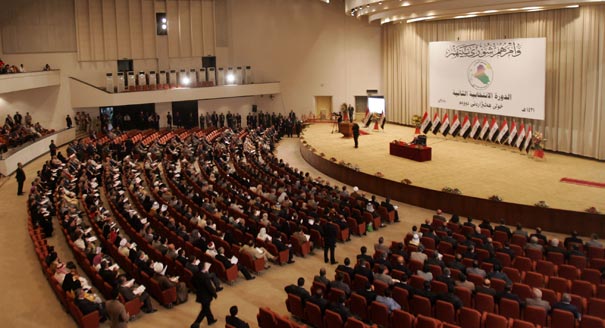
Iraq's future depends on whether the political factions that dominate the country can find it in their interest to forge a real compromise or if they will conclude that they would benefit more from going in separate directions.
Within days of the official ceremonies marking the end of the U.S. mission in Iraq, Prime Minister Nouri al-Maliki moved to indict Vice President Tariq al-Hashemi on terrorism charges and sought to remove Deputy Prime Minister Saleh al-Mutlaq from his position, triggering a major political crisis that fully revealed Iraq as an unstable, undemocratic country governed by raw competition for power and barely affected by institutional arrangements. Large-scale violence immediately flared up again, with a series of terrorist attacks against mostly Shi’i targets reminiscent of the worst days of 2006.
But there is more to the crisis than an escalation of violence. The tenuous political agreement among parties and factions reached at the end of 2010 has collapsed. The government of national unity has stopped functioning, and provinces that want to become regions with autonomous powers comparable to Kurdistan’s are putting increasing pressure on the central government. Unless a new political agreement is reached soon, Iraq may plunge into civil war or split apart.
To conservatives in the United States, particularly the architects of the war and of the ensuing state-building exercise, the crisis into which Iraq plunged after the U.S. withdrawal was final proof of the ineptitude of the Obama administration in failing to secure an agreement with Maliki that would have allowed a residual U.S. force to stay. But the lesson is more sobering: Iraq demonstrates the resilience of domestic political forces in the face of even an eight-year occupation, thus the futility of nation-building and political engineering efforts conducted from the outside. The U.S. occupation tried to superimpose on Iraq a set of political rules that did not reflect either the dominant culture or the power relations among political forces. And while cultures and power relations are not immutable, they do not change on demand to accommodate the goals of outsiders.
For the second time since the 2003 U.S. intervention brought down Saddam Hussein and his regime, Iraq is facing a real threat of political disintegration. In 2007, the United States held the country together forcibly, but the infusion of new troops could not secure a lasting agreement among Iraqis. This time, the outcome depends on whether the political factions that dominate Iraq and tear it apart find it in their interest to forge a real compromise or conclude that they would benefit more from going in separate directions.

Former Senior Associate, Middle East Program
Before joining the Endowment, Ottaway carried out research in Africa and in the Middle East for many years and taught at the University of Addis Ababa, the University of Zambia, the American University in Cairo, and the University of the Witwatersrand in South Africa.
Danial Kaysi
Carnegie does not take institutional positions on public policy issues; the views represented herein are those of the author(s) and do not necessarily reflect the views of Carnegie, its staff, or its trustees.

As the U.S. stumbles in its war with Iran, we are likely to see an acceleration of its disengagement from the region.

Michael Young
The Zaidi government’s objective to collect weapons is constrained by regional conflict, but it can take certain measures at home.
Ali Al-Mawlawi

Huawei pushed hard to enter the Egyptian data centers market, until the Americans made a better offer.

Angie Omar

Middle Eastern states should welcome an accelerated U.S. disengagement from their region.
Michael Young

The accord represents a pivotal moment in the region to avert a security vacuum in the Gulf.


Azeema Cheema, Mohanad Hage Ali