• Research
  • Diwan
  • About
  • Experts
Carnegie Middle East logoCarnegie lettermark logo
LebanonIran
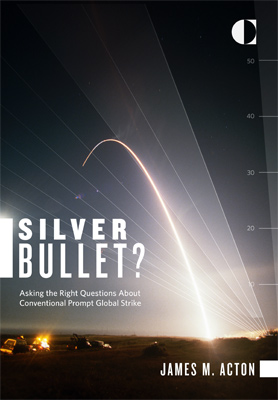
Silver Bullet? Asking the Right Questions About Conventional Prompt Global Strike
Report

Silver Bullet? Asking the Right Questions About Conventional Prompt Global Strike

With some CPGS technologies reaching maturity and an acquisition decision approaching, the time is right for a national debate about the benefits and risks of CPGS.

Link Copied
By James M. Acton
Published on Sep 3, 2013

Additional Links

Full Text

The development of non-nuclear weapons that can strike distant targets in a short period of time has been a U.S. goal for more than a decade. Advocates argue that such Conventional Prompt Global Strike (CPGS) weapons could be used to counter antisatellite weapons or sophisticated defensive capabilities; deny a new proliferator the ability to employ its nuclear arsenal; and kill high-value terrorists. Critics worry that CPGS weapons could create serious strategic risks, most notably of escalation—including to the nuclear level—in a conflict.

The U.S. Department of Defense has explored a number of CPGS technologies but has yet to decide on a preferred option, let alone acquire or deploy it. While the U.S. Congress has disapproved of particular plans, it has generally agreed with the importance of acquiring the capability. With some CPGS technologies reaching maturity and an acquisition decision approaching, the time is right for a national debate about the benefits and risks of CPGS.

The Cost-Benefit Analysis

In Focus

  • The U.S. Department of Defense has not yet decided for which missions CPGS might be acquired.
     
  • Potential missions for CPGS have varying weapon requirements according to the need for promptness and tactical surprise; the required range of the weapon; and the target’s characteristics and defenses.
     
  • Each candidate CPGS weapon has different military strengths and weaknesses; which would be “best” depends upon the scenario.
     
  • The United States is pursuing three separate pathways to develop CPGS weapons: land- or sea-based rocket-launched hypersonic gliders (boost-glide weapons); sea-based ballistic missiles; and air-launched hypersonic cruise missiles.
     
  • The military effectiveness of these weapons would depend critically upon potential adversaries’ countermeasures, including early-warning systems; interference with weapons’ GPS navigation systems; air and missile defenses; and the mobility or burial of targets.
     
  • Non-prompt alternatives to CPGS include stealth technology and forward-deployed weapons. Depending on the scenario, these alternatives could carry a lower risk of failing to fulfill military requirements.
     
  • Enabling capabilities would be absolutely essential to the effectiveness of CPGS weapons. To date, however, command and control; intelligence, surveillance, and reconnaissance; and battle damage assessment have been neglected.
     
  • CPGS weapons would likely enhance deterrence and simultaneously increase the risk of escalation in a conflict.
     
  • The most discussed strategic risk is the possibility that a CPGS weapon could be mistaken for a nuclear weapon (warhead ambiguity). Concern about this risk originated with plans to replace the nuclear warheads on ballistic missiles with conventional weapons. Other escalation risks are, however, more serious.
     
  • Non-ballistic CPGS weapons, which are highly maneuverable, could possibly lead an observing state to wrongly conclude that an incoming weapon was heading for its territory (destination ambiguity).
     
  • A state could mistakenly believe that its nuclear forces were under attack when its conventional forces were really the target (target ambiguity). This situation could arise, for instance, if a state’s nuclear and conventional assets were “entangled” because of dual-use command-and-control systems.
     
  • A state that feared its critical weapon systems—particularly nuclear weapons—were vulnerable to a preemptive CPGS strike could feel pressure to use or threaten to use those weapons first (crisis instability).
     
  • All potential CPGS weapons have some desirable and some undesirable characteristics from the perspective of mitigating strategic risks. Boost-glide weapons, for instance, would have non-ballistic trajectories, tending to reduce warhead ambiguity. However, because they are maneuverable and untrackable after the boost phase, their destination would be unpredictable, exacerbating all escalatory risks.
     
  • Russia and China, both developing CPGS-like technologies, have concerns about the U.S. program, and Washington is committed to easing them. Their concerns relate to all U.S. high-precision conventional weapons, not just CPGS.

Key Recommendations and Findings for the United States

A scenario-based approach to CPGS acquisition would maximize value for money. Before embarking on the acquisition process, the Department of Defense should decide upon the specific missions for which CPGS weapons might be acquired in order to identify clear military requirements.

A comparison of the ability of CPGS weapons and non-prompt alternatives to meet mission requirements is needed to determine whether to procure CPGS weapons at all. This comparison has been absent from the debate. It should account for the relative costs and the implications of potential countermeasures.

CPGS acquisition decisions should take into account the need for U.S. enabling capabilities. The continued failure to consider this issue could lead the United States to procure CPGS weapons incapable of fulfilling mission requirements.

The debate about the strategic ramifications of CPGS should include the full range of risks and benefits. Warhead ambiguity does not pose the biggest escalation risk in a conflict with Russia or China. All risks should be weighed against the potential benefit of enhanced deterrence.

The negative characteristics of boost-glide weapons for managing escalation in a conflict should be recognized. These risks are serious and have been overlooked.

Whatever CPGS technology the United States chooses, it should pursue cooperative confidence-building measures with Russia and China. Cooperative measures, which could be treaty based or politically binding, would more effectively mitigate the strategic risks posed by all CPGS technologies than unilateral measures.

Read Full Text

About the Author

James M. Acton

Jessica T. Mathews Chair, Co-director, Nuclear Policy Program

Acton holds the Jessica T. Mathews Chair and is co-director of the Nuclear Policy Program at the Carnegie Endowment for International Peace.

    Recent Work

  • Other
    Unpacking Trump’s National Security Strategy
      • Cecily Brewer
      • +18

      James M. Acton, Saskia Brechenmacher, Cecily Brewer, …

  • Commentary
    Trump Has an Out on Nuclear Testing. He Should Take It.

      James M. Acton

James M. Acton
Jessica T. Mathews Chair, Co-director, Nuclear Policy Program
James M. Acton
North AmericaUnited StatesNuclear PolicyArms Control

Carnegie does not take institutional positions on public policy issues; the views represented herein are those of the author(s) and do not necessarily reflect the views of Carnegie, its staff, or its trustees.

More Work from Malcolm H. Kerr Carnegie Middle East Center

  • Commentary
    Diwan
    Iran Rewrites Its War Strategy

    In an interview, Hamidreza Azizi discusses how Tehran has adapted in real time to the conflict with the United States and Israel.

      Michael Young

  • Commentary
    Diwan
    Trump’s Plan for Gaza Is Not Irrelevant. It’s Worse.

    The simple conclusion is that the scheme will bring neither peace nor prosperity, but will institutionalize devastation.

      Nathan J. Brown

  • Commentary
    Diwan
    What Does the Strait of Hormuz’s Closure Mean?

    In an interview, Roger Diwan discusses where the global economy may be going in the third week of the U.S.-Israeli war with Iran.

      Nur Arafeh

  • Commentary
    Diwan
    Tehran’s Easy Targets

    In an interview, Andrew Leber discusses the impact the U.S. and Israeli war against Iran is having on Arab Gulf states.

      Michael Young

  • Commentary
    Diwan
    The Gulf Conflict and the South Caucasus

    In an interview, Sergei Melkonian discusses Armenia’s and Azerbaijan’s careful balancing act among the United States, Israel, and Iran.

      Armenak Tokmajyan

Get more news and analysis from
Malcolm H. Kerr Carnegie Middle East Center
Carnegie Middle East logo, white
  • Research
  • Diwan
  • About
  • Experts
  • Projects
  • Events
  • Contact
  • Careers
  • Privacy
  • For Media
Get more news and analysis from
Malcolm H. Kerr Carnegie Middle East Center
© 2026 Carnegie Endowment for International Peace. All rights reserved.