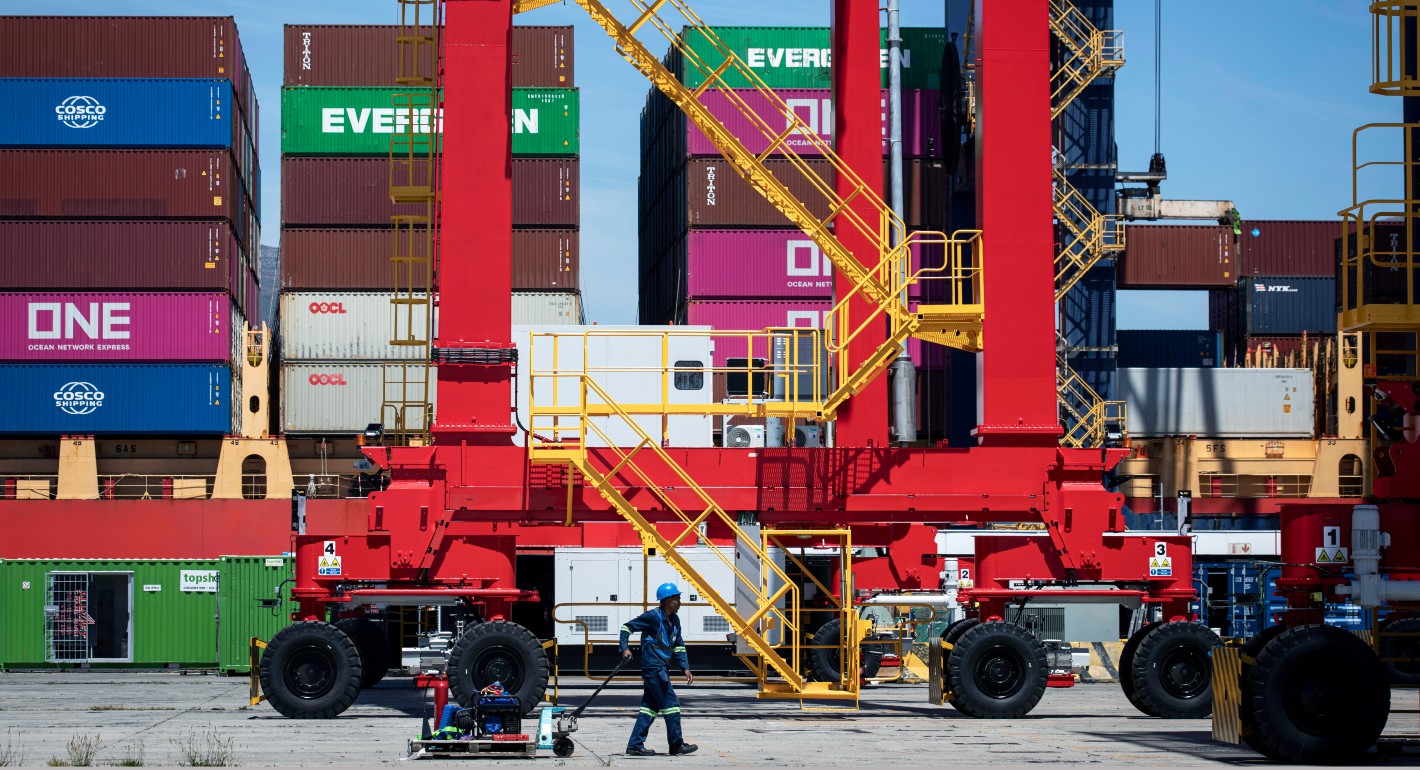
Cape Town Container Terminal (Photo by Per-Anders Pettersson/Getty Images)
Article
Africa’s Global Economic Edge: Advancing Strategic Sectors
In key sectors such as critical minerals, specialty agriculture, and fintech, Africa can become a global powerhouse by investing more in manufacturing, value-add, and scaling.
Last week’s 14th Ministerial Conference (MC14) of the World Trade Organization (WTO)—hosted in Yaoundé, Cameroon—represented only the second time the event has been hosted by an African country. As the world’s trade ministers, senior officials, and business leaders arrived on the continent, questions still lingered about Africa, the “sleeping giant” of economic potential that accounts for only 3 percent of global trade. MC14 took place amid unprecedented geopolitical upheaval, but the conference and ongoing negotiations offer a platform for the continent to take decisive steps toward positioning itself as a consequential economic player. It is critical for Africa to claim its position in the global economy by defining a way forward in key sectors that can translate into real economic development and global leadership.
In today’s geopolitical climate, strengthening Africa’s global economic influence is not optional. The African Group’s renewed request to grant the African Union observer status at the WTO underscores the continent’s growing urgency to secure a stronger voice in global trade governance. As international dynamics shift rapidly and global economic powers rethink their own economic security, African policymakers and businesses must seize the moment to establish Africa as a critical economic partner in global supply chains. In particular, three sectors offer significant promise for Africa to expand its global economic leverage and influence: critical minerals supply, specialty agriproducts, and unique financial technology (fintech) solutions. In the aftermath of MC14 and its side events, and in future dialogues, African policymakers and businesses should focus on boosting Africa’s economic relevance and leverage in these key sectors, forging partnerships, and attracting investments to ensure the continent realizes its potential.
Critical Minerals: National and Energy Security and the Green Transition
As a first area, African governments and the mining industry should use forums such as the WTO Ministerial Conferences to continue to discuss critical minerals and Africa’s plans to upgrade its role in the supply chain. U.S. President Donald Trump’s administration has further intensified the importance of critical minerals on the global agenda. It redoubled the United States’ efforts to reduce dependency on China as a supplier of products it considers critical to its national and energy security. At January’s Critical Minerals Ministerial, U.S. Vice President JD Vance announced the launch of a preferential trade zone for critical minerals to address supply chain vulnerabilities and to accelerate reindustrialization in the United States. The U.S. Department of Energy and the U.S. Geological Survey combined have identified fifty-seven products (including both critical materials for energy and critical minerals) that the United States will need in increasing quantities to maintain and obtain its lead in global defense, tech, and energy security. The European Union has identified thirty-four critical raw materials needed to support its industries and its modernization and green transition goals. Europe also seeks to reduce its dependence on single-country suppliers, including China, and has launched efforts to diversify its critical material supply chains. Over half of these minerals, such as cobalt, copper, lithium, and nickel, are critical for both partners and will see increasing demand. This growing demand for critical minerals presents Africa with a massive economic opportunity.
Africa’s share of global production or reserves in platinum group metals, cobalt, tantalum, manganese, and chromium exceed 50 percent (see table 1). However, the continent accounts for less than 1 percent of global value in clean energy technology and component manufacturing. Africa is a top producer of nine critical minerals and a major producer of four. In fact, Africa dominates global production of bauxite, cobalt, manganese, platinum group metals, and tantalum. Without Africa’s production of these five products, global value chains would simply collapse.
African countries can and should assume greater leadership in the global supply chains for these products to bridge the persistent gap between Africa’s production dominance and its value capture. The core problem is structural. Africa’s mineral economy largely follows a “pit-to-port” model: Raw or semi-processed ores are exported, but the higher-value stages of refining, chemical processing, and advanced manufacturing take place abroad. Africa exports over 70 percent of its minerals in raw form; around 40 percent of the total exports are processed in China. Several constraints explain this pattern. Mineral processing is energy-intensive and infrastructure-dependent, and reliable electricity remains scarce across the continent. Transport and logistics networks also remain underdeveloped in key mining regions. In addition, investment has historically flowed primarily into extraction rather than downstream processing, and fragmented national markets often prevent African producers from achieving the scale required to compete globally.
German manufacturing firms in Africa add value, jobs, and skills, while benefiting from demand and a diversification of trade and investment partners. It is in the interest of both African economies and Germany to deepen economic relations.
Hannah Grupp, Paul M. Lubeck
Changing this dynamic will require targeted, realistic industrial strategies centered on aggressive infrastructure development. Rather than attempting to build entire supply chains in every country, Africa should focus on developing regional processing hubs tied to its strongest mineral corridors. The copper-cobalt belt spanning the Democratic Republic of the Congo (DRC) and Zambia could anchor electric vehicle battery production; Guinea could move up the value chain from bauxite to aluminum oxide refining; Mozambique and Madagascar could expand graphite processing for battery anodes; and South Africa and Gabon could develop battery-grade manganese chemicals alongside their existing mining industries. Morocco’s emerging battery ecosystem, built around phosphates and renewable energy, already illustrates how integrated industrial policies can attract large-scale investment.
The scale of required investment is significant, but so is the potential return on investment. Estimates show that every $1 billion invested in mining and processing can contribute up to $280 million to annual GDP, create up to 6,000 jobs, and increase annual incremental government revenue and investment in regional infrastructure by up to $100 million each. African countries should leverage various funding sources, including the mining sector, international development finance institutions, export credit agencies, green and diaspora bonds, and African sovereign and pension funds. MC14 offered Africa a captive global audience to secure partners and investors to raise the capital needed to achieve its goals in this sector. At home, ministers will have invaluable opportunities to align global discussions, investors, and trading partners around Africa’s future in the critical minerals sector.
Africa has the opportunity to position itself as a geostrategic trade partner to the rest of the world and an economic powerhouse—but it needs to take the appropriate next actions, including concluding strategic trade and supply deals. Advancing these conversations will be a crucial step in the right direction.
Specialty Agriproducts
African policymakers and businesses should also expand discussions on advancing the continent’s economic prosperity to leverage the significant opportunities in specialty agriproducts. Agriculture remains Africa’s most widespread economic activity. Over 60 percent of Africans depend on it for their livelihood, and the sector employs, on average, half of the African workforce, ranging from 5 percent in Mauritius and South Africa to 85 percent in Burundi. While Africa is not exactly the world’s breadbasket, it enjoys export dominance in specific, highly valued products that are not easily sourced elsewhere. Policymakers and the private sector should consider opportunities around two specialty agriproducts for which Africa maintains export dominance in their raw materials: chocolate and shea butter.
Developing the Building Blocks of Chocolate Value Chains
Without African cocoa beans, global chocolate value chains and chocolate behemoths such as Switzerland would not be what they are. West Africa produces and exports approximately 70 percent of the world’s cocoa, mostly coming from Côte d’Ivoire, Ghana, Nigeria, and Cameroon (see table 2). However, Africa exports mostly raw cocoa beans rather than processed chocolate products. Consequently, the continent extracts the least value from an industry valued at around $146 billion, and many cocoa farmers in West Africa earn less than $1 per day.
Africa’s opportunity lies in upgrading to chocolate manufacturing on the continent, and countries such as Côte d’Ivoire are already attracting investment and support to implement their cocoa agroprocessing ambitions. African governments and institutions, together with local and foreign investors, could support infrastructure development to increase the proportion of origin grinding, roasting, and semiprocessing and, eventually, to develop a West African or even continental chocolate industry. One low-hanging fruit is for manufacturers to enhance investment in existing chocolate production capacities, with those in Ghana already well-positioned to consolidate and scale. These shifts, even if implemented incrementally, could multiply the value retained on the continent several times over.
Beauty Industry Standard: Shea Butter
All top five producers of shea nuts are African countries. The shea tree is indigenous to Africa and grows in twenty-one countries in an area called the shea belt, which crosses the Sahel from West Africa (Senegal) to East Africa (South Sudan). In 2024, Nigeria was the largest producer of shea nut followed by Mali, Burkina Faso, Benin, Ghana, Côte d’Ivoire, and Togo (see table 3). However, due to the domestic demand in Nigeria and Mali, Burkina Faso is the continent’s top exporter of shea nut, ranked fourth globally. The product resulting from shea nuts, shea butter, is a booming industry that was estimated at $2.4 billion in 2024 and is projected to reach $3.7 billion by 2030. Despite Africa’s market domination of shea nut production, no African country features among the top exporters of shea butter.
As the top producer of shea nuts, Nigeria accounts for roughly 40 percent of global production, yet the government estimated that it captures 1 percent or less of the global industry profit. While the country has installed capacity to process 32 percent of its production, it only processes 18 percent of its shea nuts domestically and exports 82 percent raw. This disparity presents a crucial opportunity for African countries to move up the value chain by producing and exporting shea butter instead of shea nuts.
It is thus critical that the shea nut industry and governments prioritize local infrastructure development to leverage value-added production. In August 2025, Nigeria implemented a six-month export ban on raw shea nuts, and in February 2026, the government renewed the ban for another year. This drastic measure was implemented to spur local and foreign investment in Nigeria’s shea butter production capabilities, with the goal of obtaining its fair share of profits. However, this measure has not yet produced the desired results, as Nigeria currently lacks the capacity to process the surplus of shea nuts. Agricultural workers, especially rural women who are the main pickers and primary processors of this product, continue to suffer financially from this ban. Meanwhile, other top producers such as Burkina Faso, Côte d’Ivoire, Mali, and Togo have also implemented varying raw shea export bans since late 2024, and Ghana has announced a phased ban starting this year, accompanied by investments in shea butter manufacturing facilities.
Improved policy interventions that prioritize investments in local shea butter processing capabilities could prevent unintended consequences such as the fallout from Nigeria’s export ban. By capturing a greater share of industry value through domestic value-added shea butter production, African shea producers could enjoy enhanced economic prosperity.
These examples of cocoa and shea nuts demonstrate the potential for some African countries to spur shifts in global supply chains to reduce their reliance on exporting raw materials and move toward value-added products to enhance revenues. In addition to showcasing the women-owned businesses and micro-, small-, and medium-sized enterprises that underpin these industries, African policymakers and industrialists should continue to emphasize agroprocessing and industrialization as critical, sustainable drivers of economic development and long-term resilience across the continent.
Financial Technology
The third area of focus for African policymakers and businesses, particularly in discussions surrounding electronic commerce and services, should be around Africa’s leadership and competitive advantage in fintech. In 2012, Africa’s digital economy was estimated at $30 billion, or 1.1 percent of its GDP. In 2020, it was estimated at $115 billion, or 4.5 percent of its GDP, and Google and the International Finance Corporation estimated that the digital economy could hit $712 billion, or 8.5 percent of the continent’s GDP, by 2050. While these numbers are modest compared to other regions, Africa’s superpower in the digital economy is not replicating current digital offerings but creating products specifically for Africa’s and other low-income regions’ needs.
Africa is not just catching up with global fintech: In mobile money, financial inclusion technology, and leapfrog digital infrastructure, Africa is the global innovator—and the rest of the world is catching up. The continent’s fintech market is expected to grow fivefold by 2028, reaching $47 billion in revenue. Africa has the highest global mobile money adoption, with 1.1 billion registered accounts. East Africa is leading the charge, and West Africa is a fast-growing second place.
Kenya’s M-Pesa is arguably the most consequential financial innovation of the twenty-first century for low-income populations. Launched in 2007 by mobile network Safaricom, M-Pesa created a model of mobile-first financial services allowing users to deposit, withdraw, or transfer money through a financial account stored on their phone, without needing a formal bank account. M-Pesa has spread to seven other African countries—namely the DRC, Egypt, Ghana, Lesotho, Mozambique, Ethiopia, and Tanzania—and currently serves more than 60 million active users who transact over $400 billion annually. It has expanded into savings, lending, and merchant payments and has formed partnerships, such as the one with South Africa’s digital payments network Onafriq, which helps to streamline Ethiopia’s remittances.
The structure and diffusion of M-Pesa have enabled millions of people across Africa—and the world—to use mobile financial services, including some who did not previously have access to formal banking services. Largely due to M-Pesa’s success, by 2014, 255 mobile money services were operating across eighty-nine countries. In 2015, more than 60 percent of developing markets had access to such services, primarily in Africa, followed by Southeast Asia and Latin America. M-Pesa-inspired products include Smart Money in the Philippines, bKash in Bangladesh, easypaisa in Pakistan, and M-Paisa in Afghanistan. Kenya is not just a fintech hub—it is the proof of concept that the world has studied for nearly two decades.
Meanwhile, Nigeria is Africa’s fintech powerhouse in terms of scale. With over 430 fintech companies and a market share of roughly 28 percent of Africa’s fintech ecosystem, Nigerian fintechs have evolved beyond consumer payments into critical financial infrastructure—providing access to banking services, facilitating remittance transactions, and boosting digital financial solutions. By 2024, Nigerian fintechs were processing 108 billion transactions annually, totaling $1.68 trillion. In the same year, 44 percent of all fintech funding raised in Africa, around $410 million, went to these companies. Moniepoint, which provides banking services and loans, raised $100 million in investment, nearly a quarter of the total. This company also achieved unicorn status (meaning a valuation of $1 billion or more) in late 2024. In fact, Nigerian fintechs—led by Flutterwave, which offers financial services to small businesses and startups—dominated Africa’s 2025 fintech unicorn list, occupying four of the eight spots. Nigerian fintechs have expanded their markets beyond their home country, and even the continent, demonstrating the universal relevance of their business models and products.
The success of Nigeria’s fintechs is attributed to their lightning-fast capture of Nigeria’s payments market through market-tailored products (for example, point-of-sale tools and cashback incentives). They took advantage of market fragmentation, and their business models were built on financial inclusion, focusing on the informal sector and the unbanked. Their growth was enabled by Nigeria’s large population and neutral and open regulatory framework, which facilitated shared infrastructure, the issuance of many fintech licenses, and collaboration across banks and startups. This fostered a competitive, multiplayer, innovative, and agile ecosystem that prevented telecoms from dominating the sector.
Nigeria’s fintech industry and Kenya’s M-Pesa services demonstrate how African countries are leading innovators in financial technology and the digital economy. These success stories highlight the potential of investing in entrepreneurship to create fintech solutions that address specific market needs. In the months that follow MC14, African policymakers and businesses should tout these case studies to draw more investment into a sector that has positioned Africa as the epicenter of financial inclusion in the world.
Conclusion
African countries have the potential to wield significant economic leverage to secure the continent’s place as a leader in the global economy. African policymakers and investors should focus on boosting the key sectors in which Africa already has a comparative advantage. The continent holds decisive positions in critical minerals, dominates key specialty agricultural products, and leads financial technology innovation. Yet these advantages will translate into durable economic power only if Africa captures more value along supply chains, expands regional industrial capacity, and invests in infrastructure, focused policies, and market integration.
Trade dialogues such as MC14 provide platforms for the continent to take pivotal steps toward positioning itself as a consequential economic player. If policymakers, businesses, and investors act decisively now, Africa can move from being the world’s supplier of raw materials to a central node in global production, innovation, and trade. As global supply chains diversify and the world searches for new growth engines, Africa’s economic edge—properly harnessed—could become one of the defining forces shaping the global economy in this century.
Carnegie does not take institutional positions on public policy issues; the views represented herein are those of the author(s) and do not necessarily reflect the views of Carnegie, its staff, or its trustees.
More Work from Malcolm H. Kerr Carnegie Middle East Center
Understanding how farmers in the Oued Sahel-Soummam Valley grapple with climate change is essential for addressing the paradoxes through which adaptation, operating at both individual and institutional levels, deepens the region’svulnerability and erodes the social fabric and agrarian identity that once defined life.
The UN Support Mission in the country should reassess its approach so that consensus between the warring parties becomes the eventual goal, rather than a procedural matter that dogs the negotiating process at every turn.