• Research
  • Emissary
  • About
  • Experts
Carnegie Global logoCarnegie lettermark logo
DemocracyIran
  • Donate
{
  "authors": [
    "Shahram Chubin"
  ],
  "type": "other",
  "centerAffiliationAll": "",
  "centers": [
    "Carnegie Endowment for International Peace",
    "Carnegie Europe"
  ],
  "collections": [
    "Iranian Proliferation",
    "Transatlantic Cooperation",
    "Europe’s Southern Neighborhood"
  ],
  "englishNewsletterAll": "",
  "nonEnglishNewsletterAll": "",
  "primaryCenter": "Carnegie Endowment for International Peace",
  "programAffiliation": "",
  "programs": [],
  "projects": [],
  "regions": [
    "North America",
    "United States",
    "Middle East",
    "Iran",
    "Western Europe",
    "Europe"
  ],
  "topics": [
    "Security",
    "Nuclear Policy"
  ]
}
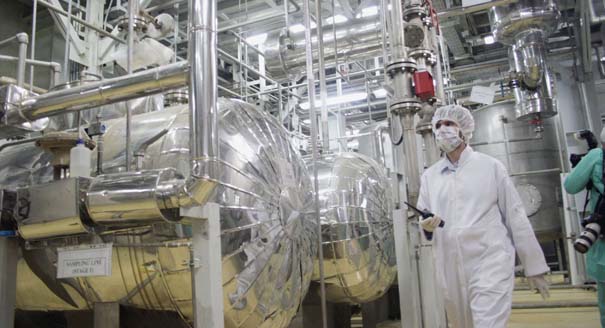
Source: Getty

Other

Command and Control in a Nuclear-Armed Iran

With the international spotlight focused on Iran and its nuclear agenda, Tehran has been loath to reliably assure the international community of its ultimate intentions.

Link Copied
By Shahram Chubin
Published on Feb 11, 2013

Source: Proliferation Papers No. 45

In the long standoff regarding its nuclear ambition, Iran has cultivated ambiguity and been loath to reliably assure the international community of its ultimate intentions, complicating Western efforts to understand, let alone constrain, Tehran’s endeavors. While many analyses have focused on how to prevent or contain a potential nuclear-armed Iran, the posture Iran would adopt once it has developed its nuclear weapons remains elusive. This paper highlights that while opting for command-and-control (C2) arrangements, Iran would have to reconcile two contrasting imperatives: first, to disperse assets and decentralize C2 to minimize the risks and potential damages of a disabling strike, which has been seen as a real – even imminent – threat in recent years. A contrasting concern emerged as the Iranian Revolutionay Guards’ Corps became a key formulator and executor of Tehran’s security policy: how to guard against the risk of unauthorized use of major weapons systems? Among the factors that could influence Iran’s choices in terms of C2 arrangements, this paper focuses on Tehran’s national security experience, the lessons it may have derived from it, as well as from the experience of other countries.

This piece originally appeared in IFRI's Proliferation Papers.

About the Author

Shahram Chubin

Former Nonresident Senior Fellow, Nuclear Policy Program

Chubin, who is based in Geneva, focuses his research on nonproliferation, terrorism, and Middle East security issues. He was director of studies at the Geneva Centre for Security Policy, Switzerland, from 1996 to 2009.

    Recent Work

  • In The Media
    Iran and the P5+1 in Moscow: Time is Running Out (Again)

      Shahram Chubin

  • In The Media
    The Revolution in Cairo is a Serious Warning for the Mullahs

      Shahram Chubin

Shahram Chubin
Former Nonresident Senior Fellow, Nuclear Policy Program
SecurityNuclear PolicyNorth AmericaUnited StatesMiddle EastIranWestern EuropeEurope

Carnegie does not take institutional positions on public policy issues; the views represented herein are those of the author(s) and do not necessarily reflect the views of Carnegie, its staff, or its trustees.

More Work from Carnegie Endowment for International Peace

  • Commentary
    Emissary
    The Iran War Is Uncovering the Weakness in U.S.-Gulf Ties

    Neither the Abraham Accords nor the presence of large U.S. bases are enough to protect Arab Gulf states.

      Marwan Muasher

  • Commentary
    Carnegie Politika
    The Afghanistan–Pakistan War Poses Awkward Questions for Russia

    Not only does the fighting jeopardize regional security, it undermines Russian attempts to promote alternatives to the Western-dominated world order.

      Ruslan Suleymanov

  • Article
    Rewiring the South Caucasus: TRIPP and the New Geopolitics of Connectivity

    The U.S.-sponsored TRIPP deal is driving the Armenia-Azerbaijan peace process forward. But foreign and domestic hurdles remain before connectivity and economic interdependence can open up the South Caucasus.

      • Areg Kochinyan

      Thomas de Waal, Areg Kochinyan, Zaur Shiriyev

  • Commentary
    Diwan
    Hezbollah’s Wartime Strategy

    The party’s objectives involve tying together the Lebanese and Iranian fronts, while surviving militarily and politically at home. 

      Mohamad Fawaz

  • U.S. President Donald Trump (C) oversees "Operation Epic Fury" with (L-R) Central Intelligence Agency Director John Ratcliffe, U.S. Secretary of State Marco Rubio and White House Chief of Staff Susie Wiles at Mar-a-Lago on February 28, 2026 in Palm Beach, Florida. President Trump announced today that the United States and Israel had launched strikes on Iran targeting political and military leaders, as well as Iran’s ballistic missile and nuclear programs. (Photo by Daniel Torok/White House via Getty Images)
    Paper
    Operation Epic Fury and the International Law on the Use of Force

    Assessing U.S. compliance with the international laws of war is essential at a time when these frameworks are already fraying.

      • Federica D'Alessandra

      Federica D’Alessandra

Get more news and analysis from
Carnegie Endowment for International Peace
Carnegie global logo, stacked
1779 Massachusetts Avenue NWWashington, DC, 20036-2103Phone: 202 483 7600Fax: 202 483 1840
  • Research
  • Emissary
  • About
  • Experts
  • Donate
  • Programs
  • Events
  • Blogs
  • Podcasts
  • Contact
  • Annual Reports
  • Careers
  • Privacy
  • For Media
  • Government Resources
Get more news and analysis from
Carnegie Endowment for International Peace
© 2026 Carnegie Endowment for International Peace. All rights reserved.