

In The Media
Shahram Chubin
{
  "authors": [
    "Shahram Chubin"
  ],
  "type": "legacyinthemedia",
  "centerAffiliationAll": "dc",
  "centers": [
    "Carnegie Endowment for International Peace"
  ],
  "collections": [],
  "englishNewsletterAll": "ctw",
  "nonEnglishNewsletterAll": "",
  "primaryCenter": "Carnegie Endowment for International Peace",
  "programAffiliation": "NPP",
  "programs": [
    "Nuclear Policy"
  ],
  "projects": [],
  "regions": [
    "Middle East",
    "Iran"
  ],
  "topics": [
    "Nuclear Policy",
    "Foreign Policy"
  ]
}
Source: Getty
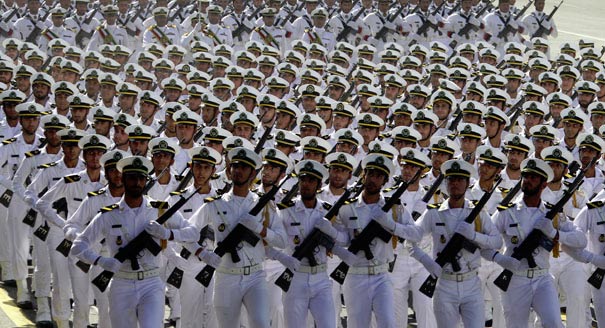
Even if the interim deal with Iran is successfully extended into a comprehensive agreement during the next twelve months, Tehran’s conduct in the Middle East will remain largely unregulated.
Source: International Institute for Strategic Studies
Iran is often seen as an aspirant regional hegemon whose immediate aim is to weaken and eliminate America’s influence and presence in the Middle East. It is also depicted as a military threat whose power to intimidate its neighbours could be amplified by its nascent but ambitious nuclear programme. As the largest Shia state and the leader of the ‘Islamic resistance front’, the country is seen as a menace by Israel and many Sunni Arab nations.
The interim nuclear agreement concluded by Iran and the P5+1 states makes no reference to the country’s regional behaviour. Even if the deal is successfully extended into a comprehensive agreement during the next 12 months, Tehran’s conduct in the Middle East will remain largely unregulated. In the meantime, the Iranian leadership will continue to actively support its resistance-front ally Syria through the provision of arms, advice, trainers and money.As in Hizbullah’s war with Israel in 2006, Iran is carefully following the conflict on the ground in Syria for tactical insights and military lessons. Tehran has been emboldened by the West’s timidity and stepped up its assistance to Syrian President Bashar al-Assad. Support for the Assad regime has an obvious strategic rationale: preserving Iran’s link to the Levant and buoying its only Arab friend, besides Nuri al-Maliki’s Iraq. But it is also useful as a potential bargaining chip if Tehran decides to seek a ‘grand bargain’ with the West.
Iran’s influence in Syria comes not from its military strength but from its flexibility and adaptability. Tehran has domestic experience in putting down popular discontent and identifying dissident ring leaders. Its Quds Force has also supervised allies’ use of simple technology, such as improvised explosive devices, to offset opponents’ superior forces and technology.
None of this indicates that Iran is confident about its military power. The country has simply inserted itself into a messy civil war because it has the strategic imperative to do so and sees the risk of a Western reaction as being minimal. Had the message from the West been different, Iran would have been more hesitant because, apart from the Quds Force, its military is focused on defence and deterrence, not power projection.
This article was originally published on the International Institute for Strategic Studies.
Former Nonresident Senior Fellow, Nuclear Policy Program
Chubin, who is based in Geneva, focuses his research on nonproliferation, terrorism, and Middle East security issues. He was director of studies at the Geneva Centre for Security Policy, Switzerland, from 1996 to 2009.
Recent Work
Shahram Chubin
Shahram Chubin
Carnegie does not take institutional positions on public policy issues; the views represented herein are those of the author(s) and do not necessarily reflect the views of Carnegie, its staff, or its trustees.

In an interview, Ian Lustick and Eli Clifton discuss their new book on why a prominent ally has so much influence in America.

Michael Young
Germany, India, and other middle powers can’t build frontier AI alone, and they risk being cut off if they depend on the United States or China. The way through is to build the capacity for a frontier sprint while hoping never to use it.

Anton Leicht, Sam Winter-Levy

The real test may come after the leaders leave the room.



Sheena Chestnut Greitens, Oriana Skylar Mastro, Yukon Huang, …

The Horn of Africa countries are among those facing a new security calculus.


Andrew Leber, Lesley Anne Warner

The new U.S.–Denmark–Greenland agreement will help Washington exert political, economic, and financial dominance under the guise of security. Yet, it acknowledged Copenhagen’s and Nuuk’s sovereignty on the island.

Marc Pierini