

Commentary
- +1
Paul Haenle, Xue Gong, Ngeow Chow Bing, …
{
  "authors": [
    "Paul Haenle"
  ],
  "type": "legacyinthemedia",
  "centerAffiliationAll": "",
  "centers": [
    "Carnegie Endowment for International Peace",
    "Carnegie China"
  ],
  "collections": [
    "China and the Developing World",
    "China’s Foreign Relations"
  ],
  "englishNewsletterAll": "",
  "nonEnglishNewsletterAll": "",
  "primaryCenter": "Carnegie China",
  "programAffiliation": "",
  "programs": [],
  "projects": [],
  "regions": [
    "South America",
    "China",
    "Taiwan",
    "North America",
    "United States",
    "East Asia"
  ],
  "topics": [
    "Foreign Policy"
  ]
}
Source: Getty
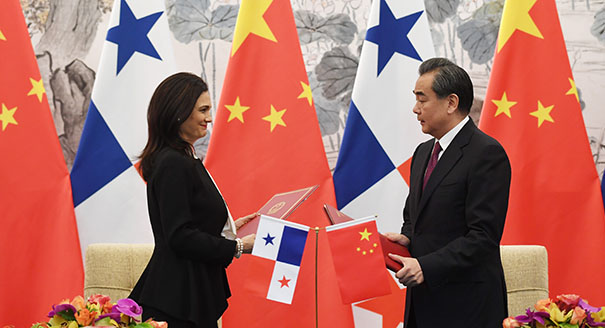
Panama's decision to establish ties with China heightens risks of diplomatic isolation for Taiwan, but the future of cross-Strait relations highly depends on the upcoming 19th Party Congress.
ChinaFile: On June 12, the small Central American nation of Panama announced it was severing diplomatic ties with Taiwan so that it could establish relations with the People’s Republic of China. Now, only 19 countries and the Vatican recognize Taiwan. Why did this happen? How does it affect Taiwan’s relationship with the mainland? Should the United States get involved in preventing the further diplomatic isolation of Taiwan?
Paul Haenle: Panama’s sudden decision to severe diplomatic ties with Taiwan and recognize China is a serious setback for Tsai Ing-wen. It marks the third diplomatic ally to flip (following the Gambia and Sao Tome and Principe) under her leadership, and comes shortly after Taiwan failed to receive an invitation to the World Health Assembly in May, for the first time since 2009. Under her predecessor Ma Ing-jeou, the leader of the KMT, Beijing and Taipei had reached a diplomatic truce not to try to poach the other’s allies. That understanding appears to have been abandoned with the DPP’s election.
Despite Tsai's trip to Central America in January to shore up relationships amid increasing pressure from China, there is a risk that other countries in the region will follow suit. Beijing has made the DPP pay a price for refusing to endorse the 1992 Consensus, both in terms of bilateral economic engagement and dialogue, as well as constraining Taiwan's international space. This pressure may also be extending to one of Taiwan’s traditional security partners; Beijing recently announced a trade agreement with Singapore after several months of relatively tense relations, partially due to Singapore’s military-to-military ties with Taiwan.
In the months prior to the 19th Party Congress, it appears that President Xi Jinping is increasing pressure on Taiwan to show a strong hand and enhance his domestic standing. We should not expect this approach to change after November. In the face of this pressure, U.S. support for our friends on Taiwan, within our one China policy framework, is critical. While President Donald J. Trump has underscored his desire to have a constructive relationship with China and to enhance cooperation with Beijing on North Korea, his administration has sent mixed signals about its policy aims with regard to Taiwan. More needs to be done to push back against changes to the status quo in cross-Strait relations and to encourage Beijing and Taipei to reopen dialogue. The United States has a deep and continuing interest in stable cross-Strait relations and the prosperity of Taiwan, a vibrant democracy and America’s ninth-largest trading partner.
There are already signs that as Taipei feels increasingly isolated, it is beginning to re-evaluate its approach to cross-Strait relations. In the long-run, however, Beijing’s actions may prove counterproductive and unsustainable. Chinese coercion has proven ineffective in the past in enticing Taiwan to stop moving away from it. In fact, it has done just the opposite — the identity foundation for unification has evaporated in Taiwan in recent decades. How Tsai and Xi manage cross-Strait relations after the 19th Party Congress will be among the most important developments for Asia this year.
This piece was republished with permission from ChinaFile.

Former Maurice R. Greenberg Director’s Chair, Carnegie China
Paul Haenle held the Maurice R. Greenberg Director’s Chair at the Carnegie Endowment for International Peace and is a visiting senior research fellow at the East Asian Institute, National University of Singapore. He served as the White House China director on the National Security Council staffs of former presidents George W. Bush and Barack Obama.
Recent Work


Paul Haenle, Xue Gong, Ngeow Chow Bing, …

Paul Haenle, Chong Ja Ian
Carnegie does not take institutional positions on public policy issues; the views represented herein are those of the author(s) and do not necessarily reflect the views of Carnegie, its staff, or its trustees.

The Plaza Accord was not an externally imposed punishment of Japan but part of a broader restructuring that Japanese economists and policymakers themselves recognized was necessary. Its effects were undermined, however, when Tokyo responded to the resulting slowdown with policies that exacerbated investment, credit expansion, and the very imbalances the adjustment was intended to resolve.

Michael Pettis

Trump has promised Belarus a massive potash deal. But Minsk is seeking something greater: restored Western transit and greater room for maneuver from Russia.

Balázs Jarábik

The real test may come after the leaders leave the room.



Sheena Chestnut Greitens, Oriana Skylar Mastro, Yukon Huang, …

The Horn of Africa countries are among those facing a new security calculus.


Andrew Leber, Lesley Anne Warner

The new U.S.–Denmark–Greenland agreement will help Washington exert political, economic, and financial dominance under the guise of security. Yet, it acknowledged Copenhagen’s and Nuuk’s sovereignty on the island.

Marc Pierini