

Commentary
Galina Yuzefovich
{
  "authors": [
    "Galina Yuzefovich"
  ],
  "type": "commentary",
  "blog": "Carnegie Politika",
  "centerAffiliationAll": "dc",
  "centers": [
    "Carnegie Endowment for International Peace",
    "Carnegie Russia Eurasia Center"
  ],
  "collections": [],
  "englishNewsletterAll": "ctw",
  "nonEnglishNewsletterAll": "",
  "primaryCenter": "Carnegie Russia Eurasia Center",
  "programAffiliation": "russia",
  "programs": [
    "Russia and Eurasia"
  ],
  "projects": [],
  "regions": [
    "Russia",
    "Caucasus"
  ],
  "topics": [
    "Political Reform",
    "Economy"
  ]
}
Source: Getty
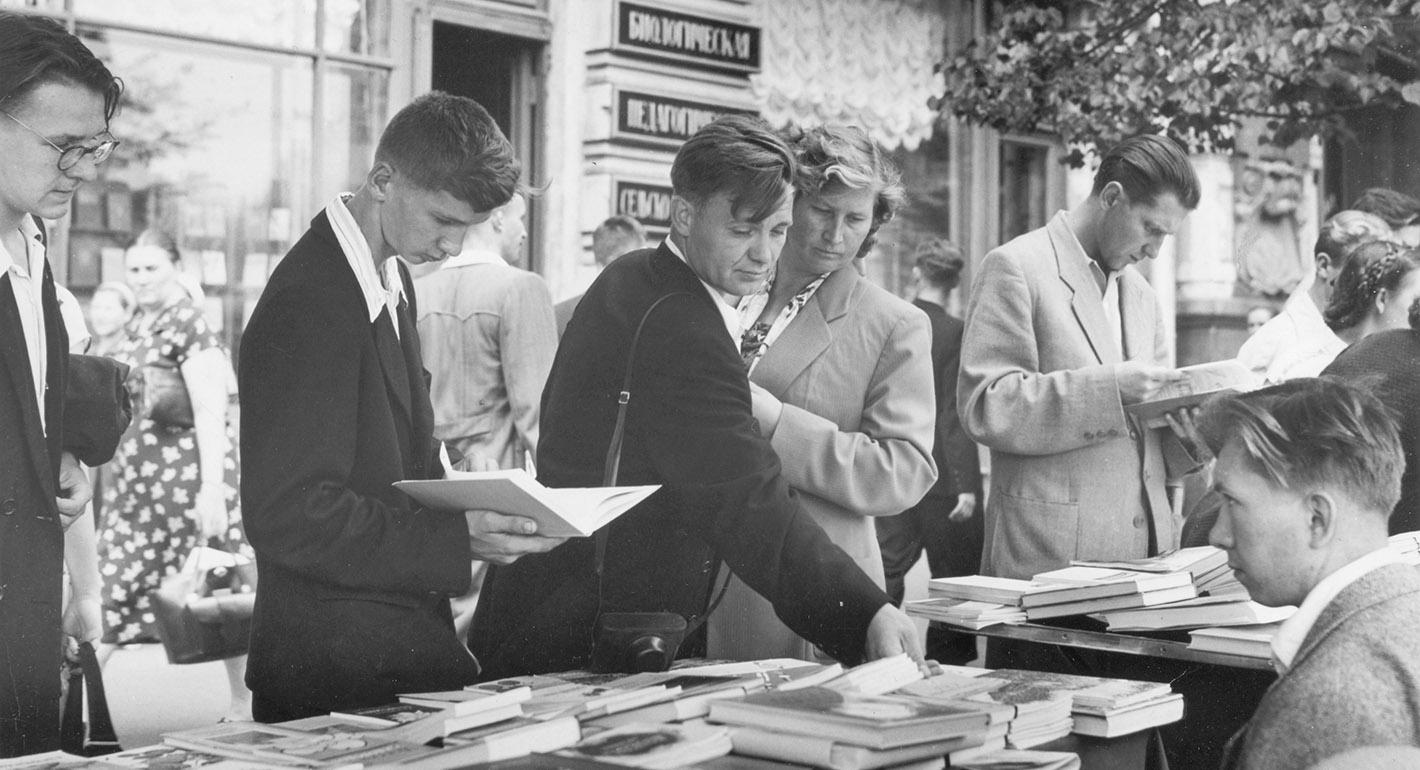
The publication of Russian-language writers abroad is unlikely to be very successful in the long term. An author’s main objective is to be read, and that is more easily accomplished inside Russia.
One of the phenomena spawned by the Cold War era was tamizdat: the publication, free from censorship, of Russian-language books outside the Soviet Union for dissemination among émigré audiences and dissenting minds within the country. The need for tamizdat—a play on samizdat, the underground distribution of banned literature—disappeared with perestroika, but many predicted its comeback after the invasion of Ukraine last February, and especially following the law banning “LGBT propaganda” last summer.
Now we are finally seeing the first tamizdat project launches. The most high-profile is the Freedom Letters publishing house set up by the former head of Russia’s prestigious Big Book award, Georgy Urushadze. Other initiatives include two Israeli projects—the Kniga Sefer publishing house and a small publishing offshoot launched by the Tel Aviv bookstore Babel—and some Latvian and Lithuanian projects. Still, tamizdat today looks unlikely to repeat the success of its Cold War predecessor.
There are several reasons for publishing Russian-language books abroad instead of at home. No Russian publishing company will take on Sergei Davydov’s novel Springfield, published by Freedom Letters, for example, because it describes a relationship between two young gay men in a provincial Russian industrial city. Valery Panyushkin’s Hour of the Wolf would certainly be subject to criminal prosecution in Russia under a law banning “discrediting the armed forces,” so it was published by the Free University in Latvia.
Meanwhile, it’s unlikely that Ukrainian poets who write in Russian, such as Boris Khersonsky, Alexander Kabanov, and others whose poems have been published by Kniga Sefer would want to be published in Russia. The same is true of the Russian rock musician Andrei Makarevich—labeled a “foreign agent” by the Russian authorities—whose book was recently published by the independent Israeli publisher Babel.
The fact that books that cannot possibly be published in Russia right now still have a chance of reaching readers is certainly a positive development, especially since they are mostly published in electronic formats that have an easier time crossing state borders.
Still, none of the above projects are commercial, and the books published by them are unlikely to make it onto bestseller lists. There’s little hope that major Russian authors like Victor Pelevin and Boris Akunin will ditch their regular Russian publishers and take their new manuscripts to Freedom Letters or its counterparts. Although Akunin did give his satirical anti-war novel The Devil’s Advocate to Babel, the new spinoff of his best-selling Fandorin historical detective series will be published by the mainstream Russian publishing company AST.
In the end, it all comes down to readership. No matter how many readers leave Russia in the foreseeable future, the majority will remain. In addition, émigré readers live all over the globe, which makes them much harder to reach.
In any case, “protest books” can hardly compete with regular ones, even in terms of content. In times of trouble, literature primarily serves to comfort readers and allow them to escape reality, at least for a while. So even anti-war and émigré audiences will generally prefer regular novels, detective stories, and nonfiction to dissident literature.
All of this means that any authors whose works conform more or less to Russia’s current legal standards will try to get published in Russia. It’s not just a question of money or bigger print runs: an author’s main objective is to be read, and that is more easily accomplished from inside Russia, whether physically or virtually.
Back in the Cold War era, most Soviet writers also first tried to get published at home, and only passed their manuscripts to the West when all their hopes of doing so had been dashed. This was true both of writers like Sergei Dovlatov and Joseph Brodsky who weren’t published in the USSR at all, and of those like Boris Pasternak, Vladimir Voinovich, and Alexander Solzhenitsyn, whose works appeared at home, but with painful censorship restrictions. It was harder in Soviet times to have it both ways, and attempts to do so usually ended in expulsion or prison sentences. Still, many tried, since just like today, the audience for a legally published book was incomparably larger than that of samizdat and tamizdat.
The tamizdat strategy is unlikely to work today. Although Soviet-era tamizdat reached a limited audience, it exerted a tremendous influence on people’s minds. In the 1960s, 1970s, and 1980s, literature was an essential medium whose impact extended well beyond the artistic realm. Nowadays, other formats are much more powerful, which means that entities like the CIA, which once engineered the publication of Pasternak’s Doctor Zhivago in the West, won’t seriously invest in uncensored Russian letters, leaving writers to fend for themselves.
This certainly does not mean, however, that Russian-language tamizdat is doomed to remain on the margins. Alternative models already exist and are gradually gaining strength. They don’t fall into a clear-cut “here and there” dichotomy, however, and are eroding borders rather than delimiting them.
Following the imposition of financial sanctions against Russia over its actions in Ukraine, many Russian publishing houses started setting up legal entities overseas. They initially served to facilitate payment to foreign partners, but are increasingly starting to function as independent agents.
These publishing companies primarily provide physical and virtual book distribution. For instance, along with Yandex subsidiary Bookmate, there is a global branch Bookmate International, while the queer literature published by Popcorn Books, effectively banned in Russia, is sold freely in countries like Kazakhstan, Kyrgyzstan, and Moldova.
Other publishers have started eyeing the publication of foreign-language books in Russian: both those prohibited by Russian legislation because of their LGBT content, and those inaccessible to Russian-language readers for other reasons. While many copyright holders are unwilling to work with Russia-based publishing companies, they are far more likely to agree to sell Russian-language publishing rights to a global company registered in Armenia or Lithuania, for example.
Problems with print copies will remain, of course. They are more expensive and difficult to produce, transport, and distribute, but still provide the lion’s share of profits. Printed books will continue to generate more sales within Russia for a long time, if not forever. Still, platforms oriented toward audio and e-books, which are accessible across the globe, regardless of where a work was published, have good chances of becoming commercially viable.
In other words, tamizdat, which pits protest audiences against conformist ones, is unlikely to be very successful in the long term. As the Freedom Letters manifesto puts it, it will enjoy an honorable but limited role of “a publishing house that gives a voice to everyone who deserves it but is deprived of the opportunity; a publishing house needed by readers across the globe who have left their homes and libraries behind.”
In contrast, services working to consolidate the Russian-language reading community beyond geographic and ideological borders can become effective in developing both book publishing and—paradoxically—Russian society as a whole.

Literary critic
Recent Work
Galina Yuzefovich
Galina Yuzefovich
Carnegie does not take institutional positions on public policy issues; the views represented herein are those of the author(s) and do not necessarily reflect the views of Carnegie, its staff, or its trustees.

For every ruble allocated to social policy, health, and education in 2027, double that amount is earmarked for the army, the police, and the security services.

Alexandra Prokopenko

Cargo traffic through Russia’s Northern Sea Route has increased because of the disruption caused by the conflict in the Middle East, the Ukraine war, and U.S.-China tensions.

Mikhail Korostikov
An analysis of traffic accident data suggests that Ukrainian drone attacks caused a material but not disastrous fall in Russian gasoline consumption over the summer.

Sergey Vakulenko

Sergei Kiriyenko used Russia’s parliamentary vote to further hone his strategy of corporate mobilization that is designed to maximize votes for United Russia.

Andrey Pertsev

The European far right might fail to steer EU policy in the direction Russia wants, but they will create enough chaos inside Europe to benefit the Kremlin.

Dimitar Bechev