

Commentary
While the Nazis rushed ahead in a revolutionary fervor, Russia’s modern crusaders against enemies of the state work methodically, giving their targets time to adjust to restrictions before closing the loopholes.
Leonid Bershidsky
{
  "authors": [
    "Vladimir Solovyov"
  ],
  "type": "commentary",
  "blog": "Carnegie Politika",
  "centerAffiliationAll": "dc",
  "centers": [
    "Carnegie Endowment for International Peace",
    "Carnegie Russia Eurasia Center"
  ],
  "collections": [
    "Aso Tavitian Initiative"
  ],
  "englishNewsletterAll": "ctw",
  "nonEnglishNewsletterAll": "",
  "primaryCenter": "Carnegie Russia Eurasia Center",
  "programAffiliation": "russia",
  "programs": [
    "Russia and Eurasia"
  ],
  "projects": [],
  "regions": [
    "Caucasus",
    "Azerbaijan",
    "Armenia",
    "Russia"
  ],
  "topics": [
    "Security",
    "Economy",
    "Foreign Policy"
  ]
}
Source: Getty
The international reaction to events in Nagorno-Karabakh has failed to prevent Azerbaijan from using military force to change the facts on the ground.
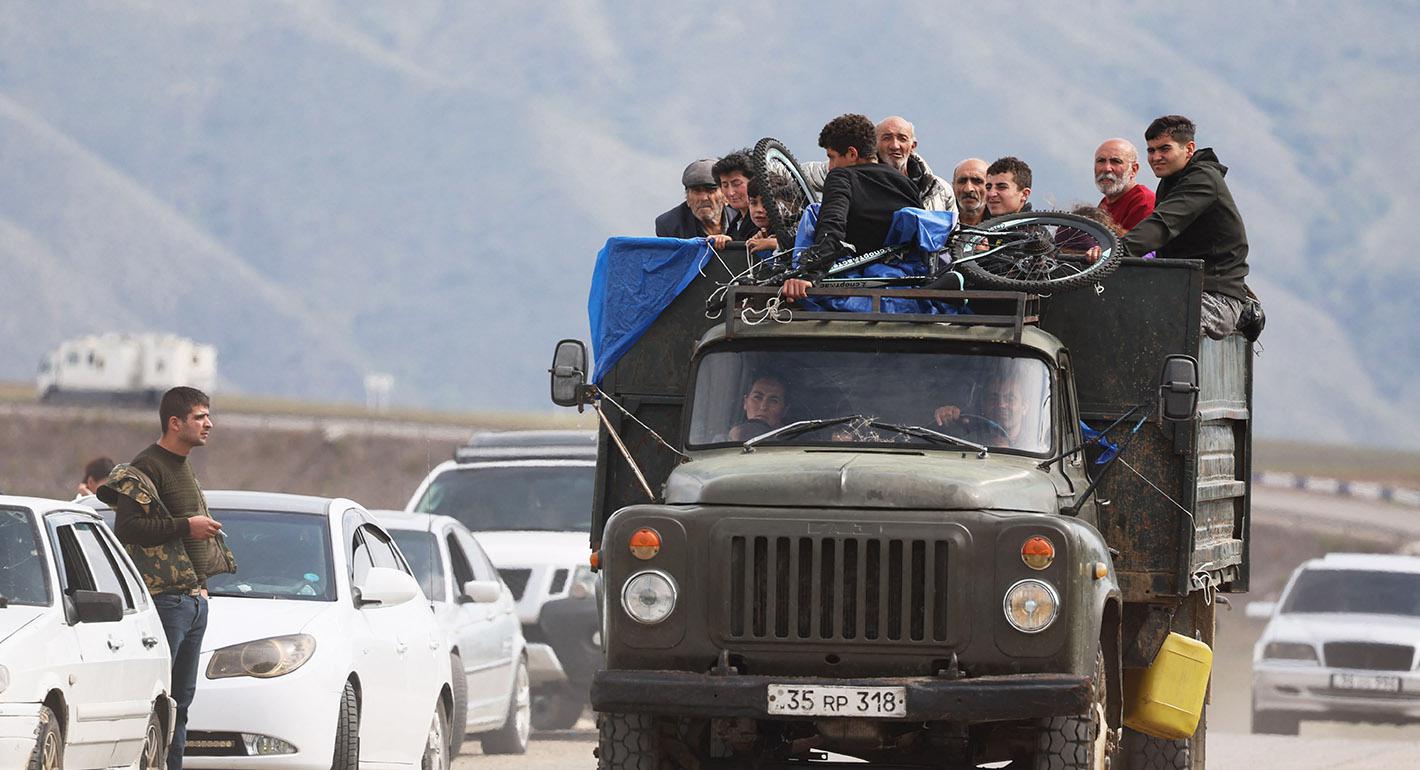
Azerbaijan has demonstrated how military force achieves more than words in the disputed region of Nagorno-Karabakh. As a result of Azerbaijan’s military assault, tens of thousands of Karabakh Armenians have fled to Armenia, and Nagorno-Karabakh looks set to come under Baku’s full control. No one has been able to halt this process, including Armenia. But this does not mean that the South Caucasus will now experience a period of peace.
On September 19, Baku launched a large military attack in Nagorno-Karabakh that it said was an “anti-terrorist operation.” Though it lasted just 24 hours, the fighting delivered exactly what Azerbaijan was seeking: local defense forces capitulated and committed to negotiations about integration.
Five days later, Baku opened the Lachin Corridor—the only road connecting Nagorno-Karabakh with Armenia—which has been blocked by Azerbaijan for ten months. This allowed Karabakh Armenians to flee to Armenia—and they don’t look likely to return. Such an outcome is a good one for Baku, which reasons that the fewer Armenians in Nagorno-Karabakh, the easier it will be to govern.
The events in Nagorno-Karabakh sparked demonstrations in Yerevan, with protesters accusing Armenian Prime Minister Nikol Pashinyan of surrender and betrayal. However, they have been unable to suggest a way forward. People have not come out onto the streets in response to calls from politicians, but because they feel powerless.
It’s difficult to predict how the protests will evolve, but they are reminiscent of unrest in 2020, when Armenia was defeated in the forty-four-day Second Karabakh War. Back then, there was similar anger directed at Pashinyan, and protesters even stormed a government building. But the authorities weathered those demonstrations, and Pashinyan called snap parliamentary elections, promising to resign if his party lost. But his party won by a wide margin.
The experience of 2020 shows Pashinyan’s strength lies in the weakness of his opponents. A political apathy that has gripped the country since 2020, as well as an unwillingness to see former regime figures back in government, plays into Pashinyan’s hands.
Recent municipal assembly elections in Yerevan—a city of about a million people—produced no clear winner and were a perfect illustration of Armenia’s political apathy, the weakness of the opposition, and the vulnerability of the ruling party. With just 28 percent turnout, 32.5 percent cast their ballots for Pashinyan’s Civil Contract party (about 75,000 votes). In second place was the National Progress Party with 18.9 percent (about 44,000 votes).
It’s possible that, in time, Pashinyan’s position will be made precarious by the arrival of refugees from Nagorno-Karabakh, many of whom oppose the government and will likely come to Yerevan. But for the moment, these people are focused on survival.
The international reaction to the crisis was not strong enough to stop Azerbaijan from using military force to change the facts on the ground. And Baku understands only too well that news about the exodus of Karabakh Armenians will soon fade from the headlines. While Western countries express concern, Russia, whose peacekeepers are deployed in Nagorno-Karabakh, calls for a nonviolent resolution.
The chances of the international reaction being any different, however, were almost nil, because Pashinyan himself has repeatedly recognized Nagorno-Karabakh as Azerbaijani territory.
Even though Pashinyan characterized the exodus of Armenians from Nagorno-Karabakh as an “ethnic cleansing” carried out by Azerbaijan and facilitated by the inaction of Russian peacekeepers, he appears to have accepted the new reality. In the same speech, he said that, if the international community fails to provide security guarantees for the Karabakh Armenians to remain, then Armenia is ready to take in all the resulting refugees.
You can already discern the outlines of Armenia’s future “anti-Russian” position. In fact, Pashinyan held such views long before he came to power in the 2018 Velvet Revolution. Pashinyan was a long-standing opponent of Armenia’s integration into the Moscow-led Eurasian Economic Union. And, since becoming prime minister, he has presided over a worsening relationship with the Moscow-led Collective Security Treaty Organization (CSTO).
The turning point in relations with the CSTO was the 2022 escalation between Armenia and Azerbaijan, when Azerbaijan attacked internationally recognized Armenian territory. Neither the CSTO nor Russia came to Armenia’s aid. Pashinyan now says that relying solely on Moscow was a mistake, and that Russia has acted in bad faith—taking advantage of Armenia’s weakness and seeking to undermine its statehood.
At the same time, it’s unclear where Yerevan can find alternate allies. While neither the United States nor the European Union are prepared to protect Armenia, it’s probably fair to assume that both Washington and Brussels would like to end Russia’s military presence in Nagorno-Karabakh and Armenia (which also includes a large base in Armenia’s second city of Gyumri and Russian border guards stationed on Armenia’s borders with Turkey and Iran).
For Baku, the Russian peacekeeping force in Nagorno-Karabakh has always been a temporary necessity. As soon as Azerbaijan realized the war in Ukraine meant Russia’s ability to project power in the South Caucasus was greatly reduced, it decided to bypass the peacekeepers and use force to get concessions.
It’s important to remember that the Russian peacekeepers do not have a clear mandate in Nagorno-Karabakh. All that they can do is monitor the situation and act as intermediaries. They are either unable or unwilling—or both—to intervene in an armed confrontation (as was proved again this month).
Once Azerbaijan has established control over Nagorno-Karabakh, President Ilham Aliyev will be able to announce that the conflict is over. When this happens, the question will arise: Why do Russian peacekeepers need to stay? For the moment, peacekeepers are participating in the negotiations between Karabakh Armenians and Baku, but when these end, it will be hard for Moscow to justify their presence.
The “resolution” of the Nagorno-Karabakh question does not mean that there are no outstanding issues between Baku and Yerevan. Most ominously, Azerbaijan appears intent on creating a land corridor through Armenian territory to the Nakhchivan Autonomous Republic, an Azerbaijani exclave bordering Turkey. Azerbaijan believes this corridor should be extraterritorial; Yerevan disagrees. There are also ongoing arguments about the exact demarcation of the Armenia-Azerbaijan border. Lasting peace is a distant prospect.
Vladimir Solovyov
Journalist
Carnegie does not take institutional positions on public policy issues; the views represented herein are those of the author(s) and do not necessarily reflect the views of Carnegie, its staff, or its trustees.
While the Nazis rushed ahead in a revolutionary fervor, Russia’s modern crusaders against enemies of the state work methodically, giving their targets time to adjust to restrictions before closing the loopholes.

Leonid Bershidsky

When faced with fuel shortages in the past, Central Asian governments could always count on additional supplies from Moscow. That safety net no longer exists.

Galiya Ibragimova

Reading the purported correspondence of celebrity Ksenia Sobchak sheds light on her role within the system, and how journalism and politics function in Putin’s Russia.
Vladislav Gorin

When political power is concentrated in the hands of a small circle of people, a country invariably ends up with technological stagnation.

Aleksei Kiselev

Two divergent trends—Putin’s hardline vision of how to prosecute the war in Ukraine, and a growing desire for change in Russia—could tear the regime apart.

Tatiana Stanovaya