

Commentary
Vladimir Solovyov
{
  "authors": [
    "Vladimir Solovyov"
  ],
  "type": "commentary",
  "blog": "Carnegie Politika",
  "centerAffiliationAll": "dc",
  "centers": [
    "Carnegie Endowment for International Peace",
    "Carnegie Russia Eurasia Center"
  ],
  "collections": [
    "Aso Tavitian Initiative"
  ],
  "englishNewsletterAll": "ctw",
  "nonEnglishNewsletterAll": "",
  "primaryCenter": "Carnegie Russia Eurasia Center",
  "programAffiliation": "russia",
  "programs": [
    "Russia and Eurasia"
  ],
  "projects": [],
  "regions": [
    "Russia",
    "Eastern Europe",
    "Moldova",
    "Caucasus"
  ],
  "topics": [
    "Foreign Policy",
    "Economy"
  ]
}
Source: Getty
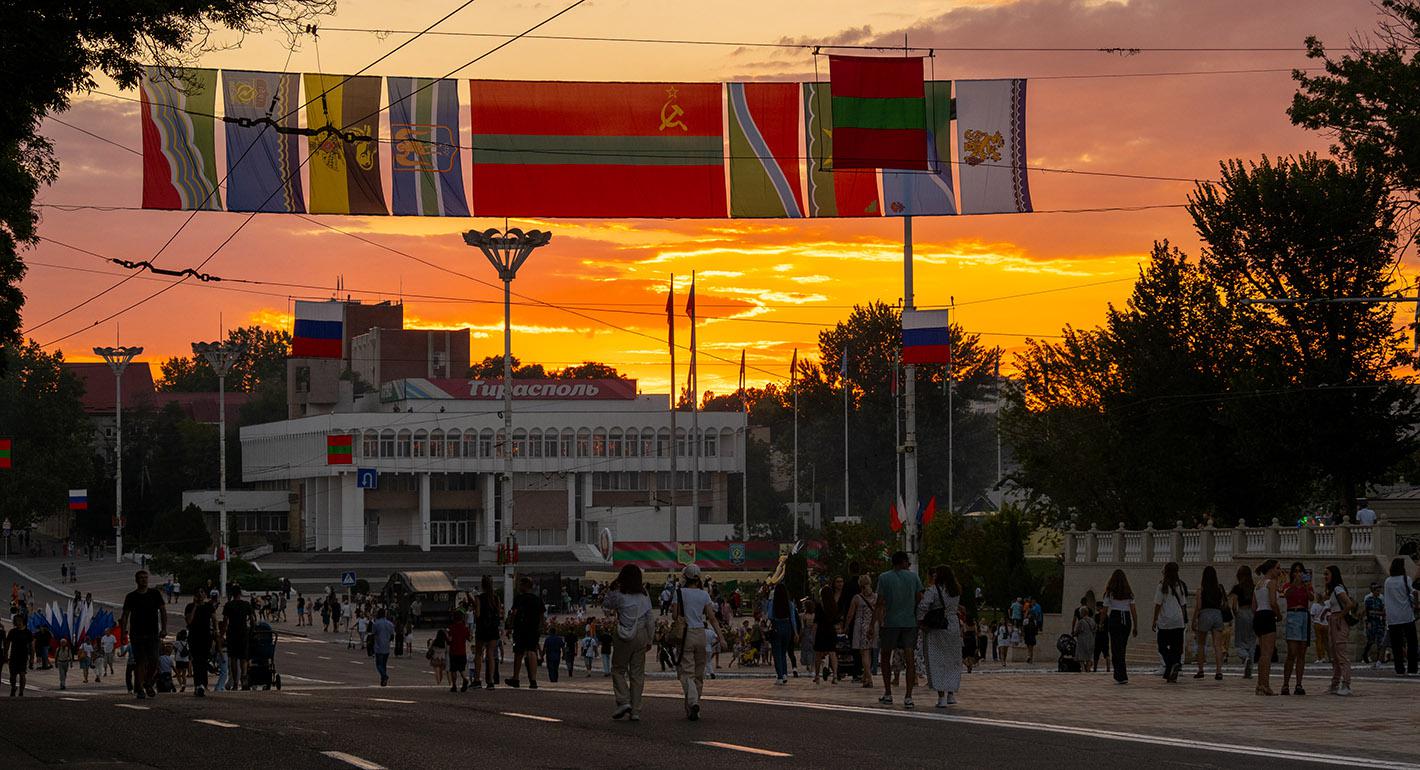
The de facto state of Transnistria and its dispute with Moldova has always been a peripheral matter for the international community. Since Russia’s invasion of Ukraine, it has faded even further into the background.
When Azerbaijan established full control over the disputed region of Nagorno-Karabakh in September 2023, the post-Soviet space was left with just one completely unrecognized de facto state: Transnistria. No one, not even Russia, disputes Moldova’s claim to sovereignty over the territory.
Yet the Transnistria conflict is also the only one in the region no one cares to resolve, an indifference that has only grown since Russia’s invasion of Ukraine. It has been years since anyone, Moldova included, tabled a proposal to end the dispute.
The most serious attempt was more than twenty years ago, in the fall of 2003. It fell through when Moldova’s then president, Vladimir Voronin, refused at the last minute to sign the already initialed Kozak Memorandum: a peace plan devised by Dmitry Kozak, then (as now) Russian President Vladimir Putin’s deputy chief of staff.
Voronin’s decision remains controversial. Moscow blames the West for ruining an opportunity for peace, while Chisinau maintains that the resulting federation of Moldova, Transnistria, and Gagauzia (a traditionally pro-Russian region of Moldova) would have been dysfunctional and unmanageable. In any case, the plan failed, and Chisinau and Tiraspol have never again come as close to reunification.
In December 2021, however, Kozak made another push to solve the issue. At his suggestion, on Christmas Eve, Transnistria’s president Vadim Krasnoselsky wrote to his Moldovan counterpart Maia Sandu proposing they return to the negotiating table. The letter was undoubtedly agreed in advance with Moscow, if not entirely written by the Russians.
What surprised observers was not only that Tiraspol had taken the initiative, but that it was calling for reunification talks following years of insistence on a civilized divorce from Chisinau. Krasnoselsky even hinted at a willingness to discuss Transnistria’s status within Moldova, but received no response from Sandu.
At the same time, Kozak flew to Vienna for talks with Thomas Mayr-Harting, the Organization for Security and Cooperation in Europe’s Transnistria point man. He was clearly hoping the West would force Moldova to the negotiating table, and announced that “Russia calls for resolving the conflict with a comprehensive political settlement as soon as possible.”
The context for all this was Russia’s diplomatic campaign in the run-up to the full-scale invasion of Ukraine, during which it issued an ultimatum to the United States and NATO demanding security guarantees. In hindsight, the ultimatum was clearly designed as a justification for the invasion, and to lay the groundwork for a Kremlin narrative about the West having provoked the war.
Kozak’s motives, however, are less clear. Perhaps he was trying to avert the invasion by promoting diplomacy: between Chisinau and Tiraspol and, by extension, Moscow and the West. Perhaps Moscow was calculating that progress on the Transnistria issue would demonstrate to the world that both war and diplomacy had a place in its toolkit.
Since the invasion in February 2022, Transnistria has been seen in various ways: as a threat to Kyiv, as a territory Ukraine could assist Moldova in clearing of pro-Russian forces, as one of the Kremlin’s military goals. At no point, though, has the prospect of resolving the Transnistrian conflict ever come up.
The war in Ukraine has torched many bridges, including the 5+2 negotiating group of Moldova, Transnistria, the OSCE, Russia, Ukraine, the EU, and the United States (with the latter two as observers). While it has not been officially disbanded, convening it in wartime is impossible, and its future remains unclear.
With 5+2 on ice and neither Russia nor the West putting forth their own peace proposals, Chisinau and Tiraspol are engaging directly with each other. Represented by Deputy Prime Minister Oleg Serebrian and Foreign Minister Vitaly Ignatiev, respectively, Moldova and Transnistria have been meeting under the auspices of the OSCE.
After a two-year hiatus, the two sides resumed dialogue on economic issues in September. To be sure, Chisinau and Tiraspol continue to air grievances and trade accusations in public. But they are talking.
Nevertheless, resolving the conflict is by all indications not a priority for Moldova, whose leaders subscribe to a consensus that there is neither any rush to end the dispute, nor any reason why Moldova cannot join the EU without Transnistria.
Sandu stated as much in September, saying that while “in the best case, a reunified Moldova would become an EU member state, it is not the case that if the Transnistrian conflict is not resolved, there will not be any European integration.”
Brussels has endorsed this approach, with Peter Stano, a European Commission foreign affairs spokesperson, declaring that “Moldova’s European future cannot be held hostage to conflicts.” Josep Borrell, the EU foreign policy chief, has also made the bloc’s position clear: “Moldova’s path is independent of what is happening in Transnistria. Cyprus became a member of the European Union having a territorial problem. Moldova can do it.”
For Moldova, the war in Ukraine has opened up the possibility that the EU might overcome its enlargement fatigue. In Brussels and other European capitals, there is a feeling that the bloc has a moral duty to admit Kyiv—and possibly other countries whose bids had previously stalled. Many now agree that while integrating new member states will be hugely costly—both financially and politically—it would still be cheaper than living with constant risks from an unstable buffer zone between the EU and a hostile Russia.
Of course, it could be another decade before a solution is reached that would satisfy both Moldova and Transnistria. In that time, Moscow would have ample opportunity to disrupt the peace process by pressuring Tiraspol with one of an array of levers at its disposal.
Nor is there any guarantee that Moldova will emerge as an EU member state at the end of the accession process that was formally launched on December 14 with the Council of Europe's decision to start accession talks with Kyiv and Chișinău. Just as enlargement fatigue conspired against it before Russia’s invasion, now growing exhaustion with the war, along with a right-wing surge across the EU, bodes ill for its prospects.
Even if Chisinau’s EU accession moves forward, the problem of Transnistria won’t just go away. How might its leadership react to Moldova joining the EU? What about its population: an unknown quantity given the absence of reliable polling data? What would it mean for the more than 90 percent of Transnistrians with Moldovan citizenship? What about Gagauzia? Chisinau may feel confident it can ignore Transnistria for now, but sooner or later these questions will need to be answered.
Journalist
Recent Work
Vladimir Solovyov
Vladimir Solovyov
Carnegie does not take institutional positions on public policy issues; the views represented herein are those of the author(s) and do not necessarily reflect the views of Carnegie, its staff, or its trustees.

Despite a new textbook, an influx of Russian teachers and managers, and an end to the teaching of Ukrainian, the Kremlin is unlikely to have “reprogrammed” locals.

Konstantin Skorkin

For every ruble allocated to social policy, health, and education in 2027, double that amount is earmarked for the army, the police, and the security services.

Alexandra Prokopenko

Cargo traffic through Russia’s Northern Sea Route has increased because of the disruption caused by the conflict in the Middle East, the Ukraine war, and U.S.-China tensions.

Mikhail Korostikov
An analysis of traffic accident data suggests that Ukrainian drone attacks caused a material but not disastrous fall in Russian gasoline consumption over the summer.

Sergey Vakulenko

Sergei Kiriyenko used Russia’s parliamentary vote to further hone his strategy of corporate mobilization that is designed to maximize votes for United Russia.

Andrey Pertsev