

Commentary
Shujaat Ahmadzada
{
  "authors": [
    "Shujaat Ahmadzada"
  ],
  "type": "commentary",
  "blog": "Carnegie Politika",
  "centerAffiliationAll": "",
  "centers": [
    "Carnegie Endowment for International Peace",
    "Carnegie Russia Eurasia Center"
  ],
  "collections": [
    "Aso Tavitian Initiative"
  ],
  "englishNewsletterAll": "",
  "nonEnglishNewsletterAll": "",
  "primaryCenter": "Carnegie Russia Eurasia Center",
  "programAffiliation": "",
  "programs": [],
  "projects": [],
  "regions": [
    "China",
    "Central Asia",
    "Caucasus"
  ],
  "topics": [
    "Economy",
    "Trade"
  ]
}
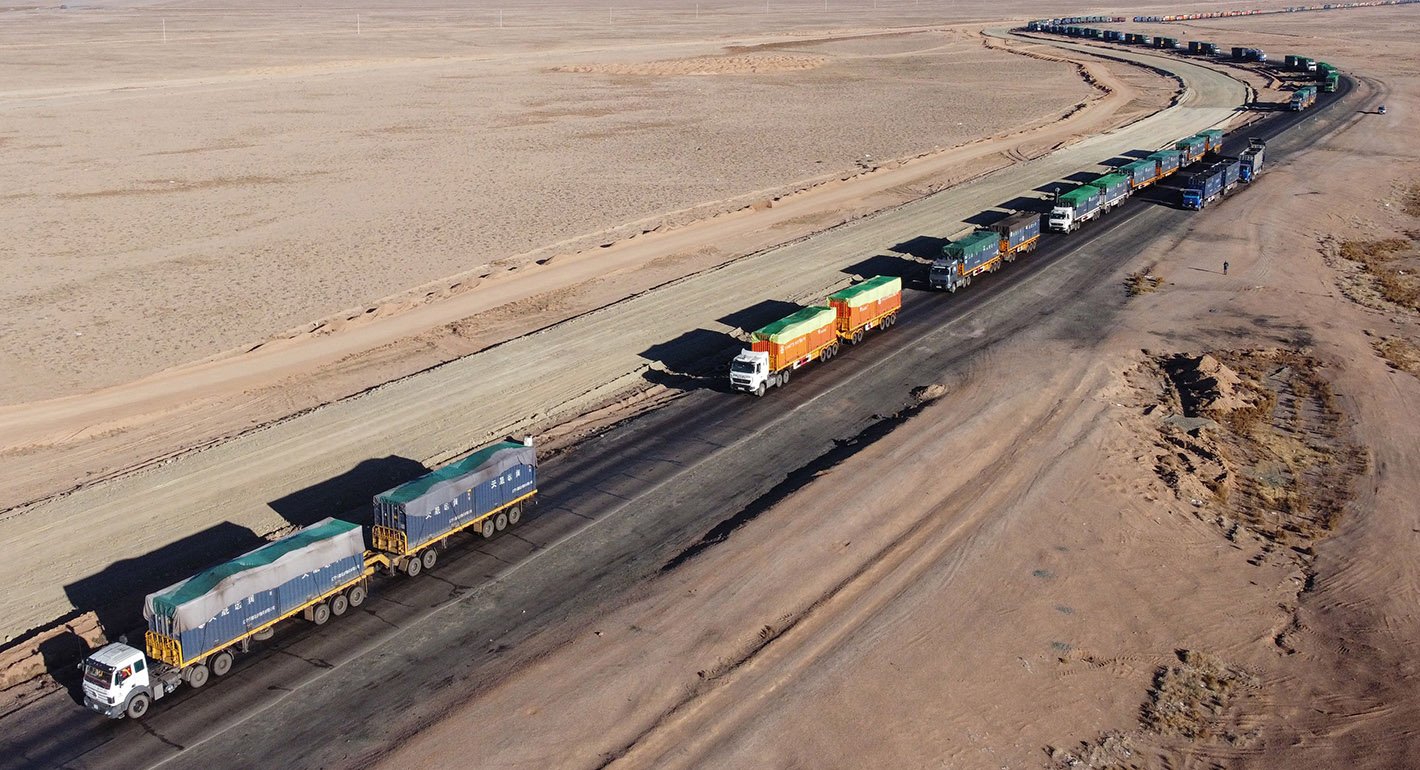
Source: Uugansukh Byamba / AFP via Getty Images
Central Asian and South Caucasus nations should use the interest in East–West trade through their territory to boost regional connectivity.
This year, an estimated 150,000 tons of freight will be shipped from central China, the eastern terminus of the ancient Silk Road, through Central Asia and across the Caspian Sea to the South Caucasus. Known as the Trans-Caspian International Trade Route, or simply the Middle Corridor, it is often seen as an alternative to more popular maritime options. Some believe that the war in Ukraine and intense interest from Beijing mean the Middle Corridor is poised to enjoy another heyday.
It was the collapse of the Soviet Union in 1991 that allowed Central Asia and the South Caucasus to once again take up intermediary roles in East–West trade. In 2013, Azerbaijan, Georgia, and Kazakhstan committed to reasserting their region’s role as a linchpin of global land trade by laying the institutional groundwork for what became known as the Middle Corridor.
While Beijing’s ambitious Belt and Road Initiative has fueled much speculation over whether the Silk Road is poised for a resurgence, the reality is that investing in maritime and coastal infrastructure makes much more sense for China than building a route through Central Asia and the Caucasus from scratch. The numbers speak for themselves. EU–China trade reached nearly $800 billion in 2023, with the vast majority—91 percent in 2021—conducted by sea. Trade by land has always accounted for approximately 3 percent of total turnover (with most going via Russia and Belarus).
Yet Russia’s invasion of Ukraine and ensuing Western sanctions have led many to seek alternatives to Russia and Belarus. That has paved the way for the revival of the Middle Corridor, with container traffic increasing 33 percent since the full-scale invasion.
Azerbaijan, Georgia, and Kazakhstan pledged in late November 2022 to make the route faster, more interconnected, and more accessible. With global maritime trade predicted to contract, and EU–China trade set to grow 30 percent by 2030, there seems to be a consensus on both sides of the Caspian Sea that now is the time to reassert the region’s agency with respect to this vital trade artery.
However, challenges remain. One downside of the Middle Corridor’s multilateral nature is the increased need for coordination between its various stakeholders, which all have their own problems and different capacities.
The Middle Corridor’s main route passes through Kazakhstan, Azerbaijan, and Georgia, countries whose logistical capabilities are far from uniform. For example, Azerbaijan plans to have at least fifty-three trains a day to carry freight from the country’s ports to the border with Georgia. In Georgia, however, only seven trains a day are available to transport this freight to the Black Sea port city of Batumi, leaving more than 80 percent of cargo for trucks to deliver.
The issue is not limited to railways. Stops for some container ships in the Georgian ports of Poti and Batumi cost twice as much as far better equipped ports like the Netherlands’ Rotterdam or China’s Shanghai. In Alat, Azerbaijan, and Aktau, Kazakhstan, dwell times are so long that they can account for up to 70 percent of the total time spent transporting goods through the Middle Corridor.
Even with significant dwell times, the Middle Corridor is a quicker option than the seventy days it can take for cargo to be delivered via the Suez Canal. But the Middle Corridor route via Russia and Belarus remains a formidable competitor for the South Caucasus and Central Asia: although legally problematic because of Western sanctions, it offers a thirteen-day transit for EU–China cargo. It’s clear some companies have used this route without running afoul of sanctions by routing trade through intermediaries like Georgia, Armenia, and Kyrgyzstan (which have seen an unprecedented surge in their trade with EU countries).
Many of the challenges facing the Middle Corridor can be overcome. Yet one major limiting issue is the Caspian Sea’s historically low (and falling) water level, which has forced vessels to carry less cargo and operate less frequently. The situation is exacerbated by factors from tectonic shifts to climate change, but there is little that can be done to fundamentally alter the trajectory. If it continues, it will undermine efforts to enhance cross-sea connectivity, including restricting the expansion of ports and the purchase of new vessels.
This raises the question: Why persist? A strict cost-benefit analysis might indicate against persisting in efforts to revive the Silk Road. Yet for the region’s actors, the Middle Corridor is one of only a few opportunities to attract foreign direct investment in infrastructure. As demonstrated by India’s Golden Quadrilateral—a highway network connecting the major cities of New Delhi, Kolkata, Mumbai, and Chennai—investment in transport infrastructure often leads to significant socioeconomic improvements for the communities along these networks.
A genuine resurgence of the Silk Road could well foster the rise of new economic hubs in the South Caucasus and Central Asia. It could also stimulate economic development. Oddly, Azerbaijan, Georgia, and Kazakhstan—with a combined population of around 30 million—lag behind Bosnia and Herzegovina, a country of about 3 million, in terms of economic complexity. Increased interregional connectivity could generate moderate GDP growth for these communities, if only temporarily.
Many feasibility studies suggest the growth of the Middle Corridor will bolster EU–China trade, though not enough to significantly affect global trade dynamics. Therefore, the Middle Corridor should be reimagined: from a global conduit between Far Eastern markets and Europe to a regional connectivity initiative, aimed at deepening the Caucasus and Central Asia’s integration and potentially boosting their economic and political resilience.
Indeed, the calculations around the Middle Corridor transcend mere economics. After all, connectivity projects operate within securitized environments. The aspiration of economically linking the Caucasus and Central Asia could eventually evolve into an interregional political and security dialogue. Perhaps, in an era of multipolarity, this is the best approach: fostering local alliances to help manage the influence of multiple hegemonic powers.

Independent researcher
Recent Work
Shujaat Ahmadzada
Shujaat Ahmadzada
Carnegie does not take institutional positions on public policy issues; the views represented herein are those of the author(s) and do not necessarily reflect the views of Carnegie, its staff, or its trustees.

Russian strikes are weakening the economy sustaining Ukraine’s war effort. Closing the growing funding gap will require more European support and politically contentious reforms in Kyiv.

Balázs Jarábik

Ex-president Gurbanguly Berdimuhamedov remains interested in politics, but his son Serdar, Turkmenistan’s current president, is becoming increasingly independent and willing to break with his father’s legacy. If their covert rivalry goes too far, both risk losing power.

Galiya Ibragimova

For every ruble allocated to social policy, health, and education in 2027, double that amount is earmarked for the army, the police, and the security services.

Alexandra Prokopenko

Cargo traffic through Russia’s Northern Sea Route has increased because of the disruption caused by the conflict in the Middle East, the Ukraine war, and U.S.-China tensions.

Mikhail Korostikov

Trump has promised Belarus a massive potash deal. But Minsk is seeking something greater: restored Western transit and greater room for maneuver from Russia.
Balázs Jarábik