

Commentary
James D.J. Brown
{
  "authors": [
    "James D.J. Brown"
  ],
  "type": "commentary",
  "blog": "Carnegie Politika",
  "centerAffiliationAll": "",
  "centers": [
    "Carnegie Endowment for International Peace",
    "Carnegie Russia Eurasia Center"
  ],
  "englishNewsletterAll": "",
  "nonEnglishNewsletterAll": "",
  "primaryCenter": "Carnegie Russia Eurasia Center",
  "programAffiliation": "",
  "programs": [],
  "projects": [],
  "regions": [
    "Russia",
    "United States",
    "Asia"
  ],
  "topics": [
    "Arms Control",
    "Military",
    "Nuclear Policy",
    "Security",
    "Foreign Policy"
  ]
}
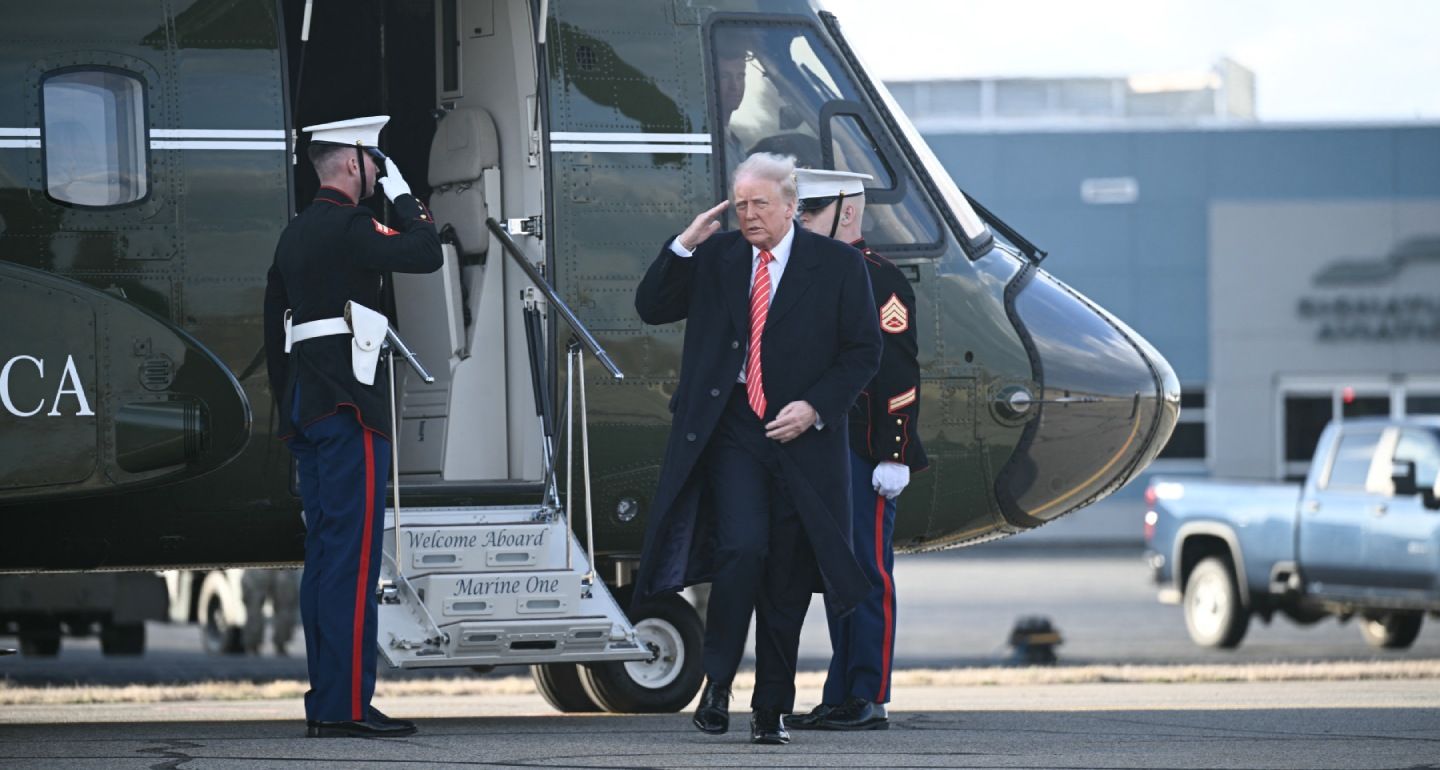
Source: Getty Images
Golden Dome will press Russia into a new arms race, forcing it to devote yet more resources to its strategic forces at a time when the country can least afford it.
Just one week after U.S. President Donald Trump’s inauguration in January this year, he used an executive order to request a new missile shield under the working title of the Iron Dome for America. Later, addressing a joint session of the U.S. Congress on March 4, Trump announced, “I’m asking Congress to fund a state-of-the-art Golden Dome missile defense shield to protect our homeland, all made in the U.S.A.” What does the project entail, will it succeed, and what does it mean for Russia?
According to General B. Chance Saltzman, Chief of Space Operations for the U.S. Space Force, Golden Dome is not a single initiative but “a system of systems.” It will bring together existing elements of U.S. missile defense and supplement them with an ambitious new structure that will, according to the executive order, provide for the “Defense of the United States against ballistic, hypersonic, advanced cruise missiles, and other next-generation aerial attacks from peer, near-peer, and rogue adversaries.” The result will be a layered missile shield that vastly surpasses the United States’ existing defenses.
Although at an early stage, the plan is for the new system to be space-based. It will consist of a constellation of hundreds of detector satellites tasked with locating missiles and their host infrastructure on land, sea, and air, as well as precisely tracking missiles after launch. A separate fleet of attack satellites will intercept the missiles during their boost phase via kinetic (i.e. missile interceptors) or non-kinetic means (i.e. lasers).
The primary purpose of Golden Dome is to provide comprehensive protection to the United States homeland. Yet Trump’s executive order suggests that the system could also cover theater missile defense. In other words, it could be extended to protect forward-deployed troops and U.S. allies in Europe and Asia.
Another feature of Golden Dome is the intended speed of development. As General Saltzman said, “If this were a traditional Pentagon development program, it could take twelve to seventeen years.” Instead, the plan is to see results before the end of Trump’s term in January 2029. To achieve this, the project will rely upon not only established defense contractors, such as Lockheed Martin, but also newer players, such as SpaceX, Anduril, and Palantir.
There are practical reasons for the development of Golden Dome. The United States’ existing system of ballistic missile defense centers on forty ground-based interceptors at Fort Greely, Alaska, plus a further four at California’s Vandenburg Space Force Base. That system is over twenty years old and was designed to offer protection against an accidental or rogue missile launch, not the strategic arsenals of Russia or China. Additionally, the ground-based interceptors provide limited protection against hypersonic weapons.
However, Trump’s enthusiasm for Golden Dome owes more to politics than practicalities. He understands the value of big symbolic projects. His promise to build a wall with Mexico propelled him to the presidency in 2016. He is now pressing for Alcatraz, the notorious prison in San Francisco Bay, to be reopened as a symbol of his commitment to law and order. The same is true of Golden Dome. Trump wants the project to be a grand manifestation of his “peace through strength” agenda.
Moreover, the project says much about Trump’s sources of inspiration. As a space-based system, Golden Dome has much in common with the Strategic Defense Initiative (SDI), the missile defense system proposed by President Ronald Reagan in 1983. The naming of the project also makes clear that Trump was influenced by Israel’s Iron Dome system.
These parallels are not entirely encouraging. SDI, which critics derided as “Star Wars,” proved too technologically demanding and was ended in 1993. Israel’s missile defenses, of which Iron Dome is just one layer, are effective, but Israel is much easier to protect than the United States. Israel is smaller than Hawaii and contends primarily with unsophisticated short-range rockets rather than advanced ballistic or hypersonic missiles. This begs the question of whether Golden Dome is feasible.
The first obstacle is technical. Even though technology has advanced enormously since the 1980s, the challenge of developing a space-based missile defense shield remains formidable. The timeline is also optimistic. Supporters point to the success of the Manhattan Project, but that was a time of war when the United States was much more united around a common purpose than it is today.
Another obstacle is cost. At the end of April, House Republicans put forward a reconciliation bill that assigns $24.7 billion to Golden Dome. That is just for starters. A National Research Council study from 2012 estimated that the total cost of a space-based, boost-phase missile defense system could be as much as $831 billion (in 2025 dollars).
Proponents argue that several factors now mean that the project can be accomplished more cheaply. Launch costs have fallen dramatically during the last decade. SpaceX, with its 7,000 Starlink satellites, has also demonstrated its capacity to create a vast constellation of satellites quickly and at limited cost.
Other cost-saving proposals include the suggestion that the detector satellites could have a “day job.” That is to say that, aside from their missile tracking role, the satellites could have a commercial function, thus enabling cost sharing in the United States’ own version of military-civil fusion. Reuters reported in April that SpaceX had proposed offering Golden Dome as a subscription service, meaning that the satellites would not actually belong to the U.S. government.
What does all this mean for Russia? Trump presents Golden Dome as a mechanism for promoting stability and peace. He has long been skeptical of nuclear weapons, describing them as “big monsters” and saying: “It would be great if we could all denuclearize.” His hope is that Golden Dome will allow the United States to reduce its reliance on nuclear weapons. This is because if the United States has a reliable means of ensuring the failure of an attack on its homeland (deterrence by denial), it will need less capability to strike at adversaries (deterrence by punishment).
Needless to say, this is not how strategists in Moscow view matters. In 2002, the United States unilaterally withdrew from the Anti-Ballistic Missile Treaty. Since then, Russian officials have consistently warned of the destabilizing effects of missile defense. In 2019, Russia’s foreign ministry condemned the United States’ then more modest missile defense plans as proof of “Washington’s desire to ensure uncontested military domination in the world.” Their concern is that, secure behind its defenses, the United States could not be deterred from aggression.
Washington’s response was always that its missile defenses were only to counter the limited threats from North Korea and Iran, and in no way undermined Russia’s large, sophisticated arsenal. This argument—which was never fully accepted by Moscow—has now been cast aside. In what represents an epochal change in U.S. policy, Golden Dome is explicitly directed not only against “rogue adversaries,” but also against “peer” and “near-peer” states (i.e. Russia and China).
Moscow’s experts will remain confident that even with its current capabilities, Russia’s strategic arsenal could overcome Golden Dome thanks to countermeasures such as decoys and jamming devices. There is also the option of “saturation,” i.e. overcoming defenses by launching more missiles than can be intercepted.
However, high confidence is not sufficient in the world of deterrence. Since the survival of the nation is at stake, strategists must proceed from the worst-case scenario and assume that Golden Dome would be effective at least against a Russian second strike.
Russia will therefore need to respond. That will entail accelerating existing efforts to modernize each leg of the nuclear triad by replacing Soviet-era delivery systems with newer Russian designs.
We can also expect renewed emphasis on exotic weapons that promise to evade all conceivable missile defense systems. In 2018, Putin famously unveiled what were subsequently dubbed his nuclear “super weapons.” These include the Burevestnik, a ground-launched, nuclear-powered cruise missile with supposedly unlimited range, and Poseidon, a nuclear-powered torpedo that is intended for strikes on aircraft carrier groups or coastal infrastructure. Since Golden Dome focuses exclusively on aerial attacks, it is likely that Poseidon will become an even greater priority.
Another probable response is a redoubling of Russian interest in nuclear anti-satellite weapons. The advantage of such weapons is that they could quickly eliminate a whole constellation of U.S. military satellites. The downside is that they would cause tremendous collateral damage, eliminating numerous civilian satellites and causing untold disruption to life on earth. However, if the choice were between losing a nuclear war and destroying much of the world’s space infrastructure, the Kremlin would undoubtedly select the latter option.
Golden Dome will therefore press Russia into a new arms race, forcing it to devote yet more resources to its strategic forces at a time when the country can least afford it. The Russian defense budget is already overstretched by the war in Ukraine, and rebuilding Russia’s conventional forces will take years. These vast outlays will require further diversion of funds from civilian sectors, with predictable consequences for the long-term health of the Russian economy.
Russia’s hurry to develop “super weapons” and nuclear weapons for space bring further dangers. Poseidon and Burevestnik have been much hyped by the Kremlin, yet they remain in the development stage and the risk of accidents is high. The nuclear-powered Burevestnik attracts particular concern and has been labeled “a flying Chernobyl.” A failed test in 2019 is reported to have caused the death of five engineers.
Ultimately, Golden Dome may never achieve Trump’s grandiose ambitions. However, even if it does not, it will have serious consequences for strategic stability and for Russia in particular.

Professor of Political Science at Temple University
Recent Work
James D.J. Brown
James D.J. Brown
Carnegie does not take institutional positions on public policy issues; the views represented herein are those of the author(s) and do not necessarily reflect the views of Carnegie, its staff, or its trustees.

A leak of Russian gas price data helps establish that China is paying Russia far less than Central Asian countries and Gazprom’s former European customers.

Sergey Vakulenko

Japan’s long-term security policy is driven by concerns about China, and there is little appetite for (or interest in) pursuing a confrontation with Moscow.
James D.J. Brown

The truth of the strategic situation is that Europe and Russia are extremely unlikely to be able to “turn the page” on their confrontation within the next two decades.

Arkady Moshes
Russia spent years building a “sovereign internet,” concentrating web infrastructure exclusively within Russian territory. Ukrainian drone attacks have shown how vulnerable that approach has left the Russian internet.

Maria Kolomychenko

Putin’s conservative staffing policies and search for ever greater control have cemented parliament’s transformation into a bureaucratic appendage of the executive branch.

Andrey Pertsev