

Commentary
Maxim Starchak
{
  "authors": [
    "Maxim Starchak"
  ],
  "type": "commentary",
  "blog": "Carnegie Politika",
  "centerAffiliationAll": "",
  "centers": [
    "Carnegie Endowment for International Peace",
    "Carnegie Russia Eurasia Center"
  ],
  "englishNewsletterAll": "",
  "nonEnglishNewsletterAll": "",
  "primaryCenter": "Carnegie Russia Eurasia Center",
  "programAffiliation": "",
  "regions": [
    "Russia"
  ],
  "topics": [
    "Nuclear Policy",
    "Arms Control",
    "Security"
  ]
}
Source: Getty Images
For Putin, upgrading Russia’s nuclear forces was a secondary goal. The main aim was to gain an advantage over the West, including by strengthening the nuclear threat on all fronts. That made growth in missile arsenals and a new arms race inevitable.
Last year was a contradiction in terms of the modernization of Russia’s nuclear forces. On the one hand, the Defense Ministry reported that new Yars intercontinental missiles, the Knyaz Pozharsky nuclear submarine, and Tu-160M missile carriers had all entered service. On the other hand, the proportion of modern weapons (i.e., Russian, not Soviet) in the nuclear triad fell from 95 percent to 92 percent.
President Vladimir Putin does not seem overly concerned by this dynamic. He is far more interested in expanding nuclear missile capabilities by placing the Oreshnik medium-range missile system on combat alert, as well as testing the nuclear-powered Poseidon underwater vehicle and Burevestnik missile.
Previously, the Russian authorities claimed that nuclear modernization was a natural process of replacing Soviet weapons with Russian ones. Now it’s becoming clear that that was only the first stage. The Kremlin’s goal is to increase its weapons stockpiles to make the threat to the West appear more convincing.
An examination of the individual components of Russia’s nuclear forces reveals that the proportion of the latest weapons in the Strategic Rocket Forces increased from 88 percent to 90 percent in 2025—meaning that the 2024 deadline set for completing the modernization of the Strategic Rocket Forces has been missed by a considerable margin.
To shed their Soviet legacy once and for all, the Strategic Rocket Forces need to replace their Soviet-era Voyevoda missiles with modern Sarmat missiles, and that is easier said than done. The service life of the Voyevoda missiles—produced in Ukraine—has been extended repeatedly, as is typical in such cases, by conducting a launch of one of the oldest missiles. The last such launch took place in 2013, securing another five years of service.
In 2014, following Russia’s annexation of Crimea and the armed uprising by Russia-backed separatists in the Donbas, the missile’s Ukrainian developers and manufacturers severed all ties with Russia, and since then Putin and the Defense Ministry have been promising that the troops will soon count Sarmat missiles among their arsenal.
In 2015, the Krasmash plant received 18 billion rubles for the Sarmat program. By 2019, the factory was supposed to have received new equipment and completely modernized its production facilities, but that process is still not yet complete. In addition, Krasmash was short of Russian components even before Russia’s full-scale invasion of Ukraine, and the situation has not improved.
Other companies involved in the Sarmat’s production are also experiencing financial and manufacturing problems, in particular with the engines. The severing of ties with Ukrainian developers and companies led to major losses in terms of technology and personnel. The development of the heavy missile essentially had to be started from scratch, which resulted in errors, do-overs, and constant delays. Even if Putin announces in 2026 that the Sarmat has entered service, the signing of the relevant paperwork could take several years. Until then, the test launches will continue.
To date, there has been only one confirmed successful Sarmat launch. Several other attempts have failed. In 2024, a silo at the Plesetsk test site in the Arkhangelsk region was destroyed during testing, after which further testing appears to have been moved to the Strategic Rocket Forces base in Yasny, in the Orenburg region. In November 2025, another unsuccessful launch took place there.
In other words, Russia has not had a technically ready heavy intercontinental missile for over seven years now. The reliability of both the old Voyevoda and the new Sarmat missiles remains questionable. That situation won’t change significantly in 2026. Statements by the Defense Ministry suggest that the Sarmat will have fewer launchers than the Voyevoda currently has. But even deploying thirty launchers could take about ten years.
The modernization of the Strategic Rocket Forces doesn’t end there. Topol-M mobile missile systems are gradually being replaced with Yars missiles. The main news from 2025 in this respect was the final equipping of the Kozelsk Division with these silo-based missile systems. Also last year, the first regiment of the Tatishchev Division was reequipped with the silo-based version of the Yars. The Topol-Ms in the Teikovo Division, on the other hand, were not replaced last year. In any case, this process doesn’t affect the figures in nuclear force modernization reports, since the Topol-M’s development was completed in the early 1990s, not during Soviet times.
The Oreshnik intermediate-range hypersonic missile requires special attention following its use in strikes against Ukraine in November 2024 and January 2026. Last August, Putin announced that the first series of Oreshnik had entered service and said that the missile would also be deployed to Belarus, most likely before the end of the year. Four months later, Chief of the General Staff Valery Gerasimov announced the formation of the first brigade to be armed with the Oreshnik, using several launchers at the Kapustin Yar test site in the Astrakhan region. Meanwhile, at a presentation of the Oreshnik system in Belarus at the end of last year, no launchers were shown.
Oreshnik production volumes will be small, at least initially. In 2025, the missile system’s manufacturer, the Votkinsk plant, continued to modernize its production facilities, upgrading equipment and building new workshops. The company faces the challenge of increasing productivity while also reducing production costs and the defective ratio. Although sanctions prevent the Votkinsk plant from receiving some computer numerical control (CNC) machines, it is optimizing the use of its existing 600 units. In the future, production of the Oreshnik is set to expand.
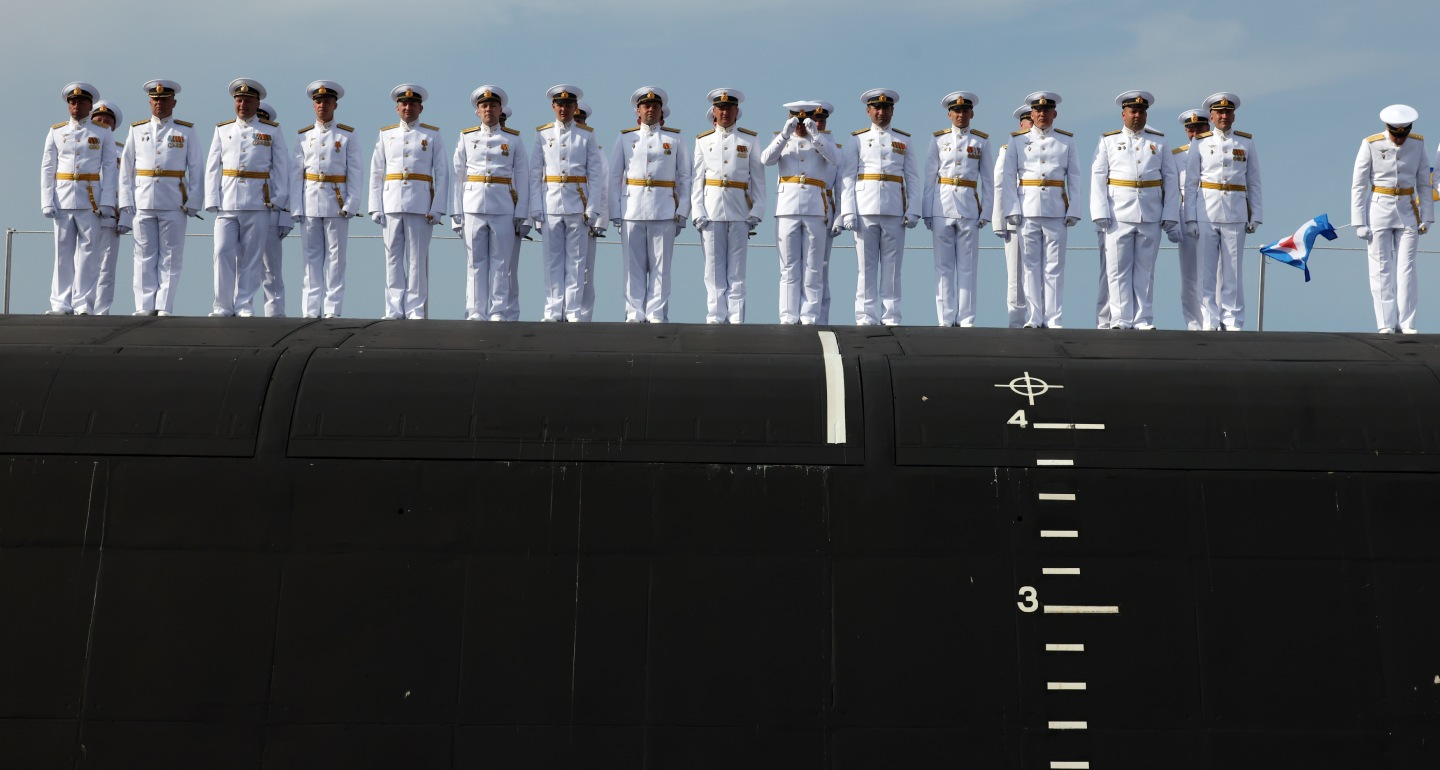
In 2025, the Russian navy received the Borei-A-class strategic submarine Knyaz Pozharsky, a year later than originally scheduled. The state armament program through 2027 had envisaged the delivery of three Borei-class submarines and eleven Borei-A-class submarines. To date, the navy has received five Borei-A submarines, and two more are under construction.
The keel laying of the eighth and ninth has been repeatedly postponed, while the tenth and eleventh submarines have never been officially announced. This can be explained by plans to transition to the third modification of the project, the Borei-AM (955AM), which requires additional time. The keel laying of submarines using this latest modification could take place in 2027.
Their manufacturing is complicated by sanctions. The Sevmash shipyard has been unable to find replacements for imported components. The Trade and Industry Ministry has been forced to hold tenders for the development of Russian-made components, planned to be implemented in 2028. The submarine delivery deadlines are therefore inevitably being pushed back. The sixth Borei-A submarine, Dmitry Donskoy, was scheduled to be launched in 2025, but that has not happened.
The problem of drawn-out construction times at Sevmash is systemic. Back in 2006, then defense minister Sergei Ivanov complained that the shipyard was taking five years instead of three to build a submarine. Since then, despite multibillion-dollar investments in modernization and the introduction of new materials, the construction time for Borei-class strategic submarines has increased to seven years.
In addition to the Borei-class submarines, Russia also still has Soviet-designed Dolphin-class strategic submarines in its arsenal. In 2025, the Dolphin-class Bryansk was returned to service after its latest overhaul. Meanwhile, the Zvezdochka shipyard is continuing work on the Karelia submarine: completion of the overhaul was initially scheduled for 2025, but was later postponed to 2026.
The Dolphin-class submarines were initially expected to be in service until 2015. But after being upgraded to carry Sineva ballistic missiles, their service life was extended to thirty-five years: i.e., through 2025–2030. Due to the slow pace of Borei-class submarine construction and the shortage of them to fully replace the Dolphin-class vessels, it was decided to extend the service life of the latter even further—until at least 2038.
As for the Poseidon unmanned underwater vehicles, they—like the Burevestnik unlimited-range cruise missile—are still at the development stage. Putin said back in early 2024 that testing was being completed, but at a Defense Ministry board meeting at the end of 2025, he said the systems would continue to be developed and “perfected.”
The Belgorod submarine served as the test carrier for the Poseidons. A total of four submarines are planned to be built to carry these super-torpedoes. The Khabarovsk, which took eleven years to build, was launched in November 2025. Construction of the Orenburg began that same year, but there will be no Poseidons for them to carry for the next few years.
As predicted last year, the delivery of four new Tu-160M bombers to the Aerospace Forces did not take place in 2025 as planned. At a Defense Ministry board meeting, Defense Minister Andrei Belousov reported receiving only two newly built aircraft. Overall, according to the ministry’s reports, seven new or upgraded Tu-160Ms were delivered.
Although the Kazan plant is focused entirely on strategic aircraft, production rates remain low: around one and a half aircraft per year. Modernization of the Soviet-built Tu-160 is also progressing slowly.
It’s obvious that the contract for the delivery of ten new Tu-160Ms will not be fulfilled on schedule—i.e., by 2027. In addition to a chronic labor shortage, the Kazan plant is facing problems with outdated foundry and composite production facilities. Sourcing alternative suppliers increases costs and lead times, and it has not proved possible to improve productivity.
The pace of Tu-160M production is largely determined by the supply of engines manufactured by the Kuznetsov United Engine Corporation. The engine in question is the NK-32-02, a modernized version of a Soviet-designed engine. After the collapse of the Soviet Union, the company lost its technological expertise and qualified personnel, meaning the engine is effectively being created from scratch, with all the challenges inherent to developing a new high-tech product.
The situation is made worse by sanctions, which limit Russian companies’ access to high-quality components. Homegrown equivalents take time to produce and are not always of comparable quality. In 2024, one of the engines on a modernized Tu-160M caught fire, resulting in the loss of the other three engines. A Defense Ministry commission subsequently discovered up to ten more faulty NK-32 engines.
Engine problems have also impacted the program to develop the next-generation PAK DA strategic stealth bomber. The first prototype was supposed to be in place by 2019, but the lack of a ready engine led to repeated delays. Industry sources now say the aircraft’s rollout is scheduled for 2026.
A comprehensive upgrade of thirty-five Tu-95MS aircraft to the Tu-95MSM variant, including the replacement of all onboard systems, is not yet feasible. Accordingly, the Defense Ministry is considering a partial replacement of the radio equipment and navigation systems, as well as adapting the aircraft for the use of Kh-101 cruise missiles, as sufficient grounds to consider the aircraft modernized. In official reports, therefore, it would be as new as the Yars missile systems or Borei submarines.
In 2023 and 2024, the Defense Ministry reported that the renewal rate of Russia’s strategic nuclear forces had stabilized at 95 percent. By the end of 2025, the agency put the figure at 92 percent.
For three years in a row, the Defense Ministry has claimed that the modernization of the naval component of the armed forces is complete. In the Strategic Rocket Forces, the proportion of cutting-edge systems increased by 2 percentage points in 2025. Accordingly, the reasons for the decline from 95 percent to 92 percent must be sought in aviation.
The only event that could have had such an impact on the level of modernization was Ukraine’s Operation Spiderweb, in which Russian military airfields were attacked by drones on June 1, 2025. In 2024, the aviation component of Russia’s nuclear forces was approximately 97 percent up to date, while now it is estimated at 86 percent.
The Defense Ministry’s calculation methodology is not made public, but the decline in the proportion of modern weapons was likely caused not only by the destruction of several Tu-95MS aircraft, but also by the forced return to service of Tu-95s that had been previously decommissioned or were scheduled for decommissioning.
The proportion of advanced weapons in the nuclear forces is unlikely to increase significantly in the coming years: the process of replacing Soviet-era designs with Russian ones has stalled. Russia will continue to produce strategic missile carriers as slowly as before, and the deployment of the Sarmat missile system will drag on for at least a decade.
From Putin’s perspective, Russia’s nuclear forces are already the most modern and high-tech in the world. In this sense, the president is confident that the task of modernization has been accomplished. At the same time, he is not resting on his laurels. The Strategic Rocket Forces will receive the Oreshnik and likely other missiles with similar ranges. At some point, the nuclear-powered weapons—the Burevestnik and Poseidon—will start to be rolled out.
Putin is confident that the global strategic balance is shifting in Russia’s favor. Modernizing the country’s nuclear forces turns out to have been a secondary goal for him: the main goal was to gain an advantage over the West, including by strengthening the nuclear threat on all fronts. That made growth in missile arsenals and an arms race inevitable.

Expert on Russian nuclear policy
Recent Work
Maxim Starchak
Maxim Starchak
Carnegie does not take institutional positions on public policy issues; the views represented herein are those of the author(s) and do not necessarily reflect the views of Carnegie, its staff, or its trustees.

Despite a new textbook, an influx of Russian teachers and managers, and an end to the teaching of Ukrainian, the Kremlin is unlikely to have “reprogrammed” locals.

Konstantin Skorkin

For every ruble allocated to social policy, health, and education in 2027, double that amount is earmarked for the army, the police, and the security services.

Alexandra Prokopenko

Cargo traffic through Russia’s Northern Sea Route has increased because of the disruption caused by the conflict in the Middle East, the Ukraine war, and U.S.-China tensions.

Mikhail Korostikov
An analysis of traffic accident data suggests that Ukrainian drone attacks caused a material but not disastrous fall in Russian gasoline consumption over the summer.

Sergey Vakulenko

Sergei Kiriyenko used Russia’s parliamentary vote to further hone his strategy of corporate mobilization that is designed to maximize votes for United Russia.

Andrey Pertsev