

Commentary
Fabrice Pothier
{
  "authors": [
    "Fabrice Pothier"
  ],
  "type": "legacyinthemedia",
  "centerAffiliationAll": "dc",
  "centers": [
    "Carnegie Endowment for International Peace",
    "Carnegie Europe"
  ],
  "collections": [
    "Transatlantic Cooperation",
    "Brexit and UK Politics"
  ],
  "englishNewsletterAll": "ctw",
  "nonEnglishNewsletterAll": "",
  "primaryCenter": "Carnegie Europe",
  "programAffiliation": "SAP",
  "programs": [
    "South Asia"
  ],
  "projects": [],
  "regions": [
    "Asia",
    "Europe",
    "North America",
    "Afghanistan",
    "Pakistan"
  ],
  "topics": [
    "Foreign Policy",
    "Economy"
  ]
}
Source: Getty
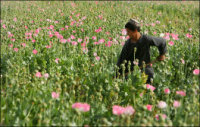
NATO's new war on drugs in Afghanistan will put troops in greater danger for a venture that may not even work. It just might be the straw that breaks the alliance's back.
Source: The National Interest

Advocates presented this decision as a “tactical adjustment.” But in fact it marks an attempt to militarize our way out of the narcotics problem in Afghanistan. At a time when troops on the ground are stretched thin and the coalition is losing the battle for Afghan hearts and minds, such a radical shift in policy could prove to be NATO's mission-too-far.
No foreign army has ever succeeded in a counternarcotics effort of this kind. Drugs are fundamentally economic and law enforcement issues. At best, military force has made only a marginal impact, and in most cases, it has been counterproductive. Thailand, Burma and, to a lesser extent, Colombia succeeded in eliminating or gaining partial control of their drug trades only after decades of sustained political and economic development efforts. But Thailand, for one, had to offer its farmers a five-year amnesty to switch from illegal to legitimate crops.
(To continue reading, click here)
Former Director, Carnegie Europe
Pothier, director of Carnegie Europe, is a noted commentator on European policy in Afghanistan and Pakistan, transatlantic issues, and global drug policy.
Recent Work
Fabrice Pothier
Fabrice Pothier
Carnegie does not take institutional positions on public policy issues; the views represented herein are those of the author(s) and do not necessarily reflect the views of Carnegie, its staff, or its trustees.

For every ruble allocated to social policy, health, and education in 2027, double that amount is earmarked for the army, the police, and the security services.

Alexandra Prokopenko

Cargo traffic through Russia’s Northern Sea Route has increased because of the disruption caused by the conflict in the Middle East, the Ukraine war, and U.S.-China tensions.

Mikhail Korostikov

The European far right might fail to steer EU policy in the direction Russia wants, but they will create enough chaos inside Europe to benefit the Kremlin.

Dimitar Bechev

Minsk clearly expected the dialogue with Washington to yield more results, in particular the lifting of EU sanctions and permission to export potash.

Artyom Shraibman

If the Russian-speaking community in Latvia cannot articulate their interests without being seen as disloyal, they could end up embracing a pro-Kremlin agenda.

Sergejs Potapkins