

Q&A
Suzanne Maloney, Aaron David Miller, Karim Sadjadpour
{
  "authors": [
    "Karim Sadjadpour"
  ],
  "type": "legacyinthemedia",
  "centerAffiliationAll": "dc",
  "centers": [
    "Carnegie Endowment for International Peace"
  ],
  "collections": [],
  "englishNewsletterAll": "menaTransitions",
  "nonEnglishNewsletterAll": "",
  "primaryCenter": "Carnegie Endowment for International Peace",
  "programAffiliation": "MEP",
  "programs": [
    "Middle East"
  ],
  "projects": [],
  "regions": [
    "Middle East",
    "Iran"
  ],
  "topics": [
    "Foreign Policy",
    "Nuclear Policy"
  ]
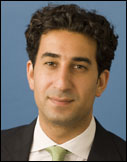
}
Source: Getty
Any successful approach toward Iran must take into account that real political power resides with Ayatollah Ali Khamenei, Supreme Leader of Iran. On C-SPAN’s Book TV, Karim Sadjadpour discussed his monograph Reading Khamenei: The World View of Iran's Most Powerful Leader, and policy implications for the United States.
Source: C-SPAN2's Book TV

A central tenet of Khamanei’s strategy, Sadjadpour explained, is to position Iran as the champion of the downtrodden and dispossessed throughout the Middle East. His writings and speeches are replete with the rhetoric of “justice.”
Sadjadpour argued that Khamenei has great ambivalence about mending Iran’s relationship with the West and the U.S. in particular. Thus far, he has straddled the line between accommodation and confrontation with the West. He refuses to compromise when Iran is pressured, since he believes this projects weakness and will invite even more pressure, but he does not seek an all out confrontation. Ultimately, Sadjadpour argued, Khamenei may desire an adversarial relationship with the U.S. to sustain the regime’s legitimacy.

Senior Fellow, Middle East Program
Karim Sadjadpour is a senior fellow at the Carnegie Endowment for International Peace, where he focuses on Iran and U.S. foreign policy toward the Middle East.
Recent Work


Suzanne Maloney, Aaron David Miller, Karim Sadjadpour

Aaron David Miller, Karim Sadjadpour, Robin Wright
Carnegie does not take institutional positions on public policy issues; the views represented herein are those of the author(s) and do not necessarily reflect the views of Carnegie, its staff, or its trustees.

Without a ceasefire with Ukraine on attacking each other’s energy infrastructure—to which the Kremlin is unlikely to agree—the diesel agreement between Putin and Trump is largely for show, rather than representing a genuine increase in the volumes of Russian diesel on the global market.

Sergey Vakulenko

Despite a new textbook, an influx of Russian teachers and managers, and an end to the teaching of Ukrainian, the Kremlin is unlikely to have “reprogrammed” locals.

Konstantin Skorkin

Cargo traffic through Russia’s Northern Sea Route has increased because of the disruption caused by the conflict in the Middle East, the Ukraine war, and U.S.-China tensions.

Mikhail Korostikov

Minsk clearly expected the dialogue with Washington to yield more results, in particular the lifting of EU sanctions and permission to export potash.

Artyom Shraibman

With the growth in points of friction between the great powers, organizations like the SCO will continue to play a role in the strategic adaptation of the smaller powers caught between them.

Temur Umarov