

Commentary
Dmitri Trenin
{
  "authors": [
    "Dmitri Trenin"
  ],
  "type": "legacyinthemedia",
  "centerAffiliationAll": "",
  "centers": [
    "Carnegie Endowment for International Peace",
    "Carnegie Russia Eurasia Center"
  ],
  "collections": [],
  "englishNewsletterAll": "",
  "nonEnglishNewsletterAll": "",
  "primaryCenter": "Carnegie Russia Eurasia Center",
  "programAffiliation": "",
  "programs": [],
  "projects": [],
  "regions": [
    "North America",
    "United States",
    "Caucasus",
    "Russia"
  ],
  "topics": [
    "Security",
    "Foreign Policy"
  ]
}
Source: Getty
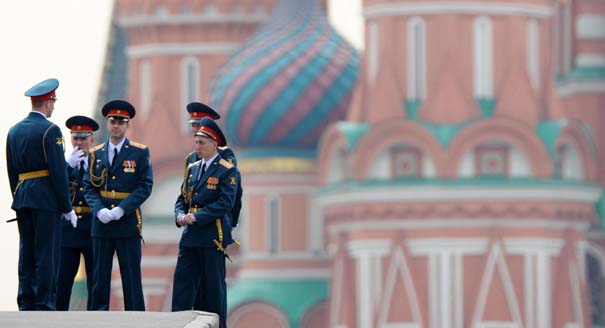
Russia's focus on America as its main adversary distorts Moscow’s strategic worldview, leads to misallocation of resources and ultimate frustration over the essential disequilibrium between the two former Cold War rivals.
Source: The Security Times

Unwilling to join the West on Western terms and unable to do so on the terms of their own, the Russian leaders have opted for what had been a default position all the time: building a bloc of post-Soviet states in Eurasia, under the Kremlin’s leadership.
In that quest for power and position, Moscow sees rivals and competitors all around but its top adversary has been the United States. In his 2007 Munich speech, Putin, having lashed out at the policies of the Bush administration, laid down conditions for mutual engagement between Russia and America. He demanded that Washington accept Russia as it is, treat it as an equal and do business with it on the basis of reciprocal interests.
In the Kremlin’s analysis, that call has been largely ignored. Rather, the United States promoted NATO’s Membership Action Plan for Ukraine and Georgia, trained and equipped Tbilisi but then failed to control it and concluded agreements with Poland and the Czech Republic on deploying U.S. missile defenses in Central Europe.
In the Kremlin’s view, the U.S. policies in Ukraine and Georgia are primarily aimed at derailing Russia’s efforts to become an independent global player. Ukraine’s proposed membership in NATO is seen as an act of hostile containment of Russia; Georgia’s military action against the Ossetians and the Russian peacekeepers was considered a U.S.-inspired test of the Putin-Medvedev leadership. Even as the Western world wondered during the Georgia war where Moscow might strike next, the Russian leadership feared that the United States could engineer another proxy conflict against Russia, to keep it in check.
Moscow fully realizes that it can only count on itself. The fact that not a single Russian ally in the Collective Security Treaty Organization (CSTO), not a single integration partner in the Eurasian Economic Community, not even the “union state” of Belarus followed Moscow’s recognition of Abkhazia and South Ossetia has weighed heavily on the Kremlin’s mind.
That China, too, stayed aloof, deepened the impact. The late-19th century maxim, attributed to Alexander III, that “Russia had only two true friends in the world, its army and its navy,” was strikingly confirmed more than a century later. Russia was not so much a power center as a lonely power.
No wonder Russia’s reliance on nuclear deterrence has continued to increase as relations with the United States sour. The conventional forces, badly neglected since Soviet days, are capable of dealing only with insurgences, such as in Chechnya, and small-scale conflicts, such as in South Ossetia. After a long break, the Russian air force has resumed air patrols in the Atlantic and the Pacific and the navy is eyeing the possibility of a permanent presence in the Mediterranean and the Indian Ocean but both remain shadows of their Soviet predecessors.
In an effort to upgrade the military’s weapons and equipment, Russia recently allocated around $100 billion – the biggest package in almost 20 years. In 2008, a plan was also approved for reforming the military itself. Yet results from these efforts will not be felt for many years.
Russia’s security strategy has been complex. At one level, Moscow seeks to dissuade Washington from what it sees as unfriendly actions by pointing out the high cost of confrontation with Russia. With the arrival of the Obama administration, the Kremlin looks forward to resuming arms control negotiations and will explore the potential of reaching an accommodation on the issues of most concern to Russia: NATO enlargement into Ukraine and Georgia; Tbilisi’s rearmament by the West; missile defenses in central Europe. In terms of carrots, Russia holds out the possibility of closer cooperation with the West on Afghanistan and Iran.
At another level, Russia relies on the major countries of continental Europe, above all Germany and France, to thwart American plans concerning Ukraine’s and Georgia’s NATO integration. In a Europe dominated by the NATO-EU duo, Moscow feels excluded and sidelined. Since coming to office in 2008, President Medvedev has been promoting the idea of a security dialogue in Europe that would ideally lead to the emergence of a new transatlantic security architecture, built around three poles: America, Europe and Russia.
At a third level, Russia is working to increase the cohesion and effectiveness of the CSTO: politically with an eye to the budding security dialogue with the West, and in actual security terms with a reference to the challenges of Islamist militancy, primarily in Central Asia. In a similar vein, Moscow has been cooperating with Beijing within the Shanghai Cooperation Organisation to bolster its own weight on the global scene vis-à-vis the West and to have a vehicle for joint action to uphold the balance in the center of the Asian continent.
The fundamental flaw of Russia’s security policy has been its obvious obsession with the United States’ power and role in the world. Viewing America as the main adversary distorts Moscow’s strategic worldview, leads to misallocation of resources and ultimate frustration over the essential disequilibrium between the two former Cold War rivals. Eventually, the Russian leaders must satisfy themselves with Schadenfreude, cheering every time America fails or gets hurt. It’s a pathetic and miserable psychological condition to be in.
Expecting the optics to change overnight would be unrealistic. The best way to deal with the situation constructively is to negotiate a new treaty on strategic arms, reach an understanding on missile defenses, give Ukraine a solid long-term European perspective but desist from the NATO option rejected by the majority of Ukrainians, create a multilateral conflict-resolution framework for the Caucasus, work on a formula of transatlantic security that includes Russia as well as Ukraine, Georgia and others in the CIS and move to practical Russian-Western security cooperation on Afghanistan and Iran.
Former Director, Carnegie Moscow Center
Trenin was director of the Carnegie Moscow Center from 2008 to early 2022.
Recent Work
Dmitri Trenin
Dmitri Trenin
Carnegie does not take institutional positions on public policy issues; the views represented herein are those of the author(s) and do not necessarily reflect the views of Carnegie, its staff, or its trustees.
In the discussions made possible by the State Duma election campaign, one question is being asked more and more loudly. “What next?”

Andrey Pertsev
While the Nazis rushed ahead in a revolutionary fervor, Russia’s modern crusaders against enemies of the state work methodically, giving their targets time to adjust to restrictions before closing the loopholes.

Leonid Bershidsky

When faced with fuel shortages in the past, Central Asian governments could always count on additional supplies from Moscow. That safety net no longer exists.

Galiya Ibragimova
Reading the purported correspondence of celebrity Ksenia Sobchak sheds light on her role within the system, and how journalism and politics function in Putin’s Russia.
Vladislav Gorin

When political power is concentrated in the hands of a small circle of people, a country invariably ends up with technological stagnation.
Aleksei Kiselev