
• Research
  • Politika
  • About
Carnegie Russia Eurasia center logoCarnegie lettermark logo
  • Donate
{
  "authors": [
    "Taiya M. Smith",
    "Douglas Rediker"
  ],
  "type": "legacyinthemedia",
  "centerAffiliationAll": "dc",
  "centers": [
    "Carnegie Endowment for International Peace"
  ],
  "collections": [],
  "englishNewsletterAll": "asia",
  "nonEnglishNewsletterAll": "",
  "primaryCenter": "Carnegie Endowment for International Peace",
  "programAffiliation": "AP",
  "programs": [
    "Asia",
    "Sustainability, Climate, and Geopolitics"
  ],
  "projects": [],
  "regions": [
    "North America",
    "United States",
    "East Asia",
    "China"
  ],
  "topics": [
    "Economy",
    "Trade",
    "Foreign Policy"
  ]
}

Source: Getty

In The Media

Who Needs a 'G-2'? Here Comes the S&ED

A tightly coordinated, well-executed S&ED may be just the format to advance the world's most important bilateral relationship.

Link Copied
By Taiya M. Smith and Douglas Rediker
Published on Jul 26, 2009

Source: Washington Note

Who Needs a 'G-2'? Here Comes the S&EDOn July 27, senior government officials from the U.S. and China will meet in Washington for the inaugural Strategic and Economic Dialogue, a.k.a. the S&ED, which is the successor to the Bush Administration's Strategic Economic Dialogue - or SED.

The meeting, at which top level delegations from the world's two most powerful nations get down to business and discuss some of the world's most pressing issues side by side - or at least across the same table, represents far more than a shift in punctuation. It is a test of whether the Obama Administration can present a unified front and demonstrate that it is serious about working together to improve and expand the U.S.'s relationship with China.

The original SED was the vision of then-Treasury Secretary Hank Paulson in 2006. Pre-dating today's calls by some for a "G-2", the SED reflected Paulson's belief that that China views strategic issues, outside Tibet and Taiwan, primarily through an economic lens.

The SED provided a single, comprehensive, high level forum at which the U.S. and China could discuss issues as disparate as the Doha round, Iran, energy policy and climate change from a similar (economic) vantage point. By getting multiple cabinet departments in the same room, it provided both governments with access to nearly every aspect of the other's policy making apparatus - each speaking with one voice.

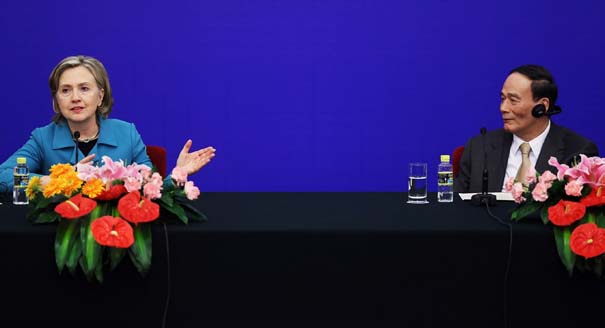
The Obama Administration has taken this precedent and made several structural modifications, the most significant of which is that while the SED was solely led by the U.S. Treasury Secretary and Chinese Vice Premier Wang Qishan, the S&ED includes both Secretary of State Hillary Clinton and the Chinese State Councilor Dai Bingguo as joint leaders of their delegations.

This shift appears to be the result of an Obama Administration compromise to avoid choosing between Secretaries Clinton and Geithner as to which would take the lead in handling our most important bilateral international relationship.

As a consequence, instead of looking at strategic issues from an economic perspective, "strategic" issues are now formally separated out from "economic" ones, thereby dividing the dialogue into two separate discussions under two distinct sets of leadership.

This division risks undermining the basic thesis of the original format - that, when dealing with China, economic issues are themselves inherently strategic. It also adds a complex and political layer of domestic coordination to the already difficult international one. With four principals speaking on economic issues rather than two, the risks of inconsistent messages and misunderstandings increase significantly.

To maximize the chance of a successful outcome from this initial S&ED, we recommend:

  1. Secretaries Geithner and Clinton should become very close friends. So should their deputies and cabinet colleagues. The U.S. needs to ensure that each speaker delivers a consistent message. In dealing with China, economic, foreign policy and other issues are often indistinguishable from one another. There cannot be any discord between senior members of the delegation. Further, participating U.S. Cabinet departments should consider how their individual agency agendas can contribute to the success of the broader dialogue.
     
  2. Ensure the right people are at the table. Each side should have Cabinet level participants and other key players in attendance and ready to deal with their individual counterparts. The U.S. team should understand who plays what role from the Chinese government side and foster the right bilateral relationships from the outset. On climate change, for example, an issue which spans multiple agencies, the two sides should ensure that their top climate change officials are present and actively participating in the conversation, regardless of whether they are from similar agencies or ministries.
     
  3. Listen to what's being said. Many Americans find it difficult to listen to formal Chinese presentations. Yet, these speeches represent the messages that China wants to send. Our delegation must listen carefully and make sure that they fully understand what is being said. Instead of furtive bathroom breaks and phone calls, they should ask questions and demonstrate engagement.

Lack of coordination, consistency or other missteps at the S&ED will not end the U.S.-China relationship. The SED built a strong foundation and there are numerous other dialogues and forums through which China and the U.S. can meet and discuss important issues. But, the potential undermining of this one harmonized meeting would be a setback to how effectively that relationship can be managed.

At some point down the road someone may seek to redefine the relationship and call it the "G-2". In the meantime, a tightly coordinated, well-executed S&ED may be just the format to advance the world's most important bilateral relationship.

About the Authors

Taiya M. Smith

Former Senior Associate, Energy and Climate Program, Asia Program

Smith has spent the last decade working in international negotiations. Most recently, she served as a member of Secretary Hank Paulson’s senior management team from 2006 to 2009 as the deputy chief of staff and executive secretary for the U.S. Department of the Treasury.

Douglas Rediker

Authors

Taiya M. Smith
Former Senior Associate, Energy and Climate Program, Asia Program
Taiya M. Smith
Douglas Rediker
EconomyTradeForeign PolicyNorth AmericaUnited StatesEast AsiaChina

Carnegie does not take institutional positions on public policy issues; the views represented herein are those of the author(s) and do not necessarily reflect the views of Carnegie, its staff, or its trustees.

More Work from Carnegie Russia Eurasia Center

  • Paper
    A Tight Spot: Challenges Facing the Russian Oil Sector Through 2035

    Russian oil production is remarkably resilient to significant price changes, but significant political headwinds may lead to a drop regardless of economics.

      • Sergey Vakulenko

      Sergey Vakulenko

  • Commentary
    Carnegie Politika
    Why Has Kazakhstan Started Deporting Political Activists?

    The current U.S. indifference to human rights means Astana no longer has any incentive to refuse extradition requests from its authoritarian neighbors—including Russia.

      Temur Umarov

  • Commentary
    Carnegie Politika
    Why Are China and Russia Not Rushing to Help Iran?

    Most of Moscow’s military resources are tied up in Ukraine, while Beijing’s foreign policy prioritizes economic ties and avoids direct conflict.   

      • Alexander Gabuev

      Alexander Gabuev, Temur Umarov

  • Commentary
    Carnegie Politika
    Georgia’s Fall From U.S. Favor Heralds South Caucasus Realignment

    With the White House only interested in economic dealmaking, Georgia finds itself eclipsed by what Armenia and Azerbaijan can offer.

      Bashir Kitachaev

  • Commentary
    Carnegie Politika
    What Does War in the Middle East Mean for Russia–Iran Ties?

    If the regime in Tehran survives, it could be obliged to hand Moscow significant political influence in exchange for supplies of weapons and humanitarian aid.

      Nikita Smagin

Get more news and analysis from
Carnegie Russia Eurasia Center
Carnegie Russia Eurasia logo, white
  • Research
  • Politika
  • About
  • Experts
  • Events
  • Contact
  • Privacy
Get more news and analysis from
Carnegie Russia Eurasia Center
© 2026 Carnegie Endowment for International Peace. All rights reserved.








