

Paper
George Perkovich
{
  "authors": [
    "George Perkovich"
  ],
  "type": "legacyinthemedia",
  "centerAffiliationAll": "dc",
  "centers": [
    "Carnegie Endowment for International Peace",
    "Carnegie Russia Eurasia Center"
  ],
  "collections": [
    "U.S. Nuclear Policy"
  ],
  "englishNewsletterAll": "ctw",
  "nonEnglishNewsletterAll": "",
  "primaryCenter": "Carnegie Endowment for International Peace",
  "programAffiliation": "NPP",
  "programs": [
    "Nuclear Policy"
  ],
  "projects": [],
  "regions": [
    "North America",
    "United States",
    "Caucasus",
    "Russia"
  ],
  "topics": [
    "Nuclear Policy"
  ]
}
Source: Getty
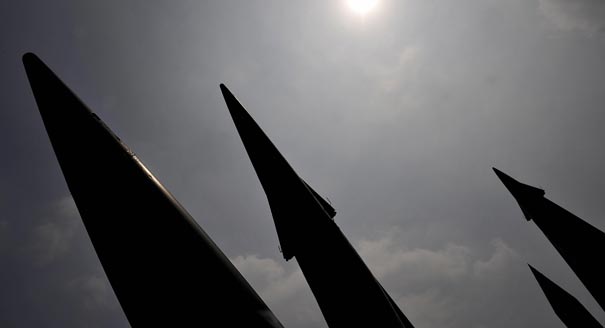
Nuclear-weapon states should commission their defense ministries and think tanks to perform serious analysis on the practical steps of moving towards zero nuclear weapons.
Source: Security Index Journal

Is it really true that Soviet leaders were determined to go to war with the United States but were deterred by the existence of nuclear weapons? At what time and place were Soviet leaders willing to go to war against NATO states but chose not to do so because of nuclear counter threats? What specific evidence shows this? There were cases, such as Vietnam and Afghanistan, where the U.S. and the U.S.S.R intervened militarily in other states. Would these interventions have happened if Washington or Moscow did not believe that nuclear deterrence would keep the other side from escalating? By making escalation to homeland attacks unthinkable, did intra-war nuclear deterrence prolong these wars and the damage they did? Is it possible that nuclear deterrence allowed more killing than it prevented during the Cold War? Even if objective scholars conclude that nuclear deterrence did directly prevent war and did not enable low-intensity conflicts in the Third World, the future effectiveness of nuclear deterrence remains unknowable.
This article was published by the Security Index Journal of the PIR Center, the Russian Center for Policy Studies, http://www.pircenter.org. It is a product of the joint PIR and NTI project "Ways towards Nuclear Disarmament."

Japan Chair for a World Without Nuclear Weapons, Senior Fellow
George Perkovich is the Japan Chair for a World Without Nuclear Weapons and a senior fellow in the Carnegie Endowment for International Peace’s Nuclear Policy Program. He works primarily on nuclear deterrence, nonproliferation, and disarmament issues.
Recent Work
George Perkovich
George Perkovich
Carnegie does not take institutional positions on public policy issues; the views represented herein are those of the author(s) and do not necessarily reflect the views of Carnegie, its staff, or its trustees.

Japan’s long-term security policy is driven by concerns about China, and there is little appetite for (or interest in) pursuing a confrontation with Moscow.

James D.J. Brown
The truth of the strategic situation is that Europe and Russia are extremely unlikely to be able to “turn the page” on their confrontation within the next two decades.
Arkady Moshes

Russia spent years building a “sovereign internet,” concentrating web infrastructure exclusively within Russian territory. Ukrainian drone attacks have shown how vulnerable that approach has left the Russian internet.

Maria Kolomychenko

Putin’s conservative staffing policies and search for ever greater control have cemented parliament’s transformation into a bureaucratic appendage of the executive branch.

Andrey Pertsev

Russia’s AI-driven propaganda campaigns operate in a fragmented, chaotic, and often illogical manner. That’s not necessarily a problem for the Kremlin, though: It’s much easier to mimic genuine public debate that way.

Ilya Klishin