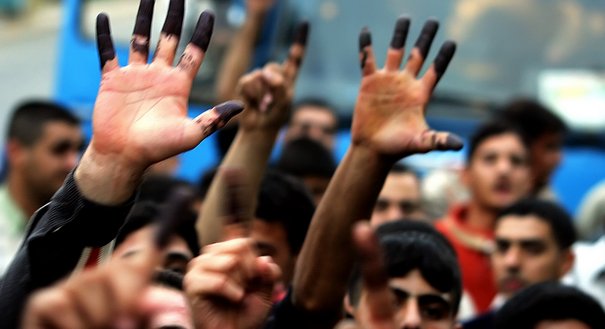
A fragile agreement on Iraq’s new election law has fallen apart over the apportionment of parliamentary seats among the provinces, casting doubt that the country’s upcoming parliamentary elections will be held by the January 31, 2010 deadline.
Source: Analysis of the 2010 Iraqi Parliamentary Elections
Election Law, Take TwoA fragile agreement on Iraq’s new election law has fallen apart, casting doubt that the country’s upcoming parliamentary elections will be held by the January 31, 2010 deadline. The battle lines remain drawn along an openly sectarian divide, pitting Sunnis, who oppose the new law and seek more representation, against Kurds and Shia's. Disagreement now centers on how the parliamentary seats are apportioned among Iraq’s provinces, not on the fate of the disputed city of Kirkuk.
Key questions remain on whether minorities and Iraqis residing abroad should have special seats, and how many compensatory seats will be awarded to political parties that did not get enough votes to win a seat at the provincial level but received enough votes nationally to gain one or more representatives.
On November 18, the Council of Representatives approved the new election law, which calls for the election of one representative for every 100,000 Iraqi citizens—equivalent to 323 seats in total. Ninety-five percent of the seats would be distributed to the provinces on the basis of population size. The remaining 5 percent (or 16 seats) would be divided in equal shares between minorities on one side and a combination of voters outside the country and compensatory seats on the other. The apportioning of minority seats was painstakingly defined, with five reserved for Christians (one seat each in Baghdad, Niniveh, Kirkuk, Dahuk, and Erbil) and one each going to Yazidis (Niniveh), Saibis (Baghdad), and Shabakis (Niniveh).
The law did not, however, decide how many seats each province would get, and one seat per 100,000 inhabitants doesn’t mean much in a country that has no voter registration process and has not had a census since the 1950s.
The Iraqi High Election Commission (IHEC) was left to solve the problem. On November 11, it provided an answer, calculated on the basis of the population figures used in the 2005 election, modified by the presumed population growth of each province in the intervening years, and by an effort to compensate for mistakes in the earlier population estimates.
With a long Shi'i religious celebration starting in late January and continuing until February 10, the earliest elections could now be held is the second half of February, and even that would be difficult to accomplish.
The highly controversial results increased seats in Niniveh province (where the population had supposedly been undercounted in 2005) by 63 percent, while giving no increase at all to Suleimaniya (where the population had supposedly been overestimated). Other provinces fell between the extremes. In general, Sunni provinces fared very well in the reapportionment, while Kurdish provinces did poorly.
Although the distribution of seats was highly favorable to Sunnis, the law was vetoed by Vice President Tareq al-Hashemi, one of the three members of the presidential council, himself a Sunni, on the grounds that it reserved too few compensatory seats, and too little representation for minorities and exiles. Rather than five percent of the seats, Hashemi argued, the law should have set aside 15 percent. Hashemi apparently assumed that most Iraqi refugees and exiles were Sunnis, and their vote would bolster the Sunni presence in parliament.
Hashemi got the opposite of what he wanted. On November 23, the Council of Representatives voted for an amended version of the law that made the situation worse for Sunnis. The measure was approved with only 151 of 275 lawmakers present, after Sunni members walked out in protest, and Hashemi is now threatening to veto the amended law as well. If that happens, the Council of Representatives will probably not be able to muster the two-thirds majority required to override the veto.
Rather than letting the IHEC decide how seats will be distributed among provinces, the amended law establishes that the number of seats received by each province will be calculated using the 2005 population figures as a baseline and assuming that all provinces have grown by 2.8 percent each year. The deal delivers a blow to Sunni provinces that benefited from the IHEC reapportionment and a boon to the Kurds, who received hardly any additional seats under the previous proposal.
The battle over the election law is not over and it could have extremely serious repercussions.
And far from increasing the number of seats reserved for exiles, the amended law eliminates them altogether, establishing that exiles will be considered to be voters in their provinces of origin and their votes will be counted as such. The number of special seats remains unchanged at 5 percent.
The battle over the election law is not over and it could have extremely serious repercussions. It has already hardened confessional and ethnic divisions throughout the country. Sunnis are entering the election process feeling aggrieved and angry—not a propitious beginning.
Furthermore, the absence of a law has again put election preparations on hold. With a long Shi'a religious celebration starting in late January and continuing until February 10, the earliest elections could now be held is the second half of February, and even that would be difficult to accomplish.
Iraq’s current parliamentary term expires on March 15, and the constitution stipulates that elections must be held at least 45 days before that date, meaning that Iraq will certainly be in violation of the constitution. And if elections cannot be held before March 15—both the speaker of the Council of Representatives and the minister of interior doubt they can—Iraq will face a full-blown crisis, with a parliament whose term has expired and a government lacking the legitimacy of parliamentary approval.
Before joining the Endowment, Ottaway carried out research in Africa and in the Middle East for many years and taught at the University of Addis Ababa, the University of Zambia, the American University in Cairo, and the University of the Witwatersrand in South Africa.
Carnegie does not take institutional positions on public policy issues; the views represented herein are those of the author(s) and do not necessarily reflect the views of Carnegie, its staff, or its trustees.
Without a ceasefire with Ukraine on attacking each other’s energy infrastructure—to which the Kremlin is unlikely to agree—the diesel agreement between Putin and Trump is largely for show, rather than representing a genuine increase in the volumes of Russian diesel on the global market.
Ex-president Gurbanguly Berdimuhamedov remains interested in politics, but his son Serdar, Turkmenistan’s current president, is becoming increasingly independent and willing to break with his father’s legacy. If their covert rivalry goes too far, both risk losing power.
Despite a new textbook, an influx of Russian teachers and managers, and an end to the teaching of Ukrainian, the Kremlin is unlikely to have “reprogrammed” locals.
Cargo traffic through Russia’s Northern Sea Route has increased because of the disruption caused by the conflict in the Middle East, the Ukraine war, and U.S.-China tensions.
Sergei Kiriyenko used Russia’s parliamentary vote to further hone his strategy of corporate mobilization that is designed to maximize votes for United Russia.