If Iraq can overcome the many risks and challenges that lie ahead of it and emerge as a stable democratic nation, it could become an engine for change in the Arab and Muslim world.
What If Iraq Succeeds?The recent parliamentary elections in Iraq raise the possibility that Iraq might be on the long and difficult road towards stability. The road will not be without risk or setbacks, and Iraq might lose its way and descend into civil war or dismemberment; but if recent trends continue, Iraq might make it, within five to ten years, as a stable, prosperous, influential and semi-democratic state in the heart of the Arab and Muslim world. Such a development would be a historic event in the Middle East and would have a transformative effect.
Iraq is not a small or marginal country. With a population of 30 million, the world’s second largest oil reserves, a geo-strategic position between Turkey, Iran and the Arab world and on the banks of the Gulf, and impeccable Arab and Muslim credentials, the future of Iraq has a great impact on the Arab and Muslim world.
In terms of governance, the Arab world has been stuck in various forms of authoritarianism for decades. The current models are either ageing republican police states or religious conservative monarchies. Internal calls for reform have fallen on deaf ears, and external pressure for change has been met with accusations of interference.
Arab regimes have a strong hold on their societies and enjoy supportive international alliances. They have been able to convince their populations that examples of democracy in other large Muslim countries like Turkey, Malaysia, Indonesia, and Pakistan are not relevant, and that democracy in the West or other parts of the world is alien.
But a democratic Iraq—even a troubled and imperfect one—would be a different matter. It would be an example, in the heart of the Arab and Muslim world—including Sunnis and Shiites, Arabs and Non-Arabs—that participatory government, although often messy and imperfect, is possible in our part of the world.
To Egyptians it sends a message that real elections with decisive outcomes are possible, even in large Arab countries. If elections can be held in Iraq, which has ten times Egypt’s security problems and divisions, then surely they can be held in Egypt, where there is a strong and sovereign state and a high level of national unity. It also sends a message to political parties that although religious and sectarian parties do well initially, in the long run secular and non-religious parties can regain momentum in national politics. Regarding religious or ethnic minorities, it shows that while majorities have a leading role in government they cannot exclude minorities from real participation, under the false pretence of security and national unity.
Syria has been gloating over its return to regional influence, regaining much influence over Lebanon, and being courted by Saudi Arabia, Europe and the US. However, Damascus has much to consider if its once authoritarian Baath neighbour develops into a powerful semi-democratic state in which parties from various communities and ideological colours compete for and share political power in an open society.
The GCC countries have made steps toward increased participation in the last decade but if Iraq succeeds, they will be pressed by their populations to move further and quicker along the path of political freedoms and participation.
Even Lebanon has important lessons to learn. The confessional oligarchy in Lebanon has maintained a majoritarian electoral system in which every sectarian party can ensure full control over its community, whether Sunni or Shiite, Christian or Muslim. The proportional electoral system in Iraq breaks sectarian monopolies and allows various parties to compete for power within, and across, sectarian and ethnic lines. The Lebanese parliament today is debating whether to introduce proportional representation to municipal elections, and later to parliamentary elections; the zaims1 know that proportional representation will break their sectarian monopolies and make it difficult to turn every political issue into a sectarian one. Iraq has shown that proportional representation is Lebanon’s only hope for breaking the absolute hold of sectarianism on politics.
Iraq is decisive for Iran as well. The government responded to the recent election protests there with violence and repression. It argued that Wilayat al Faqih could not be questioned, and implied that Shiite politics had no alternative to what Imam Khomeini had proposed. To its south, a country with stronger religious credentials and a ruling Shiite majority, is showing the Iranian people that a political and cultural alternative exists.
This will also have an impact on Shiite politics in the rest of the Arab world. Iran has been the center of Shiite aspirations since 1979; and Hizbullah has been the prime example of Shiite empowerment. Already Najaf competes with Qom for religious primacy; soon Baghdad will also be able to compete with Tehran for political influence. Iraq is showing that Shiite empowerment in the 21st century can be achieved without religious totalitarianism, without radical militarization, can embrace both religious and secular forms and can be achieved within the context of pluralistic democratic politics.
The rise of the new Iraq will also have an impact on regional order. For most of the 20th century Baghdad was a key pillar in a narrowly defined Arab order which viewed Turkey and Iran as enemies and outsiders. Saddam Hussein waged an eight year war against Iran and abused Arabism to oppress the Kurds and accuse the Shiites of disloyalty. Despite some rivalry with Iran, the new Iraq will be a close friend of Iran as it will also seek close relations with Turkey, Syria, and its GCC neighbours. Iraq will be the fulcrum of a new regional order in the eastern part of the Middle East in which the interests of Turkey, Iran, Iraq, Syria and the GCC intertwine.
As a rising oil power, Iraq will also be the fulcrum of a new web of economic relations. This will include important oil and gas pipelines running from Iraq to Syria and Turkey. It will also mean a stream of investments and business opportunities in a reconstructing Iraq.
If Iraq succeeds in surviving the many risks and challenges that lie in its long path forward, it could well emerge as the engine for change in the Arab and Muslim world. Although many rulers do not welcome this change, I know that many of us are eagerly awaiting it.
1 Traditional political leaders, often from large feudal families.
Carnegie does not take institutional positions on public policy issues; the views represented herein are those of the author(s) and do not necessarily reflect the views of Carnegie, its staff, or its trustees.
The return of parliamentary politics reflects a broader shift from earlier expectations of a settlement and elections toward the reality of a prolonged war.
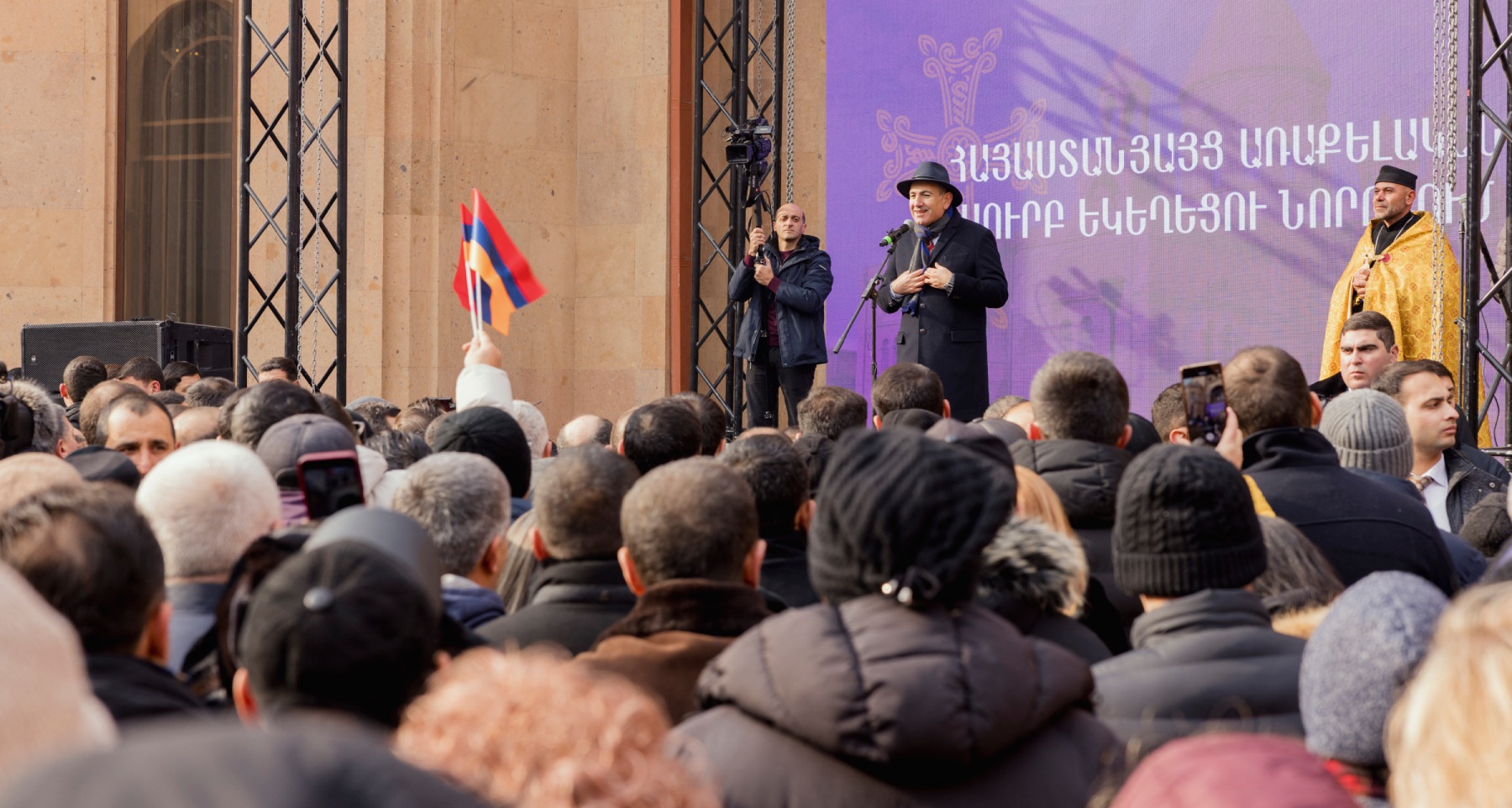
It’s true that many Armenians would vote for anyone just to be rid of Pashinyan, whom they blame for the loss of Nagorno-Karabakh, but the pro-Russia opposition is unlikely to be able to channel that frustration into an electoral victory.
The front-runner to succeed Ilia II, Metropolitan Shio, is prone to harsh anti-Western rhetoric and frequent criticism of “liberal ideologies” that he claims threaten the Georgian state. This raises fears that under his leadership the Georgian Orthodox Church will lose its unifying role and become an instrument of ultraconservative ideology.