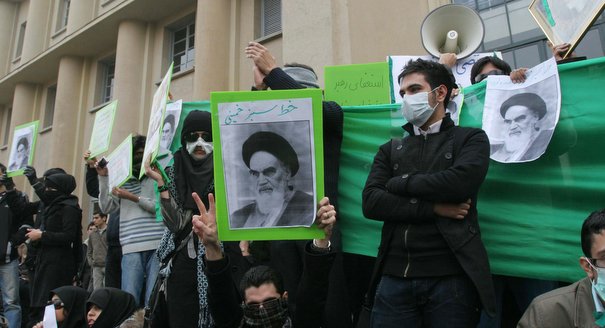
The leadership of the Green Movement recognizes that they will not be able to succeed without the support of these economic arteries, but they could be doing a better job reaching out to them. In American politics, it's often said that candidates campaign in poetry and govern in prose. The Green Movement leadership, I would argue, has perhaps focused too much on the poetry of opposition and not enough on the prose of it. Meaning, there have been platitudinal calls for political and religious justice, but not enough organization and strategy. Street protests are not a reliable strategy; they accentuate the movement's weakness and the government's strengths.
Gwertzman: If you're a worker in Iran, what is the economic situation like now?
Sadjadpour: Given Iran's very high rates of inflation, workers are having difficulties making ends meet. On almost a weekly basis, I read reports of workers in various industries and in various parts of the country striking to protest unpaid wages. But Iran's labor movements are just as amorphous as the Green Movement itself, so their collective discontent is not easy to harness politically.
I do think the leadership of the Green Movement needs to better articulate to Iranian workers, in very clear language, why they would be better off in a Green Iran. The leadership of the Green Movement needs more technocrats who can talk about how the Iranian economy is being mismanaged and how to fix it, and fewer intellectuals who spend their time rehashing religious and philosophical debates from centuries ago.
Gwertzman: Now, tell me the status of economic subsidies in Iran. Has the Ahmadinejad government passed a law to end these subsidies?
Sadjadpour: President Mahmoud Ahmadinejad has strongly advocated removing $40 billion of the approximately $90 billion spent on annual subsidies. The parliament has resisted, fearing that [it] would dramatically increase living costs [and] spark rampant inflation and potentially more popular unrest. From Ahmadinejad's vantage point, instead of blanket subsidies which defray the cost of living for all Iranians--including the upper and middle class urban sophisticates who oppose him--he'd prefer to offer direct cash handouts to curry political favor with his own constituents. The parliament is concerned that the government does not have the organizational ability or knowledge to precisely dole out these subsidies to people that need it the most.
Gwertzman: What are these subsidies, really?
Sadjadpour: The subsidies are on everyday items such as foodstuffs (cooking oil, rice, and bread), heating oil, and petrol. I believe it's still cheaper to buy a liter of gasoline in Tehran than a liter of bottled water. Removing the subsidies is not a new debate in Iran. Successive governments have long recognized the need to phase them out, but it's an incredibly sensitive political issue. Given that people are still reeling from last year's elections, some Iranian officials, including conservatives, fear that removing these subsidies could douse gasoline on the fires under the ashes.
Gwertzman: How would you describe the current Iranian government?
Sadjadpour: In the aftermath of the elections, any lingering moderates were purged from the system. Power is increasingly wielded by an unholy trinity of nouveau riche Revolutionary Guards, hardline clergymen, and indoctrinated Basij militants. The balance of power between the clergy and the Revolutionary Guards has dramatically tilted toward the latter. I would still make the argument that the supreme leader Ayatollah Khamenei remains at the apex of the power pyramid in Iran, but he's certainly ceded enormous influence to the Revolutionary Guards in order to maintain control. The worldview of Iran's hardliners is very Machiavellian in that they would rather be feared than liked by the population. Their foreign policy worldview, especially toward the United States, is guided by two overarching instincts: mistrust and defiance.
Gwertzman: At the same time, in recent months the Iranians have been seeking to win friends in the developing world. How did the nuclear accord with Brazil and Turkey come about?
Sadjadpour: The Turkish-Brazilian offer was a win-win for Tehran. It didn't require them to make any major nuclear compromises, and at the same time they believed it could undermine the developing consensus against them at the UN Security Council and scuttle any sanctions resolution. They didn't anticipate the fact that China and Russia were not pleased about getting upstaged by Turkey and Brazil and moved forward with the sanctions resolution anyway. Nonetheless, the fact that Turkey and Brazil voted against the UN resolution was a small victory for Iran and a small defeat for the United States. Still, despite all the efforts Iran has made in courting the non-aligned, developing, and Islamic worlds, their only consistent allies who support them in international fora are Venezuela, Syria, Belarus, and Cuba.
Gwertzman: After the demonstrations started last June, the American government seemed to not want to get too involved for fear that Iranians would blame the demonstrations on the United States. The Iranians blamed the United States anyway. What should the U.S. policy be right now for Iran?
Sadjadpour: The irony of Obama's engagement approach toward Iran is that it failed to do what it intended, which was to moderate Tehran's nuclear ambitions, but it succeeded where it hadn't intended, which was to catalyze Iran's democracy movement. I've said this many times before, but I truly believe that whereas the Bush administration's hardline approach unintentionally united Iran's competing political factions against a common threat, Obama's engagement approach widened Iran's existing internal divides, both among political elites and between the population and the regime.
Today, the Obama administration's Iran policy faces a few major challenges. First, how do you go about reaching a modus vivendi with a hardline regime in Tehran which seemingly needs the U.S. as its adversary? Second, what's the best way to go about engaging the regime without demoralizing the opposition? Third, what's the best way to champion the cause of the opposition without tainting its independence?
We faced somewhat similar challenges during the latter years of the Cold War, and U.S. policy toward the Soviet Union in the 1980s can be an instructive model. In addition to the fact that it's certainly not a superpower, Iran policy is somewhat different in that it's not yet a nuclear power, and we're still feverishly focused on preventing that possibility, rather than thinking about how to expedite political transformation in Tehran.
Obama inherited a very difficult situation. For the last seven years, every politician in America, including Obama himself, has said a nuclear-armed Iran is unacceptable. Engagement failed to moderate Iran's nuclear drive, and if they're really intent on moving forward, sanctions can slow them down but not stop them. If you don't want to use military force--which the administration surely doesn't--then you're forced to gradually morph into a containment policy of sorts. But how do you articulate a containment policy politically, after the American public has for seven years been hearing that a nuclear-armed Iran is unacceptable? I think Iran actually poses more of a political challenge than a military challenge.
Gwertzman: Do you think Iran intends to build a nuclear weapon?
Sadjadpour: Before last year's presidential election in Tehran, the conventional wisdom was that Iran was in pursuit of the Japan model; it wanted to be a screwdriver-turn away from weaponizing its program. There is increasing concern that given the purge of pragmatic elements from the Iranian government's decision-making structure, there are now many hardliners who are more intrigued by the example of Pakistan than that of Japan. They believe that when Pakistan tested a weapon there was international outrage for a week, followed by a rush to engage Pakistan and incentivize it not to use its weapon. The world was so terrified about the prospect of a nuclear war between India and Pakistan that it became a successful policy of extortion by the Pakistani government. At least some Iranian hardliners similarly believe that, paradoxically, the pressure against them would be alleviated if they actually cross the nuclear weapons threshold.
Despite the international obsession about the danger of Iran's nuclear ambitions, I sometimes think we may look back years from now and see that the nuclear program was for the Islamic Republic what the invasion of Afghanistan was for the Soviet Union: an enormous money pit which bled the country financially, without any tangible political and economic gains.