

Commentary
James D.J. Brown
{
  "authors": [
    "James D.J. Brown"
  ],
  "type": "commentary",
  "blog": "Carnegie Politika",
  "centerAffiliationAll": "",
  "centers": [
    "Carnegie Endowment for International Peace",
    "Carnegie Russia Eurasia Center"
  ],
  "englishNewsletterAll": "",
  "nonEnglishNewsletterAll": "",
  "primaryCenter": "Carnegie Russia Eurasia Center",
  "programAffiliation": "",
  "regions": [
    "East Asia",
    "Russia",
    "Japan"
  ],
  "topics": [
    "Nuclear Policy",
    "Global Governance",
    "Security"
  ]
}
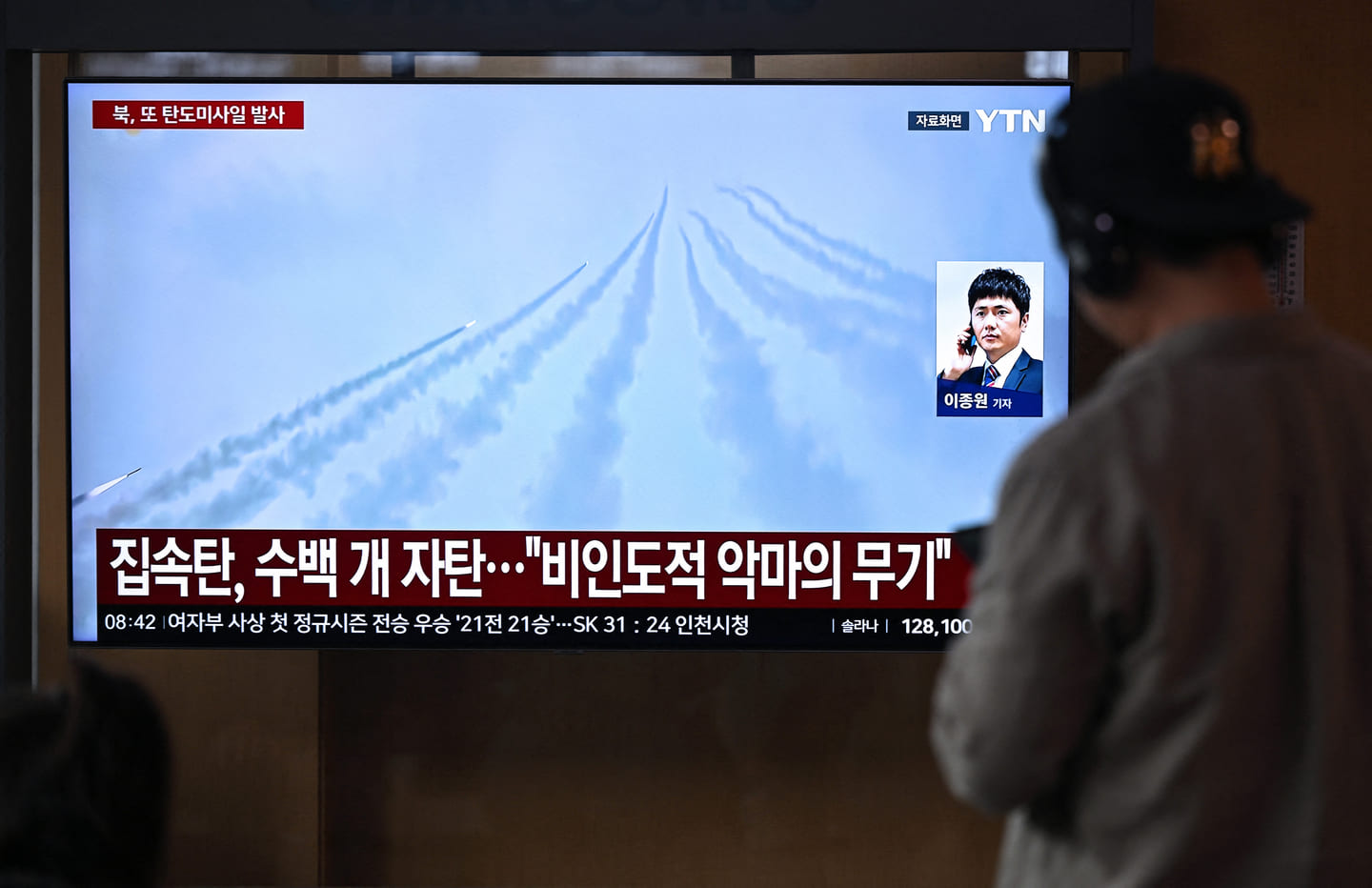
Source: Getty Images
Troubled by the growing salience of nuclear debates in East Asia, Moscow has responded in its usual way: with condemnation and threats. But by exacerbating insecurity, Russia is forcing South Korea and Japan to consider radical security options.
In December 2025, Japanese media reported that a senior government official close to Prime Minister Takaichi Sanae had told journalists that Japan should have nuclear weapons. Given Japan’s status as the only country to have been the victim of nuclear attacks during warfare, this sent shockwaves throughout Japanese society. The initially anonymous official was revealed to be Oue Sadamasa, special advisor to the prime minister on national security and nuclear nonproliferation issues.
South Korea has recently seen even more pronounced discussion of nuclear weapons. In 2023, then president Yoon Suk-yeol argued that South Korea may need to “introduce tactical nuclear weapons or build them on our own.” His successor, Lee Jae-myung, has struck a more cautious tone, yet Korean society remains in favor. A 2025 opinion poll by the Asan Institute found that a record 76.2 percent of South Korean respondents support acquiring indigenous nuclear weapons.
What is driving interest in this previously taboo topic? What are the prospects of Japan and South Korea actually going nuclear? And what would this mean for Russia?
Bilateral alliances with the United States have long been the cornerstone of security for both Japan and South Korea. This remains true today. Yet Washington’s security guarantee is not what it once was. U.S. military power has declined relative to China’s. Moreover, President Donald Trump’s disregard for alliances—as seen in his threat to withdraw from NATO—has raised concerns about U.S. abandonment.
China has exacerbated this insecurity by expanding its military, including nuclear capabilities. The U.S. Defense Department estimates that China now has more than 600 operational nuclear warheads and is on track to exceed 1,000 by 2030. Added to this, Beijing frequently exerts diplomatic and economic pressure on its East Asian neighbors. Japan has been the most recent target. After Prime Minister Takaichi said in November that a crisis over Taiwan could require the deployment of Japan’s Self-Defense Forces, Chinese officials responded with hostile language, export restrictions, and reductions in Chinese tourism.
Russia has also been responsible for undermining regional security. Its full-scale invasion of Ukraine in 2022 demonstrated that nuclear-weapons states can attack non-nuclear-armed neighbors and use the threat of nuclear escalation to prevent intervention by third countries.
The alarm that this caused quickly reached East Asia. Just days after the start of Russia’s invasion, former prime minister Abe Shinzo stated that Japan should consider “nuclear sharing,” referring to the NATO program under which European countries host U.S. nuclear weapons. Public opinion surveys conducted in South Korea after February 2022 also showed marked increases in support for nuclear weapons.
Just as importantly, Russia’s increasingly close relationship with North Korea—embodied in the 2024 Comprehensive Strategic Partnership Treaty—has seriously shaken regional security. Tokyo and Seoul are fearful of what technical assistance Russia may be providing to Pyongyang. These worries became more pronounced in April when the International Atomic Energy Agency (IAEA) observed “a very serious increase in the capabilities of the DPRK [Democratic People’s Republic of Korea] in the area of nuclear weapons production.”
Japan and South Korea are also concerned that Russian support has emboldened Pyongyang. In 2024, North Korean leader Kim Jong Un called for the constitution to be revised to designate South Korea as the “primary foe.” He also stated, “We need to swiftly … mobilize all physical means, including nuclear force, in a bid to accelerate preparations for the great event of putting the entire territory of South Korea under our control.”
No one should be surprised that, facing this acute insecurity, Japanese and South Korean thoughts are turning to the ultimate deterrent. However, the pathway to the bomb is not straightforward.
In Japan’s case, the main obstacles are not technical or even legal. As noted by the Nuclear Threat Initiative, Japan “is the only non-nuclear-weapons state in possession of a full nuclear fuel cycle and has advanced WMD-relevant industries.” Japan possesses approximately 48 tons of reprocessed reactor-grade plutonium, which could be further purified into weapons-grade and is sufficient to produce thousands of nuclear weapons.
These capabilities are part of Japan’s strategy of nuclear hedging, meaning maintaining the ability to develop nuclear weapons quickly, yet currently choosing not to do so. This has quietly been the policy of Japanese governments since at least 1957, when the cabinet of Prime Minister Kishi Nobusuke adopted the position that nuclear weapons would not necessarily be inconsistent with Japan’s pacifist constitution if limited to the minimum necessary for self-defense.
A bigger barrier is public opinion. While much of the Japanese elite is open to nuclear options, the public remains opposed. A survey by the Yomiuri Shimbun newspaper and the Japan Institute of International Affairs in early 2026 found that 79 percent of respondents supported the principle that Japan shall not possess nuclear weapons. Japan also features several well-organized anti-nuclear groups, including Nihon Hidankyo, which won the 2024 Nobel Peace Prize.
The obstacles for South Korea are different. While the public is supportive, there are greater technical challenges, since the country does not yet have operational enrichment capabilities. South Korea does, however, have considerable nuclear expertise thanks to its advanced civilian nuclear sector. Seoul also pursued a clandestine nuclear weapons program until 1975 when it ratified the Nuclear Non-Proliferation Treaty (NPT). Even after that weapons program was abandoned, South Korea continued undeclared enrichment experiments, prompting criticism from the IAEA in 2004.
South Korea would also face international condemnation if it withdrew from the NPT or pursued nuclear weapons in violation of its provisions. This could result in sanctions, including the suspension of the supplies of nuclear fuel upon which Korea’s nuclear sector relies. Between 2020 and 2024, 32 percent of this enriched uranium was imported from Russia, while 38 percent came from France.
Traditionally, the United States could be relied upon to oppose proliferation to its East Asian allies. However, this assumption is now open to question.
In 2016, Donald Trump was asked by CNN, “You’re ready to let Japan and South Korea become nuclear powers?” He answered, “I am prepared to, if they’re not going to take care of us properly, we cannot afford to be the military and police for the world.”
This view is shared by Elbridge Colby, the current under secretary for defense policy in the U.S. Defense Department. In 2024, Colby told the South Korean news agency Yonhap that “all options” should be on the table, including South Korea’s independent nuclear armament. He added that Washington should not support sanctions against Seoul if it were to develop its own nuclear weapons.
Further concerns were raised in November 2025 when the White House announced its support for “the process that will lead to the ROK’s [Republic of Korea’s] civil uranium enrichment and spent fuel reprocessing.” Although the Trump administration stressed that this would be “for peaceful uses,” this step reverses decades of U.S. opposition to the spread of enrichment and reprocessing capabilities.
The Trump administration has also given its approval for South Korea to build nuclear-powered submarines. Although these will supposedly be conventionally armed submarines, it is notable that nuclear propulsion is precisely the technology a country would want if it had the intention of developing a submarine-based nuclear deterrent, like that operated by the United Kingdom.
All this raises the possibility of “friendly proliferation,” under which the United States would encourage nuclear proliferation to South Korea and Japan to strengthen deterrence against North Korea and China.
It remains far from certain that South Korea or Japan will develop nuclear weapons. Yet the probability has clearly increased, and nuclear strategists must plan for all scenarios.
For Russia, South Korea or Japan’s development of independent nuclear weapons would be a historic setback. First, it could be a potentially fatal blow to the nonproliferation regime and could result in a further cascade of nuclear acquisition. That would substantially erode Russia’s special status as a nuclear-weapons state. This is of particular concern to Moscow since, unlike the United States and China, Russia’s claim to superpower status rests exclusively on its nuclear arsenal.
Second, the emergence of further autonomous nuclear-weapons states, especially those regarded as “unfriendly” by Moscow, would greatly complicate Russia’s nuclear planning. So long as South Korea and Japan remain under the U.S. nuclear umbrella, Moscow need only consider how policy actors in Washington will respond to nuclear scenarios involving Western allies in East Asia. Deterrence calculations would be greatly complicated if two further actors, with their own strategic cultures and perceptions of national interest, were added.
Third, proliferation to South Korea and Japan would place an enormous additional burden on Russian armed forces in the Far East. To mention just a few factors, if we assume South Korea and Japan’s nuclear deterrent would be submarine-based, Russia would need to significantly expand its anti-submarine warfare capabilities to track and hold at risk additional fleets of ballistic-missile submarines.
Intelligence, surveillance, and reconnaissance (ISR) capabilities would also need to be meaningfully increased to reflect South Korea and Japan’s upgrade from followers of the United States to independent, nuclear-armed actors. Such an additional commitment of resources would be difficult at any time, but would be next to impossible for Russia in the short to medium term given the stresses that the Ukraine war has placed on its military.
Troubled by the growing salience of nuclear debates in East Asia, Moscow has responded in its usual way: with condemnation and threats. In April, presidential aide Nikolai Patrushev alleged that Japan was returning to its militarist past, saying “After eighty-five years, [Japan] is once again becoming an aggressive military-political player.”
Russia has also regularly dispatched nuclear-capable aircraft to conduct flights in regional airspace. On March 17, MiG-31 fighter jets armed with dual-capable Kinzhal hypersonic missiles flew over the Sea of Japan.
The purpose is to demonstrate the danger that Russia can pose to South Korea and Japan, thus deterring them from steps that Moscow opposes. The result is the exact opposite. By exacerbating their insecurity, Russia is forcing Seoul and Tokyo to consider radical security options.
There is an alternative to this security dilemma. When the Russian leadership made common cause with North Korea after 2022, it did so with only thoughts of the Ukraine war and the assistance, such as artillery shells, that Pyongyang could provide. No consideration was given to the destabilizing impact on regional security that Russia’s alignment with Pyongyang’s aggressive, nuclear-armed regime would create.
If the Kremlin really wants to ensure that South Korea and Japan never become nuclear-weapons states, the best course of action would be to begin distancing Russia from North Korea.

Professor of Political Science at Temple University
Recent Work
James D.J. Brown
James D.J. Brown
Carnegie does not take institutional positions on public policy issues; the views represented herein are those of the author(s) and do not necessarily reflect the views of Carnegie, its staff, or its trustees.

Japan’s long-term security policy is driven by concerns about China, and there is little appetite for (or interest in) pursuing a confrontation with Moscow.
James D.J. Brown

The truth of the strategic situation is that Europe and Russia are extremely unlikely to be able to “turn the page” on their confrontation within the next two decades.

Arkady Moshes

Russia spent years building a “sovereign internet,” concentrating web infrastructure exclusively within Russian territory. Ukrainian drone attacks have shown how vulnerable that approach has left the Russian internet.

Maria Kolomychenko

Putin’s conservative staffing policies and search for ever greater control have cemented parliament’s transformation into a bureaucratic appendage of the executive branch.

Andrey Pertsev

Russia’s AI-driven propaganda campaigns operate in a fragmented, chaotic, and often illogical manner. That’s not necessarily a problem for the Kremlin, though: It’s much easier to mimic genuine public debate that way.

Ilya Klishin