• Research
  • Politika
  • About
Carnegie Russia Eurasia center logoCarnegie lettermark logo
  • Donate
{
  "authors": [
    "Karim Sadjadpour"
  ],
  "type": "legacyinthemedia",
  "centerAffiliationAll": "dc",
  "centers": [
    "Carnegie Endowment for International Peace",
    "Carnegie Europe"
  ],
  "collections": [],
  "englishNewsletterAll": "menaTransitions",
  "nonEnglishNewsletterAll": "",
  "primaryCenter": "Carnegie Endowment for International Peace",
  "programAffiliation": "MEP",
  "programs": [
    "Middle East"
  ],
  "projects": [],
  "regions": [
    "Middle East",
    "Iran"
  ],
  "topics": [
    "Political Reform",
    "Nuclear Policy"
  ]
}
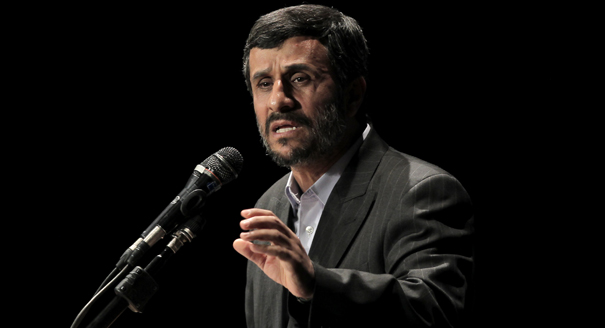
Source: Getty

In The Media

Questions for Mahmoud Ahmadinejad

During Iranian President Ahmadinejad’s visit to the U.N. General Assembly in New York, journalists will have the opportunity to confront him on human rights issues in Iran, the country’s internal politics, and the recent defections of Iranian senior diplomats.

Link Copied
By Karim Sadjadpour
Published on Sep 22, 2010

Source: The Wall Street Journal

Questions for Mahmoud AhmadinejadIranian President Mahmoud Ahmadinejad is visiting the United Nations General Assembly in New York this week. Here are some questions that journalists should ask him:

  • One of your closest spiritual advisers, Ayatollah Mesbah Yazdi, recently said that democracy, freedom and human rights have no place in Islamic theology. Do you agree with Mr. Yazdi?
     
  • According to human-rights organizations including Amnesty International, executions have increased four-fold since you became president in 2005, and Iran now executes more people per capita than any other country in the world. Iran also lifted its moratorium on stoning since you became president. And according to Reporters Without Borders, Iran is now the world's "biggest prison for journalists." Do you take pride in your record?
     
  • The prominent human-rights activist Mehrangiz Kar has reported that last August five young men in the city of Hamadan had their hands chopped off as a punishment for theft. Do you agree with such a draconian punishment?
  •  Two days after the June 12, 2009, presidential election, you declared that Iran is "the most stable country in the world." But the next day nearly three million people, according to the mayor of Tehran, took to the streets to protest the election results. Given your confidence in your popular support, would you grant the opposition a permit to protest, and would you guarantee their safety?
  • According to the International Monetary Fund, Iran has one of the highest rates of brain drain in the world, with as many as 100,000 people leaving annually in search of greater economic dignity and political freedom. Economists estimate that the brain drain has accelerated during your presidency. How much does it bother you that many of Iran's top minds are forced to reside abroad?
     
  • Iran's supreme leader, Ayatollah Ali Khamenei, reportedly issued an edict earlier this year demanding that all Muslims obey him as the earthly deputy of both the Prophet Muhammad and the Twelfth Imam (whom Shiite Muslims consider a messianic figure). Do you believe that Mr. Khamenei is the representative of these prophets on Earth?
     
  • When you first ran for president, you declared that the government has more important business to worry about than policing people's hairstyles and enforcing the veiling of women. Yet the hijab remains obligatory and the government has recently issued officially mandated hairstyles for men. Will the hijab ever not be obligatory in the Islamic Republic?
     
  • Why does the Islamic Republic persecute Iranians of the Bahai faith? Bahais are not allowed to practice their religion and their gravesites are regularly destroyed. When you say that Iran is free and fair, do you believe that this applies to the Bahais?
     
  • You have declared that the U.N. Security Council sanctions against Iran are a gift from God. Yet you have vowed revenge against those countries that supported them. Why should you be upset with them if the sanctions were a gift from God? And since the sanctions have brought economic hardship on your population, isn't it irresponsible to refer to them as a divine gift?
     
  • You have called for a U.N.-monitored referendum among Palestinians and Israelis to resolve the conflict in the Holy Land. Would you agree to an U.N.-monitored referendum among Iranians to determine their political future?
     
  •  When President Obama was campaigning, you said that a black man would never be allowed to be president of the United States. More recently you argued that Mr. Obama is not really in charge, and Zionists are manipulating him. Are you confident that you fully understand America and American politics?
     
  • Muhammad Javad Larijani, one of your senior colleagues and an adviser to the supreme leader, this year referred to Mr. Obama as "kaka sia," a racist term akin to "nigger." Do you condemn Mr. Larijani's words?
     
  • How did you react when your longtime ally Fidel Castro recently implored you to stop slandering the Jews, and argued that Iran's religious dogmatism makes a nuclear compromise less likely?
     
  • Three senior Iranian diplomats have recently defected in Europe, denouncing your government's illegitimacy and seeking political asylum. This is unprecedented in Iran's modern history. Is it a sign of wider disaffection within your regime?
     
  • It was considered a foreign policy victory for you when Brazil voted against a recent U.N. sanctions resolution. But Brazil has recently announced that it will adhere to the sanctions, and that regarding Iran it shares the aims (if not the tactics) of the U.S. How do you answer critics who say that, under your leadership, Iran has created dozens of adversaries but very few allies?
     
  • For 14 months Iran has imprisoned two American hikers for entering Iranian territory illegally, but the regime has brought no evidence against them. You recently intimated that you'd exchange the two hikers for Iranians held in American custody and accused of trading illicit arms. Are you holding these two young Americans hostage?

About the Author

Karim Sadjadpour

Senior Fellow, Middle East Program

Karim Sadjadpour is a senior fellow at the Carnegie Endowment for International Peace, where he focuses on Iran and U.S. foreign policy toward the Middle East.

    Recent Work

  • Q&A
    What’s Keeping the Iranian Regime in Power—for Now

      Aaron David Miller, Karim Sadjadpour, Robin Wright

  • Q&A
    How Washington and Tehran Are Assessing Their Next Steps

      Aaron David Miller, David Petraeus, Karim Sadjadpour

Karim Sadjadpour
Senior Fellow, Middle East Program
Karim Sadjadpour
Political ReformNuclear PolicyMiddle EastIran

Carnegie does not take institutional positions on public policy issues; the views represented herein are those of the author(s) and do not necessarily reflect the views of Carnegie, its staff, or its trustees.

More Work from Carnegie Russia Eurasia Center

  • Commentary
    Carnegie Politika
    Russia Is Meddling for Meddling’s Sake in the Middle East

    The Russian leadership wants to avoid a dangerous precedent in which it is squeezed out of Iran by the United States and Israel—and left powerless to respond in any meaningful way.

      Nikita Smagin

  • Commentary
    Carnegie Politika
    Is Frustration With Armenia’s Pashinyan Enough to Bring the Pro-Russia Opposition to Power?

    It’s true that many Armenians would vote for anyone just to be rid of Pashinyan, whom they blame for the loss of Nagorno-Karabakh, but the pro-Russia opposition is unlikely to be able to channel that frustration into an electoral victory.

      Mikayel Zolyan

  • Commentary
    Carnegie Politika
    The Afghanistan–Pakistan War Poses Awkward Questions for Russia

    Not only does the fighting jeopardize regional security, it undermines Russian attempts to promote alternatives to the Western-dominated world order.

      Ruslan Suleymanov

  • Commentary
    Carnegie Politika
    After Ilia II: What Will a New Patriarch Mean for Georgia?

    The front-runner to succeed Ilia II, Metropolitan Shio, is prone to harsh anti-Western rhetoric and frequent criticism of “liberal ideologies” that he claims threaten the Georgian state. This raises fears that under his leadership the Georgian Orthodox Church will lose its unifying role and become an instrument of ultraconservative ideology.

      Bashir Kitachaev

  • Commentary
    Carnegie Politika
    What the Russian Energy Sector Stands to Gain From War in the Middle East

    The future trajectory of the U.S.-Iran war remains uncertain, but its impact on global energy trade flows and ties will be far-reaching. Moscow is likely to become a key beneficiary of these changes; the crisis in the Gulf also strengthens Russia’s hand in its relationships with China and India, where advantages might prove more durable.

      • Sergey Vakulenko

      Sergey Vakulenko

Get more news and analysis from
Carnegie Russia Eurasia Center
Carnegie Russia Eurasia logo, white
  • Research
  • Politika
  • About
  • Experts
  • Events
  • Contact
  • Privacy
  • For Media
Get more news and analysis from
Carnegie Russia Eurasia Center
© 2026 Carnegie Endowment for International Peace. All rights reserved.










