

Commentary
Sergei Kiriyenko used Russia’s parliamentary vote to further hone his strategy of corporate mobilization that is designed to maximize votes for United Russia.
Andrey Pertsev
{
  "authors": [
    "Matthew Rojansky",
    "Petr Topychkanov"
  ],
  "type": "legacyinthemedia",
  "centerAffiliationAll": "dc",
  "centers": [
    "Carnegie Endowment for International Peace",
    "Carnegie Russia Eurasia Center"
  ],
  "collections": [],
  "englishNewsletterAll": "ctw",
  "nonEnglishNewsletterAll": "",
  "primaryCenter": "Carnegie Endowment for International Peace",
  "programAffiliation": "russia",
  "programs": [
    "Russia and Eurasia",
    "Sustainability, Climate, and Geopolitics"
  ],
  "projects": [
    "U.S.-Russia Bilateral Presidential Commission"
  ],
  "regions": [
    "North America",
    "United States",
    "Caucasus",
    "Russia"
  ],
  "topics": [
    "Climate Change",
    "Foreign Policy",
    "Nuclear Policy"
  ]
}
Source: Getty
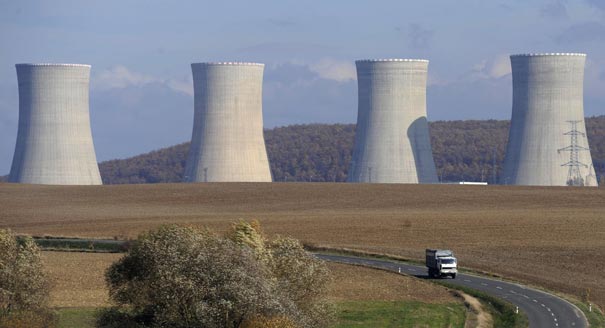
U.S.-Russia cooperation on civilian nuclear energy would enhance mutual security, promote economic growth, cement the gains of the reset, and provide the relationship with long-term stability.
Source: The Hill

Cooperation on peaceful nuclear energy is one such opportunity. Both countries have invested substantially in civilian nuclear research and development, and both share basic interests in capitalizing on the global “nuclear energy renaissance” by developing proliferation-resistant reactor technologies, increasing environmental safety, and making nuclear energy more economically competitive. By combining each side’s comparative advantages, the United States and Russia can each profit handsomely, while illustrating the power of innovation to transform Cold War competition into free-market competitiveness.
Enabling this type of cooperation, however, requires support from Washington. Specifically, Congress must endorse an agreement signed by the two countries that meets criteria listed in Section 123.a of the U.S. Atomic Energy Act of 1954. This type of “123 Agreement”—which the United States has signed with Australia, South Korea, and 19 other states—allows U.S. companies to share nuclear technology and materials with foreign counterparts, carry out joint research and development activities, and bid jointly on civil nuclear projects.
In May, President Obama submitted the proposed text of the U.S.-Russian Civilian Nuclear Cooperation Agreement to Congress. The 123 Agreement will likely go into effect in November, unless Congress enacts a joint resolution of disapproval, which requires majority votes in both chambers.[1] Although two draft resolutions of disapproval have been introduced, neither has attracted more than a handful of cosponsors.
Critics of the agreement allege that Russia may share the fruits of nuclear cooperation with its business partners in the Middle East, including potentially Iran and Syria, who could use that knowledge to advance their own nuclear programs. But Russia’s support for the recent Security Council sanctions on Iran, and its refusal to sell Tehran sophisticated air defenses, should blunt these critiques.
Of course, a new crisis in U.S.-Russian relations could still derail the agreement. Though the Bush administration signed the deal and submitted it to Congress in May 2008, the White House withdrew it that August after the Russia-Georgia war erupted. Since then, the “reset”—and an array of high-level working groups established under the auspices of the U.S.-Russia Bilateral Presidential Commission—have re-energized bilateral cooperation and given both sides incentives to prevent future disagreements from freezing relations. Focusing on concrete cooperation in technical areas, such as civilian nuclear cooperation, will help build on this momentum and endow the bilateral relationship with long-term stability.
When it comes to civil nuclear cooperation, the United States and Russia each bring unique and complementary assets to the table. Russia is the world’s largest supplier of uranium for nuclear power plants, and has pioneered both secure storage of spent fuel and so-called “fast breeder” reactor technologies that produce no weapons-usable nuclear waste. Fortunately, Russia seeks to expand fuel sales to the United States, which is currently capable of producing less than one-fifth of its domestic fuel needs, as well as provide secure permanent storage for United States spent fuel, something no U.S. state has been willing to do.
The Russian nuclear industry is also interested in partnering with U.S. firms like GE and Westinghouse on bids for third-country contracts and, in the past year and a half, eight deals have been signed between U.S. and Russian firms anticipating future cooperation. The United States expressed its willingness to work with Russia when it initiated the Global Nuclear Energy Partnership (GNEP) in 2006, which identified Russia as a nuclear supplier “partner” state that can help provide expanded access to nuclear power in an efficient, environmentally safe, and proliferation-proof manner.
Drawing on shared interests and opportunities like these, nuclear energy has strong prospects to emerge as one of the main areas of U.S.-Russian cooperation post-reset. It is also exactly what Presidents Obama and Medvedev called for when they created the Bilateral Presidential Commission and its nuclear energy working group.
But such cooperation will only be possible if the 123 Agreement takes effect. Rather than cast about for excuses to block the deal, Congress should recognize that the best way to ensure Russia plays a constructive role in the civil nuclear renaissance and non-proliferation is to open the door to partnership with the United States. Handled responsibly, civil nuclear cooperation will fuel economic growth, enhance security, and cement the gains of the U.S.-Russia reset. That would serve both countries well.

Former Deputy Director, Russia and Eurasia Program
Rojansky, formerly executive director of the Partnership for a Secure America, is an expert on U.S. and Russian national security and nuclear-weapon policies.
Former Fellow, Nonproliferation Program, Moscow Center
Topychkanov was a fellow in the Carnegie Moscow Center’s Nonproliferation Program.
Carnegie does not take institutional positions on public policy issues; the views represented herein are those of the author(s) and do not necessarily reflect the views of Carnegie, its staff, or its trustees.

Sergei Kiriyenko used Russia’s parliamentary vote to further hone his strategy of corporate mobilization that is designed to maximize votes for United Russia.

Andrey Pertsev

Trump has promised Belarus a massive potash deal. But Minsk is seeking something greater: restored Western transit and greater room for maneuver from Russia.

Balázs Jarábik

The European far right might fail to steer EU policy in the direction Russia wants, but they will create enough chaos inside Europe to benefit the Kremlin.

Dimitar Bechev

Minsk clearly expected the dialogue with Washington to yield more results, in particular the lifting of EU sanctions and permission to export potash.

Artyom Shraibman

Russia’s ruling party would have benefited from Putin appearing as its distant patron, but as an active frontman imposing his views on the public, he has done nothing but harm both the party’s election campaign and the ruling system overall.
Andrey Pertsev