

Paper
George Perkovich
{
  "authors": [
    "George Perkovich"
  ],
  "type": "legacyinthemedia",
  "centerAffiliationAll": "dc",
  "centers": [
    "Carnegie Endowment for International Peace"
  ],
  "collections": [],
  "englishNewsletterAll": "ctw",
  "nonEnglishNewsletterAll": "",
  "primaryCenter": "Carnegie Endowment for International Peace",
  "programAffiliation": "SAP",
  "programs": [
    "South Asia"
  ],
  "projects": [],
  "regions": [
    "North America",
    "United States",
    "South Asia",
    "India"
  ],
  "topics": [
    "Foreign Policy"
  ]
}
Source: Getty
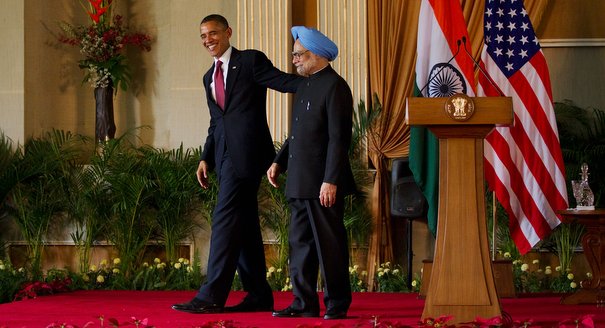
Showing undue favor to Indian interests may not only conflict with U.S. goals, it risks undermining the very international rules the United States is looking to strengthen.
Source: The Economic Times

Recently, however, some observers have been warning that India has been neglected under the Obama administration and this partnership is in decline. This perceived decline is, in fact, a necessary adjustment from the high-rolling days of the Bush administration, which saw a sharp upward spike in the relationship, thanks to the civilian nuclear cooperation deal. Like all spikes or bubbles, this one inevitably could not be sustained.
A resumption of more stable and normal ties is healthy. The relationship will continue to rise. Its base will deepen and grow, thanks more to business-to-business ties and people-to-people interactions than to governmental action. As Columbia University economist Arvind Panagariya writes, “Outside of the highly complex security area, there is very little beyond the atmospherics that the governments can do to promote partnerships.”
The United States will welcome an India that is powerful, vibrant, and successful at home, regionally, and internationally, and will help create conditions conducive to this. That being said, there is little that the United States can do to make or break India’s success.
Like China, India’s rise to global prominence will be of its own making, and India has much work to do to improve its infrastructure, calm domestic social tensions, and overcome violence and insurgency. American policies will have, at best, marginal effects in these areas.
In areas of international governance, however, American policies could severely damage the international system that has been built since the end of World War II. In the essential areas of climate change, free trade, and nuclear non-proliferation, showing undue favour to Indian interests may both conflict with American goals and undermine the norms and rules the United States is looking to strengthen.
International reaction to the civilian nuclear deal serves as a prime example of this. Many states cite the deal to justify stalling action to strengthen inspections, control the spread of uranium enrichment and plutonium reprocessing, and sanction Iran, showing that even well-intentioned efforts to favour India can harm American and international interests on other fronts.
The disintegration of a rule-based international system would be in no one’s interest, and Indian policy makers and commentators must understand that the United States will need to take certain actions to strengthen it that India might not prefer. These disagreements will necessarily result in tension in the relationship, as disagreements always do. To expect anything else would be unrealistic.
Even on important regional matters, Indian and American interests will not always converge in the near term. America’s friendly, though troubled, relationship with Pakistan has, and will, continue to irritate and sometimes alarm India. American efforts to bring the war in Afghanistan to a close could upset an India fearful of a new Islamist neighbour.
Even on China, Indian and American actions will often differ tactically. China’s rise is often presented as the primary motivator for deepened US-Indian ties, but the trilateral relationship is not a simple one. In many instances, Indian and Chinese interests will be similar and will differ from the US, such as on issues of trade and climate change.
Military balancing against China would be an important element of any close US-Indian partnership. But, as K Subrahmanyam has said, the primary threats India and the United States face in the 21st century are not military and “cannot be dealt with by a military alliance”.
The odds of a Chinese attack on India are very slim, and the prospects for an American intervention in that eventuality are questionable. More likely would be a Sino-American conflict on behalf of Taiwan or Japan or an ASEAN state over disputed islands in the South and East China seas. But the champions of US-India defence cooperation have not explained how, where, or when the Indian polity would go to war with the US in such scenarios.
China and India are neighbours and close trading partners, and their common interests may conflict with American objectives in the region. The partnership between the United States and India has the potential to be fruitful and valuable for both sides, but we must be realistic about our expectations.
America’s relationship with India will be like its relationship with other important friendly nations, with disagreements and conflicts that cannot be avoided, even as both sides know that their long-term interests lie together. Realism like this is the basis of any lasting friendship.

Japan Chair for a World Without Nuclear Weapons, Senior Fellow
George Perkovich is the Japan Chair for a World Without Nuclear Weapons and a senior fellow in the Carnegie Endowment for International Peace’s Nuclear Policy Program. He works primarily on nuclear deterrence, nonproliferation, and disarmament issues.
Recent Work
George Perkovich
George Perkovich
Carnegie does not take institutional positions on public policy issues; the views represented herein are those of the author(s) and do not necessarily reflect the views of Carnegie, its staff, or its trustees.

Trump has promised Belarus a massive potash deal. But Minsk is seeking something greater: restored Western transit and greater room for maneuver from Russia.

Balázs Jarábik

Minsk clearly expected the dialogue with Washington to yield more results, in particular the lifting of EU sanctions and permission to export potash.

Artyom Shraibman

With the growth in points of friction between the great powers, organizations like the SCO will continue to play a role in the strategic adaptation of the smaller powers caught between them.

Temur Umarov

When faced with fuel shortages in the past, Central Asian governments could always count on additional supplies from Moscow. That safety net no longer exists.

Galiya Ibragimova

Despite unhappiness on the ground, Moscow is determined to use both carrot and stick to ensure there is record support for United Russia in occupied Ukraine.

Konstantin Skorkin