

Paper
Matthew Rojansky
{
  "authors": [
    "Matthew Rojansky"
  ],
  "type": "legacyinthemedia",
  "centerAffiliationAll": "dc",
  "centers": [
    "Carnegie Endowment for International Peace",
    "Carnegie Russia Eurasia Center"
  ],
  "collections": [],
  "englishNewsletterAll": "ctw",
  "nonEnglishNewsletterAll": "",
  "primaryCenter": "Carnegie Endowment for International Peace",
  "programAffiliation": "russia",
  "programs": [
    "Russia and Eurasia"
  ],
  "projects": [
    "U.S.-Russia Bilateral Presidential Commission"
  ],
  "regions": [
    "North America",
    "United States",
    "Caucasus",
    "Russia"
  ],
  "topics": [
    "Foreign Policy"
  ]
}
Source: Getty
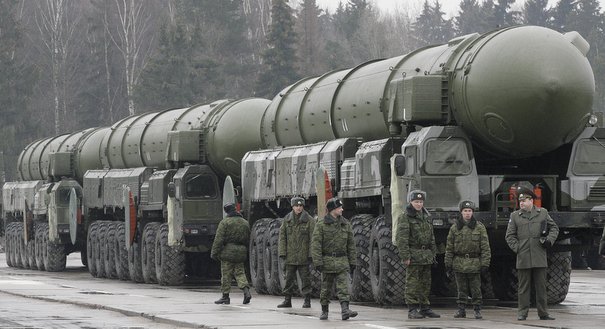
The civil nuclear cooperation deal, or 123 agreement, will greatly improve the ability of both Russia and the United States to prevent proliferation and it will advance mutual interests, improve relations, and deliver on the promise of the reset.
Source: U.S. News and World Report

The mandate for such cooperation comes not a moment too soon. An acrimonious debate over New START has distracted from the arguably more important accomplishments of the reset, notably the establishment of a Bilateral Presidential Commission and the accomplishments of its working groups on nuclear security, business and economic development, and scientific cooperation. Participants, senior officials, and industry leaders have all cited the 123 agreement as a necessary step to advance mutual interests, improve relations, and deliver on the promise of the reset.
Beyond benefiting relations, cooperation on peaceful nuclear energy makes financial sense. The United States and Russia have invested substantially in civilian nuclear research and development, and both share basic interests in capitalizing on the global "nuclear energy renaissance" by developing proliferation-resistant reactor technologies, increasing environmental safety, and making nuclear energy more economically competitive.
And when it comes to civil nuclear power, Russia brings a lot to the table. For instance, the United States does not operate so-called "fast breeder" reactors and reprocessing facilities that don't produce nuclear waste that can be used for weapons, but Russia does. And, while the United States hasn't built a single new nuclear power plant since 1973, Russia opened its first fast breeder reactor that very year and plans to bring 26 new nuclear facilities online before 2030. And the Kremlin has already allocated some $3.6 billion for research on fast breeders and other projects under a program dedicated to the next generation of nuclear technology.
With U.S. support, Russia has developed a sophisticated infrastructure to securely store spent nuclear fuel—and Moscow even offered to store and reprocess spent fuel from the United States, while no American state has been willing to do the same. Russian companies already supply roughly half of the uranium consumed in U.S. and European power plants and will need to supply more in the future as the United States is only able to produce a fifth—at most—of its nuclear fuel stock domestically. Fortunately, Russia's nuclear industry is interested in expanding its uranium enrichment and reprocessing activity in the U.S. market and potentially cooperating with American firms, including GE and Westinghouse, on bids for contracts in other countries.
Closer U.S.-Russia cooperation on nuclear power means better nuclear security. As a major player in civil nuclear markets worldwide, Russia has a unique window into potential risks and opportunities to insist on measures that protect sensitive sites and technologies. Russia, with U.S. support, also has the chance to compete more effectively with China's nuclear industry, which is less scrupulous in its nonproliferation commitments.
The importance of partnering with Russia was made clear during Secretary Clinton's recent trip to Central Asia. Belarus, the former Soviet republic, agreed to give up its stock of highly enriched uranium by 2012 in return for U.S. help in developing a new nuclear power reactor. But Russia has had its eye on this potentially lucrative project, and has the right experience to work effectively with Belarus's Soviet-era infrastructure. Washington should cooperate—instead of compete—with Moscow to build an environmentally safe, proliferation-proof reactor in Belarus. A quarter century after the Chernobyl disaster, this would be a powerful symbol that both sides can move beyond the Cold War legacy.
New START will benefit the United States, Russia, and the world, but all have paid a high political cost for it already. Politics, however, has not derailed the 123 agreement. The deal will advance US-Russia ties and create new opportunities for bilateral cooperation, helping make America richer and keep it safer for years to come. Moving ahead with the 123 agreement will help demonstrate that the reset is about much more than arms control.

Former Deputy Director, Russia and Eurasia Program
Rojansky, formerly executive director of the Partnership for a Secure America, is an expert on U.S. and Russian national security and nuclear-weapon policies.
Recent Work
Matthew Rojansky
Matthew Rojansky
Carnegie does not take institutional positions on public policy issues; the views represented herein are those of the author(s) and do not necessarily reflect the views of Carnegie, its staff, or its trustees.

Russia’s ruling party would have benefited from Putin appearing as its distant patron, but as an active frontman imposing his views on the public, he has done nothing but harm both the party’s election campaign and the ruling system overall.

Andrey Pertsev

Depleted financial reserves and a shrinking tax base mean it is no longer possible to simultaneously deliver high defense spending, price stability, and economic growth.

Alexandra Prokopenko
Blurring the line between humans and animals is a long-standing tradition in social utopian prose. In his latest novel, Leonid Bershidsky reminds us that in social experiments, people are often treated no differently than animals.
Alexander Baunov

While France and Australia are seeking to establish the legal obligations of messaging apps like Telegram, Russia wants total subordination.

Maria Kolomychenko

The recent uncovering of Dmitry Donskoy’s relics in the Cathedral of the Archangel is yet another attempt by the Russian Orthodox Church to help the state solve its problems. However, parroting the state’s version of Russian history leaves the Church with no message except “patriotism.”
Alexander Zanemonets