• Research
  • Politika
  • About
Carnegie Russia Eurasia center logoCarnegie lettermark logo
  • Donate
{
  "authors": [
    "Lahcen Achy"
  ],
  "type": "legacyinthemedia",
  "centerAffiliationAll": "",
  "centers": [
    "Carnegie Endowment for International Peace",
    "Carnegie Europe",
    "Malcolm H. Kerr Carnegie Middle East Center"
  ],
  "collections": [
    "Arab Awakening"
  ],
  "englishNewsletterAll": "",
  "nonEnglishNewsletterAll": "",
  "primaryCenter": "Malcolm H. Kerr Carnegie Middle East Center",
  "programAffiliation": "",
  "programs": [],
  "projects": [],
  "regions": [
    "Maghreb",
    "Morocco",
    "North Africa",
    "Middle East"
  ],
  "topics": [
    "Economy",
    "Political Reform"
  ]
}
Source: Getty

In The Media
Malcolm H. Kerr Carnegie Middle East Center

2011 Looks Difficult for Morocco

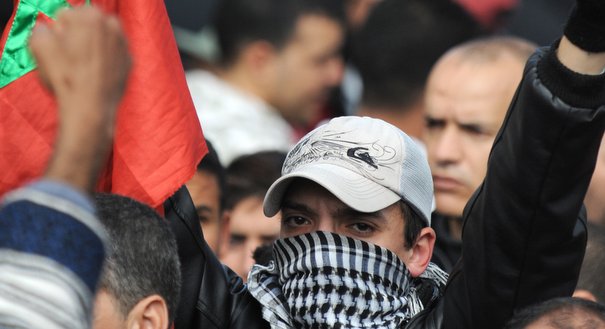
In order to avert a possible uprising, Morocco must undertake a number of reforms to create more balanced power sharing between the executive, legislative, and judicial authorities and to guarantee more rights and equality for Moroccans.

Link Copied
By Lahcen Achy
Published on Feb 17, 2011

Source: Maroc Hebdo International

2011 Looks Difficult for Morocco
Lahcen Achy, economist at the Beirut-based Carnegie Middle East Center, looks into the economic situation in Morocco: A disturbing observation.
 
Maroc Hebdo International: Do you believe that Morocco is safe from the possibly contagious events of Tunisia and Egypt? 
 
Lahcen Achy: What happened in Tunisia and Egypt is no new phenomenon. Popular uprisings have already taken place in Eastern Europe and Latin America not so long ago. 
 
In Morocco, the ruling regime, namely the King, has garnered undeniable popular legitimacy. To avoid any popular dissent, Morocco must now undertake a number of reforms towards more balanced power sharing. The executive authority, namely the government, must have broader powers. The Parliament must fully play its oversight role by monitoring government actions. The judicial authority should be more unbiased and autonomous by distancing itself from the other two authorities. The governance system in Morocco has to evolve in the right direction to guarantee more rights and more equality to Moroccans.
 
Maroc Hebdo International: The Moroccan government has recently adopted economic measures to subsidize a number of food staples (sugar, oil, flour etc.). In your opinion, are these measures adequate? 
 
Lahcen Achy: I do not think that increased subsidies of food staples can be sufficient to satisfy the grievances of the Moroccans. These subsidies not only benefit the poor, but all social classes, including both the rich and the richer. This encourages a poor distribution of wealth, thus leading to blatant social inequality. Moroccans, just like Tunisians, Egyptians or even Jordanians, have other major concerns in life such as securing a stable job which guarantees their dignity and reasonable purchasing power to live decently. Citizens also need a place to live with their families in peace and dignity. Arab peoples, including Moroccans, aspire to more democracy and freedom. Political grievances usually overshadow economic grievances.
 
Maroc Hebdo International: What do you think of the economic situation in Morocco?
 
Lahcen Achy: The Moroccan economy is generally doing well. The government has managed to uphold a number of macroeconomic indicators, namely inflation, controlled at around 2%. The 5% economic growth in Morocco is also interesting compared to other countries of the region. 
 
However, there are still certain structural problems preventing Morocco from stepping into the world of truly emerging economies. Unemployment, namely youth unemployment, is constantly on the rise, while the education and training system remains below expectations. If economic reforms are to be undertaken soon, they should focus on employment and education in the first place. While Morocco has successfully overcome the global economic and financial crisis, it faces today a profound social crisis. It is further dangerous as it directly affects Moroccans. The upcoming years seem to be even more difficult than previous years. 
 
Maroc Hebdo International: Exactly. Morocco is expected to face a very difficult year with the soaring prices of raw materials worldwide. Do you think Morocco will succeed in its stake?
 
Lahcen Achy: It is up to the current government. I believe, however, that 2011 will be very difficult, as you mentioned, because of the soaring prices of raw materials, namely oil, which has exceeded more than 100 dollars per barrel.
 
The upcoming year will also be difficult because of the increased subsidies. When will the Moroccan government stop bearing the difference between the real price of products and their market price? Fourteen billion were allocated to the Compensation Fund for 2011 while predictions are based on 30 billion. Where is the rest to be found? 
 
There is also the public debt. Morocco has recently borrowed one billion Euros on the international financial market. All these figures ought to weigh down on the budgetary deficit. 
 
Maroc Hebdo International: What do you think about political practice in Morocco?
 
Lahcen Achy: There is today a real problem of credibility in the official and political discourse. Young people have no faith in officials or in lifeless political parties. I believe political practice in Morocco is deficient.
 
Maroc Hebdo International: Would you say that political life needs to be revamped? 
 
Lahcen Achy: I am not sure about that. But Moroccan political parties are not playing their role anymore, i.e. guiding citizens and rationally managing public affairs.
 
If Morocco has managed to organize somehow transparent elections, how can we explain the weak voter turnout? The government, political parties and all civil society actors must seek to answer this question. Today, citizens and politics are estranged.

About the Author

Lahcen Achy

Former Nonresident Senior Associate, Middle East Center

Achy is an economist with expertise in development, institutional economics, trade, and labor and a focus on the Middle East and North Africa.

    Recent Work

  • In The Media
    Arab States Need Industrial Policy Reform

      Lahcen Achy

  • Paper
    The Price of Stability in Algeria

      Lahcen Achy

Lahcen Achy
Former Nonresident Senior Associate, Middle East Center
Lahcen Achy
EconomyPolitical ReformMaghrebMoroccoNorth AfricaMiddle East

Carnegie does not take institutional positions on public policy issues; the views represented herein are those of the author(s) and do not necessarily reflect the views of Carnegie, its staff, or its trustees.

More Work from Carnegie Russia Eurasia Center

  • Commentary
    Carnegie Politika
    Tokayev’s New Constitution Is a Bet on Stability—At Freedom’s Expense

    Kazakhstan’s new constitution is an embodiment of the ruling elite’s fears and a self-serving attempt to preserve the status quo while they still can.

      Serik Beysembaev

  • Commentary
    Carnegie Politika
    The Kremlin Is Destroying Its Own System of Coerced Voting

    The use of technology to mobilize Russians to vote—a system tied to the relative material well-being of the electorate, its high dependence on the state, and a far-reaching system of digital control—is breaking down.

      Andrey Pertsev

  • Commentary
    Carnegie Politika
    Notes From Kyiv: Is Ukraine Preparing for Elections?

    As discussions about settlement and elections move from speculation to preparation, Kyiv will have to manage not only the battlefield, but also the terms of political transition. The thaw will not resolve underlying tensions; it will only expose them more clearly.

      Balázs Jarábik

  • Commentary
    Carnegie Politika
    Once Neutral on the Ukraine War, Arab States Increasingly Favor Moscow

    Disillusioned with the West over Gaza, Arab countries are not only trading more with Russia; they are also more willing to criticize Kyiv.  

      Ruslan Suleymanov

  • Commentary
    Carnegie Politika
    Where Does the Split in the Ruling Tandem Leave Kyrgyzstan?

    Despite its reputation as an island of democracy in Central Asia, Kyrgyzstan appears to be on the brink of becoming a personalist autocracy.

      Temur Umarov

Get more news and analysis from
Carnegie Russia Eurasia Center
Carnegie Russia Eurasia logo, white
  • Research
  • Politika
  • About
  • Experts
  • Events
  • Contact
  • Privacy
Get more news and analysis from
Carnegie Russia Eurasia Center
© 2026 Carnegie Endowment for International Peace. All rights reserved.