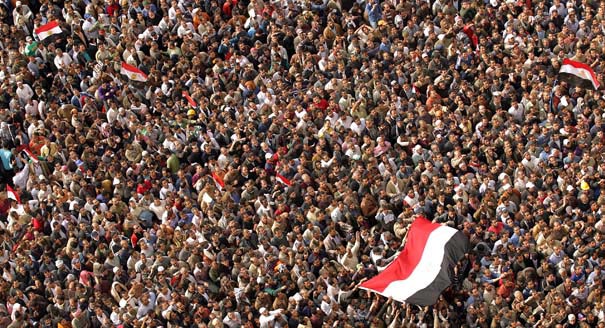
Egypt’s current government has the chance to oversee a smooth transition toward democratic governance by delegating the army to handle security, dissolving the parliament, amending the constitution to secure political and civil liberties, and initiating domestic reform policies.
Egypt's Path Ahead: Agree to the People's DemandsFor Egypt, this is not a moment for long, drawn out explanations. What is happening is simple: The people rose up together, regardless of sect, to fight against indignity and for their political and socioeconomic rights.
Egyptians came forth without fear of violence and repression demanding change, liberty, social justice and the ousting of the ruling regime. The people overturned Egypt's traditional balance of power where the ruler commands and the citizen obeys.
Today, it has been replaced with one in which the citizens make demands and President Hosni Mubarak is forced to respond. After today, the ruling regime no longer has the option to bypass the people. Dismissing the government or making promises that do not translate into immediate reforms are irrelevant gestures.
If the current government truly seeks to protect the nation and thwart complete chaos, the only choice for the ruling establishment is to comprehensively respond to the people's demands.
The first step would be to delegate the army to protect public and private installations and guarantee citizens' security on the condition of a complete commitment to avoiding violence, protecting citizens' lives and property, and assuring their right to collective peaceful expression of opinion.
Next, the president must commit to refusing his party's nomination for the upcoming presidential elections. Mr Mubarak has ruled for five consecutive presidential terms and the time has come for change in Egypt's highest post.
Parliament should be dissolved, a constituent assembly formed to amend the constitution, and new parliamentary and presidential elections held. The 2010 parliamentary elections were blatantly rigged. The current legislature is illegitimate, as has been confirmed by administrative judicial decisions rendering the process in a number of districts null and void.
Legal experts recognised for their independence from the regime must be consulted in order to draft constitutional amendments with integrity, which should then be voted upon and confirmed only by a referendum by the people. Within a transitional period not to exceed six months, a new round of parliamentary and presidential elections should be held.
Articles of the constitution that are specific to the presidency should be amended. Articles 76 and 77 set the conditions for candidacy and the presidential term. The removal of the restraints imposed on citizens' candidacy for president must be guaranteed and the maximum number of presidential terms must be limited.
The articles of the constitution that will guarantee clean elections and civil liberties also need to be amended. Recent changes to Article 88 abolished the total judicial supervision of Egyptian elections, and they must be reversed or modified. For example, an independent electoral commission is a possibility, as exists in Egypt today, but must be neutral in its oversight. Until now, elections have been dominated by the regime's interior ministry. In addition, Article 179 - and the arbitrary powers granted the state to subvert civil liberties with the terrorism law - must be abolished.
The emergency law needs to be immediately eliminated. The regime's arguments about the necessity of the emergency law to maintain public security have been disproved with the outbreak of these events. The state of emergency has effectively suspended political life in Egypt and legalised the persistent oppression of citizens' rights by the security apparatus since 1981.
The law has silenced the freedom to express opinions, organise politically and take an interest in public affairs. Most gravely, it has legalised the use of torture and a range of human rights abuses.
The formation of a national unity government would be the next step to support the constituent assembly during the transitional period. Forty per cent of Egyptian citizens today live either below the poverty line or just above it, and vast numbers of others have been deprived of basic services of health care, education and social security.
Time has run out for the National Democratic Party (NDP), which has centralised the country's politics, economy and resources into the hands of the minority encircling the ruling regime. The state has failed to adequately address the crises facing the nation and change is at the helm. The NDP and its leaders, theorists, technocrats and media figures have no place in Egypt today.
Lastly, it is incumbent upon the president to immediately release political detainees and halt all human rights violations. The constituent assembly and a national unity government would also need to ensure that the security forces completely abstain from violence.
Egyptians throughout the country must be allowed to continue peaceful protest. For that to happen, the government must compel security forces to prohibit all practices of torture and violations of human rights. These agencies must also immediately release those currently in prison who are being detained simply for expressing their opinions, and likewise protect those protesting peacefully in the coming day.
Amr Hamzawy is a senior fellow and the director of the Carnegie Middle East Program. His research and writings focus on Egypt’s and other middle powers’ involvement in regional security in the Middle East, particularly through collective diplomacy and multilateral conflict resolution
Carnegie does not take institutional positions on public policy issues; the views represented herein are those of the author(s) and do not necessarily reflect the views of Carnegie, its staff, or its trustees.
Sergei Kiriyenko used Russia’s parliamentary vote to further hone his strategy of corporate mobilization that is designed to maximize votes for United Russia.
The European far right might fail to steer EU policy in the direction Russia wants, but they will create enough chaos inside Europe to benefit the Kremlin.
If the Russian-speaking community in Latvia cannot articulate their interests without being seen as disloyal, they could end up embracing a pro-Kremlin agenda.
Russia’s ruling party would have benefited from Putin appearing as its distant patron, but as an active frontman imposing his views on the public, he has done nothing but harm both the party’s election campaign and the ruling system overall.