

Commentary
Putin’s conservative staffing policies and search for ever greater control have cemented parliament’s transformation into a bureaucratic appendage of the executive branch.
Andrey Pertsev
{
  "authors": [
    "Matthew Rojansky",
    "Lyndon Allin"
  ],
  "type": "legacyinthemedia",
  "centerAffiliationAll": "dc",
  "centers": [
    "Carnegie Endowment for International Peace",
    "Carnegie Russia Eurasia Center"
  ],
  "collections": [],
  "englishNewsletterAll": "ctw",
  "nonEnglishNewsletterAll": "",
  "primaryCenter": "Carnegie Endowment for International Peace",
  "programAffiliation": "russia",
  "programs": [
    "Russia and Eurasia"
  ],
  "projects": [],
  "regions": [
    "Eastern Europe",
    "Moldova"
  ],
  "topics": [
    "Political Reform"
  ]
}
Source: Getty
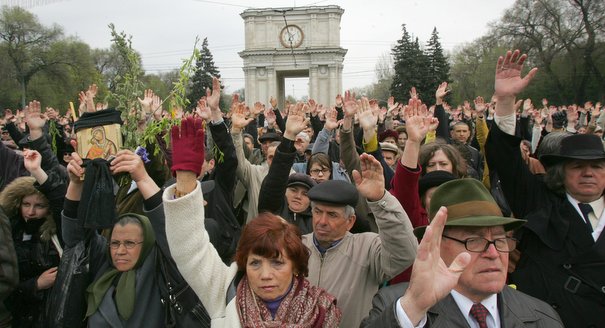
Built gradually on a foundation of growing consensus and electoral support, Moldova’s political change may be more sustainable in the long term than the color revolutions in Georgia and Ukraine.
Source: World Politics Review

Since that time, Moldova has held two national elections, and a European-oriented coalition of parties has gained votes and seats in parliament both times. In fact, since the disputed April 2009 elections, the parliamentary balance of power has shifted from a strong old-guard majority, with then-President Vladimir Voronin's Communist Party holding 60 of 101 seats, to a 59-seat majority for the Alliance for European Integration (AEI) following elections in November. The alliance's three constituent parties range from conservative-nationalist to pragmatic-centrist, but all agree that Moldova's future lies in closer cultural, institutional and trade ties with Europe.
Although the magnitude of this political transition was similar to that of Georgia and Ukraine’s color revolutions, and the change in the parliamentary balance of power exceeded that of the 2010 U.S. midterms, it has garnered relatively little attention from the West. In part, this may be because the AEI lacks a single charismatic leader and a sound-bite-friendly narrative. A deeper reason for the relative indifference to Moldova's reorientation has been its failure to overcome structural gridlock imposed by the requirement of a 61-vote supermajority in the parliament to select a president. Since no party or coalition has yet mustered the required votes, successive Moldovan governments have been without a permanent president for nearly two years.
The absence of a permanent president and the fragility of the ruling coalition have limited the country's ability to take decisive steps on its path to European integration. Yet growing popular support for the AEI and substantial financial aid from the European Union have enabled the Alliance to govern effectively, even during a global financial crisis that was particularly punishing for Moldova's main labor-export markets. By virtue of the AEI's composition, it has the potential to enhance cohesion among Moldova's multiethnic and multilingual society and to promote reconciliation with the country's secessionist region of Transdniester.
Progress to date may be undermined, and future potential may not be realized, if the AEI once again fails to elect a president. Under the constitution, if no presidential candidate is able to achieve the required supermajority in parliament, the acting president must dissolve parliament and call new parliamentary elections. There is a serious risk of a backlash from Moldovans, who understandably feel that they already voted for change and real results in three general elections over the past two years. A new election would raise the possibility that the coalition might fragment, allowing the communists to form a new government with one of the AEI's constituent parties.
The West has a critical role to play in encouraging and enabling the AEI's leadership to pursue an agreement with at least two additional deputies in parliament so that it can select a president and avoid another round of elections. Stabilizing the current government with a permanent president at its head will also empower Chisinau to pursue European-oriented reforms that impose short-term costs in exchange for long-term benefits. Moldovans themselves must agree on the compromise necessary to achieve a 61-vote supermajority, but the West can provide clear incentives for this government to finally end the cycle of elections and political maneuvering.
In a stabilized political environment, Chisinau must follow through on promises of domestic political reforms that have been frustrated by two years of perpetual campaigning and demonstrate that it can be a much-needed success story for the EU's Eastern Partnership program. For its part, Brussels should deliver on its own promises of a Moldova-EU association agreement, a more-liberal visa regime for Moldovan labor migrants and reduced barriers to trade, particularly for Moldovan wine and other agricultural products. Although history, geography and economic reality put Europe at the center of Moldova's Western reorientation, Washington can also provide recognition of Chisinau's progress. The most important actions would be continued Millennium Challenge Corporation assistance, graduation from the anachronistic Jackson-Vanik trade limitations and a visit from the secretary of state or another Cabinet-level U.S. official.
Moldova’s so-called Twitter revolution did not capture the world's imagination the way that events in Georgia and Ukraine did, but the country’s political change has been no less real or comprehensive. In fact, because it has been built gradually on a foundation of growing consensus and electoral support, this slow-motion revolution may be more profoundly significant and sustainable in the long term.

Former Deputy Director, Russia and Eurasia Program
Rojansky, formerly executive director of the Partnership for a Secure America, is an expert on U.S. and Russian national security and nuclear-weapon policies.
Lyndon Allin
Former EASI-Hurford Next Generation Fellow
Lyndon Allin is a political officer with the Organization for Security and Cooperation in Europe Mission to Moldova.
Carnegie does not take institutional positions on public policy issues; the views represented herein are those of the author(s) and do not necessarily reflect the views of Carnegie, its staff, or its trustees.

Putin’s conservative staffing policies and search for ever greater control have cemented parliament’s transformation into a bureaucratic appendage of the executive branch.

Andrey Pertsev

Ex-president Gurbanguly Berdimuhamedov remains interested in politics, but his son Serdar, Turkmenistan’s current president, is becoming increasingly independent and willing to break with his father’s legacy. If their covert rivalry goes too far, both risk losing power.

Galiya Ibragimova

Sergei Kiriyenko used Russia’s parliamentary vote to further hone his strategy of corporate mobilization that is designed to maximize votes for United Russia.
Andrey Pertsev

The European far right might fail to steer EU policy in the direction Russia wants, but they will create enough chaos inside Europe to benefit the Kremlin.

Dimitar Bechev

If the Russian-speaking community in Latvia cannot articulate their interests without being seen as disloyal, they could end up embracing a pro-Kremlin agenda.

Sergejs Potapkins