

Research
- +10
Rosa Balfour, Frances Z. Brown, Yasmine Farouk, …
{
  "authors": [
    "Moisés Naím"
  ],
  "type": "legacyinthemedia",
  "centerAffiliationAll": "",
  "centers": [
    "Carnegie Endowment for International Peace"
  ],
  "collections": [],
  "englishNewsletterAll": "",
  "nonEnglishNewsletterAll": "",
  "primaryCenter": "Carnegie Endowment for International Peace",
  "programAffiliation": "",
  "programs": [],
  "projects": [],
  "regions": [
    "North America",
    "South America"
  ],
  "topics": [
    "Economy"
  ]
}
Source: Getty
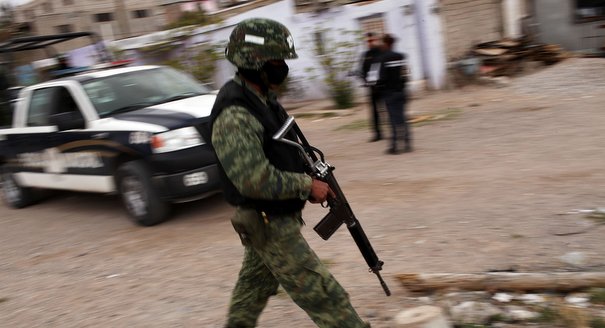
There are no simple solutions to the violence plaguing Mexico, but unless Mexican leaders of all parties and social sectors realize that it is everyone’s problem—and not just the president’s—violence will continue to be the beleaguered country's main story.
Source: Huffington Post

What happened?
The answer does not matter just to Mexicans. The United States and Europe, both with large numbers of drug users of their own and therefore with powerful drug trafficking organizations in their midst, are also affected by what happens in Mexico, just like the rest of Latin America.
A frequent response is that the current Mexican tragedy is the result of decades of tolerance for the narco-traffickers. There was a tacit non-aggression pact that the Mexican government, politicians, business leaders, and the media had with the drug cartels. Others blame President Felipe Calderón who, without a clear plan, declared war on the cartels thereby breaking the truce that kept the country relatively calm for years. Another explanation is that the problem was imported: "It's the gringos," said a Mexican friend. "The United States buys our drugs and thereby creates these immensely rich criminals to whom in turn they freely sell machine guns and all kinds of advanced weapons that are used to kill our people." The bad economy of recent years is of course also a factor.
It is a question of moral values, say others. President Calderón, for example, recently stressed that Mexico must continue fighting the criminals and strengthening its institutions, but stressed that rebuilding the moral base of Mexican society was the main priority. "I'll tell you something that will make you think," said the president. "We captured a criminal who was just 19 years old and yet he boasted that he'd killed more than 200 people."
Who is right? Everyone. There is no doubt that Mexican leaders for decades succumbed to the temptation to believe their country was merely a "transit point" between the Andean farmers and American consumers. This illusion masks the fact that the criminals controlling the transit routes become rich and powerful and inevitably end up controlling politicians, judges, generals, governors, mayors, police, media companies, and even banks. Furthermore, in all the "transit" countries, part of the inventory stays there and is consumed locally, thus boosting demand at home while some imports are replaced by domestic production which creates an indigenous drug industry.
It is also true that President Calderón, by attacking the drug cartels, stirred up a hornet's nest which led to this terrible war. But it's just as true that without Calderon's reaction the capture of much of the Mexican state by the traffickers would have been complete and would have placed the nation even more at risk.
The fiercest critics of the president do not seem to give too much weight to the urgent need to contain the criminalization of the state. They say the price paid by the country has been too high and that Calderon's reclamation of key public institutions from the grip of the criminals is limited and will, in any case, be ephemeral.
Unfortunately, many Mexicans, terrified by the daily horrors and seduced by promises of a return to the calmer past thanks to a hypothetical -- and no longer realistic in practice -- truce with the drug cartels, have abandoned their president. Thus, this battle, one which should be fought by any decent society, has been instead reduced to "Calderón's war." And Calderón cannot win it alone.
Reclaiming the state and the many societal institutions now in the hands of criminals will require time, sacrifice, and commitment from all Mexicans: politicians and social leaders, journalists and the military, trade unionists and businessmen, housewives and university students. This cannot be Calderón's war, it must be Mexico's war. But Mexicans are angered by decades of economic frustration as mediocre policies and politicians fail to deliver on their promises of progress.
The country's murder statistics are of course shocking. 30,000 dead so far. But other data on Mexico is also striking: according Cristobal Pera, the CEO of Random House Mexico, there are no bookstores in 94 percent of municipalities and the percentage of people who actually read books is one of the lowest in Latin America.
According to a study by Johns Hopkins University, Mexico's workforce has one of the world's lowest rates of participation in non-profit organizations (0.04 percent in Mexico; more than 2 percent in Peru and Colombia). I cite these statistics only to suggest that Mexico's narcotics problem has wider and fiendishly complex ramifications ranging from irrational U.S. policies on drugs and arms sales; to the negligible consumption of books in the country; to the low quality of its educational institutions; to the precariousness of its civil society organizations.
There are no quick or simple solutions to these problems. But the inescapable reality is that this is not the president's problem. It's the entire country's problem. Unless this is recognized by Mexican leaders of all parties and social sectors, Mexico's violence will continue to be the beleaguered country's main story.

Distinguished Fellow
Moisés Naím is a distinguished fellow at the Carnegie Endowment for International Peace, a best-selling author, and an internationally syndicated columnist.
Recent Work



Rosa Balfour, Frances Z. Brown, Yasmine Farouk, …
Moisés Naím
Carnegie does not take institutional positions on public policy issues; the views represented herein are those of the author(s) and do not necessarily reflect the views of Carnegie, its staff, or its trustees.

Russian strikes are weakening the economy sustaining Ukraine’s war effort. Closing the growing funding gap will require more European support and politically contentious reforms in Kyiv.

Balázs Jarábik

For every ruble allocated to social policy, health, and education in 2027, double that amount is earmarked for the army, the police, and the security services.

Alexandra Prokopenko

Depleted financial reserves and a shrinking tax base mean it is no longer possible to simultaneously deliver high defense spending, price stability, and economic growth.
Alexandra Prokopenko

A much-discussed disagreement over internet restrictions in Russia was never an existential threat for Putin: It was about elite groups protecting their interests.
Alexandra Prokopenko

The demands of the Kremlin’s war in Ukraine, demographic problems, and public hostility toward Central Asians mean Russia does not have enough workers.

Salavat Abylkalikov