

In The Media
John Judis
{
  "authors": [
    "John Judis"
  ],
  "type": "legacyinthemedia",
  "centerAffiliationAll": "",
  "centers": [
    "Carnegie Endowment for International Peace"
  ],
  "collections": [],
  "englishNewsletterAll": "",
  "nonEnglishNewsletterAll": "",
  "primaryCenter": "Carnegie Endowment for International Peace",
  "programAffiliation": "",
  "programs": [],
  "projects": [],
  "regions": [
    "North America",
    "United States"
  ],
  "topics": [
    "Political Reform"
  ]
}
Source: Getty
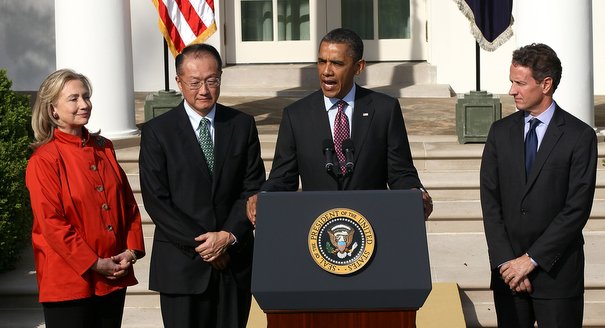
Secretary of the Treasury Timothy Geithner's focus on cutting the deficit risks worsening America's economic crisis.
Source: New Republic

But now I learn, in an excellent profile by Washington Post reporter Zachary Goldfarb, that Geithner is also behind the Obama administration’s unseemly obsession with reducing the debt and deficits—even if that should throw a few people out of work, prolong the Great Recession well into this decade, and pitch American politics to the right. (And, oh yes, increase the deficit and debt itself, because if the U.S. remains in a slump, that will cut into tax revenues and widen the deficit, whatever spending cuts Geithner and the Republicans should recommend.)
According to Goldfarb, Geithner gained the “upper hand” early last year in an administration debate about whether to propose a second stimulus program to Congress. While Lawrence Summers and Christina Romer argued for focusing on bringing down unemployment, Geithner called for focusing on reducing government debt. Of Geithner, Austan Goolsbee, who recently announced he is leaving his post as Chair of the Council of Economic Advisors to return to the University of Chicago Business School, says: “From the earliest moments of the administration and even before, he clearly had a big focus on long-term deficit reduction and making clear, not just to the markets but for the entire economy, that the government is living within its means.”
Of course, Presidents have gotten bad advice from their Treasury Secretaries before. In June 1937, while the United States was still in the midst of the Great Depression, but was enjoying a very modest rebound, Franklin Roosevelt’s Secretary of the Treasury Henry Morgenthau, Jr. recommended that he cut spending. Morgenthau acknowledged that while “the patient might scream a bit when he was taken off narcotics,” the time had come “to strip off the bandages, throw away the crutches,” and let the economy see if “it could stand on its own feet.” Roosevelt followed Morgenthau’s advice, and the economy plunged back into recession, the unemployment rate shot up, and Republicans and conservative Southern Democrats were able to attack the “Roosevelt recession.”
When the stock market tanked in March, 1938, Roosevelt began to have second thoughts. Morgenthau warned him that abandoning the attempt to balance the budget would harm business confidence. But Roosevelt decided not to listen to Morgenthau. He pressed ahead with new relief legislation and, by the next year, the economy was again showing modest signs of growth. Will Obama continue to listen to Geithner? I certainly hope not. I used to blame the administration’s timid and self-defeating fiscal policy on Republican intransigence, but as Goldfarb’s profile shows, Obama and his Treasury Secretary deserve a good part of the blame for what is becoming Obama’s “Great Recession.”

Former Visiting Scholar
As a visiting scholar at Carnegie, Judis wrote The Folly of Empire: What George W. Bush Could Learn from Theodore Roosevelt and Woodrow Wilson.
Recent Work
John Judis
John Judis
Carnegie does not take institutional positions on public policy issues; the views represented herein are those of the author(s) and do not necessarily reflect the views of Carnegie, its staff, or its trustees.

If the Russian-speaking community in Latvia cannot articulate their interests without being seen as disloyal, they could end up embracing a pro-Kremlin agenda.

Sergejs Potapkins

Russia’s ruling party would have benefited from Putin appearing as its distant patron, but as an active frontman imposing his views on the public, he has done nothing but harm both the party’s election campaign and the ruling system overall.

Andrey Pertsev

In the tenth year of his presidency, President Mirziyoyev’s system is becoming even more personalized than that of his predecessor Karimov.

Galiya Ibragimova

The greater threat to Zelensky comes not from Fedorov alone, but from the convergence between the former defense minister’s political campaign and the anti-corruption investigations moving ever closer to the presidential administration.

Balázs Jarábik

With his public call for new elections in Ukraine, ex-defense minister Mykhailo Fedorov has opened Pandora’s box.

Konstantin Skorkin