

• Research
  • Politika
  • About
Carnegie Russia Eurasia center logoCarnegie lettermark logo
  • Donate
{
  "authors": [
    "Uri Dadush",
    "Michele Dunne"
  ],
  "type": "legacyinthemedia",
  "centerAffiliationAll": "dc",
  "centers": [
    "Carnegie Endowment for International Peace"
  ],
  "collections": [
    "Arab Awakening"
  ],
  "englishNewsletterAll": "menaTransitions",
  "nonEnglishNewsletterAll": "",
  "primaryCenter": "Carnegie Endowment for International Peace",
  "programAffiliation": "MEP",
  "programs": [
    "Middle East"
  ],
  "projects": [],
  "regions": [
    "North America",
    "United States",
    "Middle East",
    "North Africa",
    "Egypt",
    "Libya",
    "Tunisia",
    "Western Europe"
  ],
  "topics": [
    "Political Reform",
    "Economy",
    "Foreign Policy"
  ]
}

Source: Getty

In The Media

American and European Responses to the Arab Spring: What’s the Big Idea?

Given the economic problems facing both sides of the Atlantic, Europe and the United States can best support democratic transitions in Arab countries through enhanced trade agreements that improve market access and maximize job-promoting reforms.

Link Copied
By Uri Dadush and Michele Dunne
Published on Sep 1, 2011

Source: Washington Quarterly

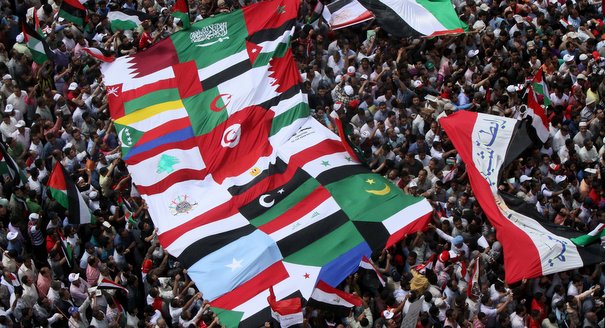
American and European Responses to the Arab SpringHow can Europe and the United States support democratic transitions in a way that is acceptable to the Arab countries, effective in inducing genuine change, and affordable at a time when both continents are confronting fiscal crises? The best instruments available are enhanced trade agreements that not only promote market access, but even more importantly maximize competitiveness-enhancing and job-promoting reforms in the Arab countries. The pre-uprising Western Policies—pressing recalcitrant Arab leaders to undertake top-down political reforms while building civil society capacity to generate bottom-up demand—have been overtaken by events in at least a significant minority of countries. There is now an explicit commitment to democratize, deeply-rooted in the general will of the people. The question is not whether, but how to do it.

Analogous to the process that successfully drew the formerly planned economies of Eastern Europe to liberal democracy, what is needed is a new and compelling vision for closer and more equitable economic relations both among Arab countries and between them and the trans-Atlantic community. Reflecting the global interest in successful transitions, the initiative should also mobilize assistance from large oil-importing countries outside of Europe and the United States. It should also draw on help from Saudi Arabia and the other Gulf States which, though clearly ambivalent about the democratic transitions in their Arab neighbors, have a vital interest in their growth and stability. To these ends, new trade agreements should be far deeper and more comprehensive than those currently in force and contain many of the elements included in Eastern European countries’ accession agreements, including a bold multi-year trade assistance initiative designed to bolster competitiveness and the role of the private sector in the Arab countries.

About the Authors

Uri Dadush

Former Senior Associate, International Economics Program

Dadush was a senior associate at the Carnegie Endowment for International Peace. He focuses on trends in the global economy and is currently tracking developments in the eurozone crisis.

Michele Dunne

Former Nonresident Scholar, Middle East Program

Michele Dunne was a nonresident scholar in Carnegie’s Middle East Program, where her research focuses on political and economic change in Arab countries, particularly Egypt, as well as U.S. policy in the Middle East.

Authors

Uri Dadush
Former Senior Associate, International Economics Program
Uri Dadush
Michele Dunne
Former Nonresident Scholar, Middle East Program
Michele Dunne
Political ReformEconomyForeign PolicyNorth AmericaUnited StatesMiddle EastNorth AfricaEgyptLibyaTunisiaWestern Europe

Carnegie does not take institutional positions on public policy issues; the views represented herein are those of the author(s) and do not necessarily reflect the views of Carnegie, its staff, or its trustees.

More Work from Carnegie Russia Eurasia Center

  • Commentary
    Carnegie Politika
    Will Hungary’s New Leader Really Change EU Policy on Russia and Ukraine?

    Orbán created an image for himself as virtually the only opponent of aid to Ukraine in the entire EU. But in reality, he was simply willing to use his veto to absorb all the backlash, allowing other opponents to remain in the shadows.

      Maksim Samorukov
  • Commentary
    Carnegie Politika
    Power, Pathways, and Policy: Grounding Central Asia’s Digital Ambitions

    Central Asia’s digital ambitions are achievable, but only if policy is aligned with the region’s physical constraints.

      Aruzhan Meirkhanova

  • Commentary
    Carnegie Politika
    The Afghanistan–Pakistan War Poses Awkward Questions for Russia

    Not only does the fighting jeopardize regional security, it undermines Russian attempts to promote alternatives to the Western-dominated world order.

      Ruslan Suleymanov

  • Commentary
    Carnegie Politika
    Moldova Floats a New Approach to Its Transnistria Conundrum

    Moldova’s reintegration plan was drawn up to demonstrate to Brussels that Chișinău is serious about the Transnistria issue—and to get the West to react.

      Vladimir Solovyov

  • Commentary
    Carnegie Politika
    After Ilia II: What Will a New Patriarch Mean for Georgia?

    The front-runner to succeed Ilia II, Metropolitan Shio, is prone to harsh anti-Western rhetoric and frequent criticism of “liberal ideologies” that he claims threaten the Georgian state. This raises fears that under his leadership the Georgian Orthodox Church will lose its unifying role and become an instrument of ultraconservative ideology.

      Bashir Kitachaev

Get more news and analysis from
Carnegie Russia Eurasia Center
Carnegie Russia Eurasia logo, white
  • Research
  • Politika
  • About
  • Experts
  • Events
  • Contact
  • Privacy
  • For Media
Get more news and analysis from
Carnegie Russia Eurasia Center
© 2026 Carnegie Endowment for International Peace. All rights reserved.