

Article
Bernd von Muenchow-Pohl
{
  "authors": [
    "Bernd von Muenchow-Pohl"
  ],
  "type": "legacyinthemedia",
  "centerAffiliationAll": "dc",
  "centers": [
    "Carnegie Endowment for International Peace",
    "Carnegie Europe"
  ],
  "collections": [],
  "englishNewsletterAll": "ctw",
  "nonEnglishNewsletterAll": "",
  "primaryCenter": "Carnegie Endowment for International Peace",
  "programAffiliation": "SAP",
  "programs": [
    "South Asia"
  ],
  "projects": [],
  "regions": [
    "South Asia",
    "India",
    "Western Europe",
    "Asia",
    "Europe"
  ],
  "topics": [
    "Economy",
    "Trade",
    "Foreign Policy"
  ]
}
Source: Getty
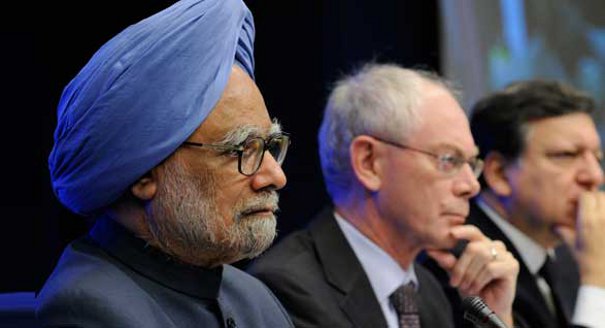
Despite initially high expectations, the enhanced relationship between India and the European Union has so far made relatively little impact and has fallen short of its own objectives.
Source: Great Indian Dream

From a historic perspective, the match seemed as if it would have a solid foundation. Adding a new dimension to its relationship with Europe, which was still overshadowed by the colonial past, New Delhi established diplomatic relations with the European Economic Community (EEC) as early as 1963. Ten years later, when Britain — India’s most important trading partner at the time — joined the original six EEC members, India’s loss of imperial trade preferences led to its first commercial cooperation agreement with the community. It took both sides another 20 years to sign their first political declaration after the EEC had morphed into an enlarged European Union of then twelve member states. In 2000, India’s raised economic and political profile and the EU’s desire to extend its newly defined political mission beyond the confines of the European continent after the end of the Cold War, brought about the first summit meeting in Lisbon. Successive annual summits heralded the EU-India Strategic Partnership (2004) and a voluminous Joint Action Plan for its implementation (2005).
Former Nonresident Scholar, South Asia Program
Von Muenchow-Pohl was a nonresident scholar in Carnegie’s South Asia Program, where his work focuses on Indian domestic, foreign, and economic policy.
Recent Work
Bernd von Muenchow-Pohl
Bernd von Muenchow-Pohl
Carnegie does not take institutional positions on public policy issues; the views represented herein are those of the author(s) and do not necessarily reflect the views of Carnegie, its staff, or its trustees.

With the growth in points of friction between the great powers, organizations like the SCO will continue to play a role in the strategic adaptation of the smaller powers caught between them.

Temur Umarov

When faced with fuel shortages in the past, Central Asian governments could always count on additional supplies from Moscow. That safety net no longer exists.

Galiya Ibragimova

Andrey Melnichenko’s essay offers no answer to the fundamental question of how, under any kind of negotiated settlement, Europe can protect itself from the Russian ressentiment that is inevitable in all scenarios except for an outright victory for Putin.

Leonid Bershidsky

Despite unhappiness on the ground, Moscow is determined to use both carrot and stick to ensure there is record support for United Russia in occupied Ukraine.

Konstantin Skorkin

Whether PAS can refocus on the unfinished business of state-building may ultimately prove more consequential for Moldova’s European future than the pace of its accession negotiations.

Balázs Jarábik