

Commentary
Dmitri Trenin
{
  "authors": [
    "Dmitri Trenin"
  ],
  "type": "legacyinthemedia",
  "centerAffiliationAll": "",
  "centers": [
    "Carnegie Endowment for International Peace",
    "Carnegie Russia Eurasia Center"
  ],
  "collections": [],
  "englishNewsletterAll": "",
  "nonEnglishNewsletterAll": "",
  "primaryCenter": "Carnegie Russia Eurasia Center",
  "programAffiliation": "",
  "programs": [],
  "projects": [],
  "regions": [
    "North America",
    "United States",
    "Caucasus",
    "Russia"
  ],
  "topics": [
    "Political Reform",
    "Foreign Policy"
  ]
}
Source: Getty
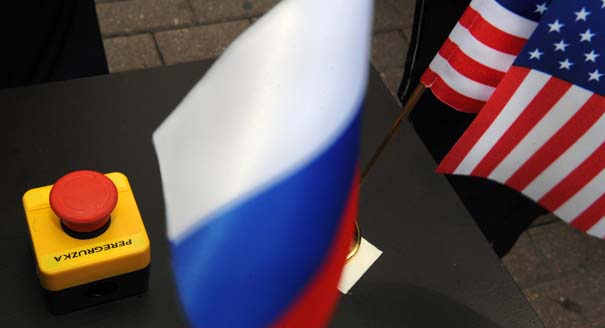
Missile defense continues to be a potential game changer in the often strained strategic relationship between Washington and Moscow.
Source: International Herald Tribune

But his statement, and more broadly the state of U.S.-Russian arms-control efforts, reveals a broad gap in how the nuclear powers perceive each other’s importance. For Washington, Russia has fallen far down on the list of priorities. The Russian political and security establishment, by contrast, continues to be obsessed with the United States.
In the televised statement, Medvedev warned that should the United States continue with plans to base antimissile systems in Europe, Russia would arm its ballistic missiles with advanced defense-penetration systems, deploy tactical missiles on the border with Poland, and possibly withdraw from the New Start nuclear arms reduction treaty.
The tough talk was provoked by Medvedev’s widely anticipated failure at a meeting with President Obama in Honolulu earlier this month to secure a formal assurance that the NATO system could not be used against Russia’s intercontinental ballistic missiles.
Obama’s refusal has its reasons, one of which is domestic. In some respects, for the White House to negotiate with the Republicans in Washington and even with parts of the U.S. government on any arms deal with Russia is more difficult than talking with the Russians.
As for Russia, a year after the promising Lisbon NATO summit — at which Russia and the alliance declared that they were on a path toward a strategic partnership — and less than a year before the U.S. presidential elections — the Russians have concluded that they have nothing to expect from Obama on arms issues in the remainder of his term.
As responses go, Medvedev’s may not have been particularly smart, but the damage so far is not great, either.
One of the measures listed by the Russian president — a radar under construction in Kaliningrad — is about early warning of a missile attack, not about countering NATO’s future missile defenses.
Similarly, giving Russia’s new strategic nuclear warheads a better capability to penetrate missile defenses is a long-standing program, which will continue as long as deterrence remains the mainstay of the U.S.-Russian strategic relationship. As for New Start, there is little that Russia can gain from quitting the treaty. Before it does so, it should look back on the experience of the U.S.-Soviet arms race and its role in the terminal exhaustion of the Soviet Union.
Medvedev’s darker, but also more distant threat to deploy Iskander missiles in Kaliningrad and Krasnodar to target Poland and Romania, is, of course, anything but smart. By threatening the countries that will host U.S. interceptors, Russia will refurbish its reputation as a security threat to Europe and help solidify NATO, and it could lead to a new confrontation if the U.S. responds by raising the ante and creating a threat to Russia analogous to the Euromissiles of the early 1980s.
With Europe and Russia having slipped down on the Pentagon’s priority list, a new Cuban missile crisis appears improbable. Nonetheless, the failure to agree on missile defenses in the past year has revealed important and troubling things about the American and Russian security establishments.
Beyond Afghanistan, and to some extent Iran, the United States sees Russia as a low-value partner. It does see it as a security risk in view of the anti-Americanism of much of Russia’s elite and Moscow’s close ties with a number of anti-U.S. regimes. But as America becomes ever more focused on the Asia-Pacific region, it is basically ignoring Russia, whose presence and influence there are considered negligible.
The Russians, on the contrary, persist in seeing the United States through the old Soviet prism of a superpower confrontation. Most officials in Moscow refuse to accept Iran as the real rationale for the U.S./NATO missile-defense efforts, and see them as a cover for undermining the Russian deterrent. Hence the insistence on a dual key, which would give Moscow the means to block NATO’s system; or the idea of a sectoral defense, which would ban NATO assets from northern Europe, from where they could threaten Russian missiles; and essentially a demand, in the form of legally-binding guarantees, for a new ABM treaty.
The situation is clearly asymmetrical: While the U.S. does not care much about Russia, the Russians’ pride refuses to accept this, preferring to believe that the U.S. is only dissimulating its deep-seated desire to diminish and, if possible, destroy Russia.
One can certainly live with that, but both governments would do themselves a lot of good if they started to amend the state of affairs between them. Russia will not be a U.S. ally, but there are a number of areas in which the Russian connection has been and will continue to be useful for Washington: nonproliferation, terrorism, and regional issues, including in the Asia-Pacific.
For Russia, seeking to regain the status of a politico-military peer of the United States, and, through rearmament, restore the balance of terror as the only acceptable basis for the bilateral relationship, can come only at a high cost, both financial and political.
Despite the lack of progress so far, missile defense continues to be a potential game changer in the woefully archaic strategic relationship between Washington and Moscow. Russia needs to take a hard look at its negotiating position and cleanse it of the unrealistic and essentially useless demands for formal guarantees of U.S. nonaggression. The United States, for its part, needs to hold out a prospect of serious technological transfers to Russia as part of missile-defense cooperation.
Unless the U.S.-Russian diplomatic recess is used for serious homework and building channels for intense trust-building dialogue between Russia, on the one hand, and the U.S. and its allies on the other, mutual assured destruction, as during the Cold War, will remain the foundation of security in the Euro-Atlantic.
Former Director, Carnegie Moscow Center
Trenin was director of the Carnegie Moscow Center from 2008 to early 2022.
Recent Work
Dmitri Trenin
Dmitri Trenin
Carnegie does not take institutional positions on public policy issues; the views represented herein are those of the author(s) and do not necessarily reflect the views of Carnegie, its staff, or its trustees.

Japan’s long-term security policy is driven by concerns about China, and there is little appetite for (or interest in) pursuing a confrontation with Moscow.

James D.J. Brown

The truth of the strategic situation is that Europe and Russia are extremely unlikely to be able to “turn the page” on their confrontation within the next two decades.

Arkady Moshes

Russia spent years building a “sovereign internet,” concentrating web infrastructure exclusively within Russian territory. Ukrainian drone attacks have shown how vulnerable that approach has left the Russian internet.

Maria Kolomychenko

Putin’s conservative staffing policies and search for ever greater control have cemented parliament’s transformation into a bureaucratic appendage of the executive branch.

Andrey Pertsev

Russia’s AI-driven propaganda campaigns operate in a fragmented, chaotic, and often illogical manner. That’s not necessarily a problem for the Kremlin, though: It’s much easier to mimic genuine public debate that way.

Ilya Klishin