

Commentary
Dmitri Trenin
{
  "authors": [
    "Dmitri Trenin"
  ],
  "type": "legacyinthemedia",
  "centerAffiliationAll": "",
  "centers": [
    "Carnegie Endowment for International Peace",
    "Carnegie China",
    "Carnegie Russia Eurasia Center"
  ],
  "collections": [
    "China’s Foreign Relations",
    "U.S.-China Relations"
  ],
  "englishNewsletterAll": "",
  "nonEnglishNewsletterAll": "",
  "primaryCenter": "Carnegie Endowment for International Peace",
  "programAffiliation": "",
  "programs": [],
  "projects": [
    "Eurasia in Transition"
  ],
  "regions": [
    "East Asia",
    "China",
    "Caucasus",
    "Russia",
    "North America",
    "United States"
  ],
  "topics": [
    "Foreign Policy"
  ]
}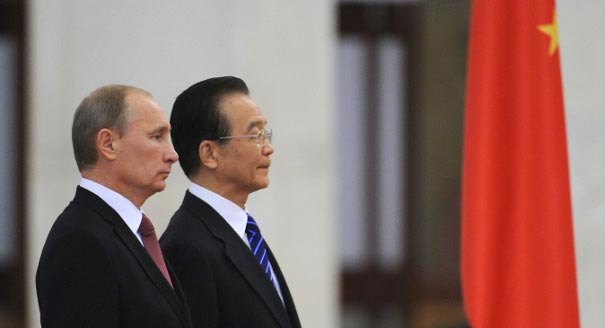
Source: Getty
As China's power continues to grow, Russians need to rediscover themselves as a Euro-Pacific nation and strengthen ties to East Asia in order to avoid becoming Beijing's junior partner.
Source: Public Service Europe

The remarkable thing is that, given the enormity of the change and its swiftness, Moscow and Beijing managed to end their 30-year-long Cold War in 1989 and moved toward a generally peaceful and collaborative arrangement. The thorny border issue, a fulcrum of tension in the past, has been resolved. And the border itself has been largely demilitarised. China has become Russia's biggest foreign trade partner, ahead of Germany. Russian arms sales over the past 20 years have helped the PLA to narrow the gap with the world's top militaries. With a number of smaller Central Asian states, China and Russia have formed the Shanghai Cooperation Organisation, which helps mitigate their regional rivalry and functions as a platform for dialogue involving much of continental Asia. Finally, on the global arena, Moscow and Beijing speak the language of multilateralism and insist on the sanctity of national sovereignty - and the principle of non-interference in domestic affairs. ...
Full text of the article in Public Service Europe
Former Director, Carnegie Moscow Center
Trenin was director of the Carnegie Moscow Center from 2008 to early 2022.
Recent Work
Dmitri Trenin
Dmitri Trenin
Carnegie does not take institutional positions on public policy issues; the views represented herein are those of the author(s) and do not necessarily reflect the views of Carnegie, its staff, or its trustees.

For every ruble allocated to social policy, health, and education in 2027, double that amount is earmarked for the army, the police, and the security services.

Alexandra Prokopenko

Cargo traffic through Russia’s Northern Sea Route has increased because of the disruption caused by the conflict in the Middle East, the Ukraine war, and U.S.-China tensions.

Mikhail Korostikov
An analysis of traffic accident data suggests that Ukrainian drone attacks caused a material but not disastrous fall in Russian gasoline consumption over the summer.

Sergey Vakulenko

Sergei Kiriyenko used Russia’s parliamentary vote to further hone his strategy of corporate mobilization that is designed to maximize votes for United Russia.

Andrey Pertsev

Trump has promised Belarus a massive potash deal. But Minsk is seeking something greater: restored Western transit and greater room for maneuver from Russia.

Balázs Jarábik