

Commentary
Sarah Chayes
{
  "authors": [
    "Sarah Chayes"
  ],
  "type": "legacyinthemedia",
  "centerAffiliationAll": "dc",
  "centers": [
    "Carnegie Endowment for International Peace"
  ],
  "collections": [],
  "englishNewsletterAll": "democracy",
  "nonEnglishNewsletterAll": "",
  "primaryCenter": "Carnegie Endowment for International Peace",
  "programAffiliation": "DCG",
  "programs": [
    "Democracy, Conflict, and Governance"
  ],
  "projects": [],
  "regions": [
    "North Africa",
    "Tunisia"
  ],
  "topics": [
    "Political Reform",
    "Democracy",
    "Economy"
  ]
}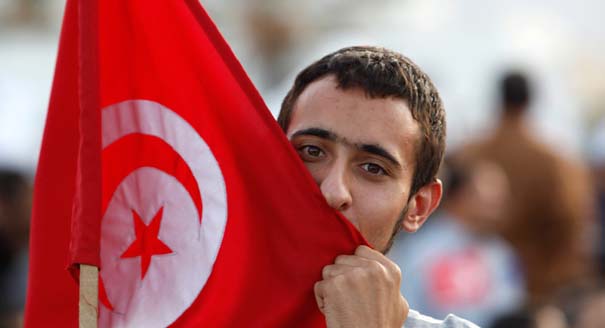
Source: Getty
Widespread corruption led to the overthrow of ben Ali's regime in Tunisia. If the current government does not tackle the problem, it could have dire consequences for Tunisia's fledgling democracy.
Source: Los Angeles Times

But it wasn't religion that set off the Jasmine Revolution; it was acute economic injustice and the pervasive and structured corruption that helped produce it. The fate of Tunisia, and its neighbors, may depend most on whether that lingering problem is addressed.
You can usually tell which buildings in this sparkling, white-and-sky-blue country the family of former dictator Zine el Abidine ben Ali had a stake in; they're eyesores. Last month, a small group of protesters gathered in front of one of them, a squat, mustard-colored hotel complex on a beach in the town of Kilibia.
Kilibia, home to extensive Roman and Punic archaeological sites, also boasts beaches of silky, ash-white sand, which audibly sings underfoot as you walk across it. The seafront is exactly the kind of resource members of the Ben Ali family liked to commandeer for their personal gain.
They had shares in several sprawling hotels here, including the yellow one, built with an Italian investor. Typically for the Tunisian tourism industry, it functioned and still functions as a closed system: Tunisians are not allowed on the beach; the hotel employs no Tunisians except for a few guards, purchases no Tunisian supplies or food — not even any luscious local olive oil. Everything is shipped in from Italy.
Now the hotel is dumping coarse yellow sand across the top half of the beach to cushion tourists' feet from a rock formation.
This may sound like a trivial transgression. But it typifies the arrogation of public resources and financial opportunities for the personal enrichment of regime insiders that sparked last year's uprising.
Under the Ben Ali dictatorship, physical repression, torture and disappearances were fairly uncommon. The regime perpetrated its oppression by means of a diabolically intrusive system of state corruption.
This particularity has prompted Tunisian activists to blaze new paths in human rights doctrine. They are seeking to expand the definition of "gross violations of human rights" to include systematic economic crimes. They want perpetrators to answer for these crimes in a public reckoning, as part of a transitional justice process, like the ones in South Africa or Rwanda that focused on physical abuses.
Tunisia's new Cabinet includes a minister for "governance and anti-corruption." This is an innovation, certainly, but activists worry that his appointment was more show than substance.
A commission established in the weeks after Ben Ali's overthrow, and including public accountants and specialists in the intricacies of administrative or real estate law, examined some 5,000 complaints. The report it released in November exposed a vast system of structured corruption by which the Ben Ali in-laws and their cronies helped themselves to the best of everything: stakes in the most lucrative businesses, exemption from customs dues, choice public land. Government institutions such as tax authorities and the judiciary, even private banks, became instruments of coercion. Recalcitrant chief executives would get slapped with an audit or see their loans dry up or their authorizations revoked.
The commission developed evidence on 400 cases, which it transferred to courts. But according to member Amine Ghali, only a handful have been taken up by a judiciary still largely staffed by Ben Ali-era personnel.
"We're no one's first priority," says Ghali, detailing examples of neglect by the current government. "We have no office equipment or vehicles, no power to subpoena witnesses or to protect them. Members who are government employees don't even get relieved of their regular duties but have to do this work on the side. You get the feeling the government doesn't care if we succeed."
Many fear that the current political elite, including the leadership of the ruling Islamist party, intends to quietly appropriate the old structures and practices for their own benefit. Recently passed provisions of this year's budget include Ben Ali-style shelters for potentially ill-gotten gains, in return for a financial contribution. Taoufik Chamari, of the National Anti-Corruption Network, warns of the "real risk that the same system of corruption will be maintained, legitimized by new beneficiaries."
Corruption is a less photogenic issue than heavily veiled women. Yet when it grows so pervasive as to amount to capture of the state by a structured criminal network, as it did in Tunisia and in Egypt, public outrage can get explosive. Many here predict that if Tunisia does not use this remarkable post-revolutionary moment to impose accountability, then a frustrated people may truly radicalize, turning to militant, puritanical readings of Islam to afford a recourse the post-revolutionary democracy did not.
As the example of the yellow hotel suggests, actions of Westerners — conscious or unconscious — matter. Our support for Arab nations in transition, our behavior as investors and visitors, should break with past habits of contributing to corruption.
This article was originally published in the Los Angeles Times.

Former Senior Fellow, Democracy, Conflict, and Governance Program
Sarah Chayes is internationally recognized for her innovative thinking on corruption and its implications. Her work explores how severe corruption can help prompt such crises as terrorism, revolutions and their violent aftermaths, and environmental degradation.
Recent Work
Sarah Chayes
Carnegie does not take institutional positions on public policy issues; the views represented herein are those of the author(s) and do not necessarily reflect the views of Carnegie, its staff, or its trustees.
The greater threat to Zelensky comes not from Fedorov alone, but from the convergence between the former defense minister’s political campaign and the anti-corruption investigations moving ever closer to the presidential administration.

Balázs Jarábik

With his public call for new elections in Ukraine, ex-defense minister Mykhailo Fedorov has opened Pandora’s box.

Konstantin Skorkin

In the discussions made possible by the State Duma election campaign, one question is being asked more and more loudly. “What next?”

Andrey Pertsev

Two divergent trends—Putin’s hardline vision of how to prosecute the war in Ukraine, and a growing desire for change in Russia—could tear the regime apart.

Tatiana Stanovaya
Ultimately, Zelensky sided neither with the reform camp nor with the military establishment as such, but with political control.
Balázs Jarábik