

Commentary
Sarah Chayes
{
  "authors": [
    "Sarah Chayes"
  ],
  "type": "legacyinthemedia",
  "centerAffiliationAll": "dc",
  "centers": [
    "Carnegie Endowment for International Peace"
  ],
  "collections": [],
  "englishNewsletterAll": "ctw",
  "nonEnglishNewsletterAll": "",
  "primaryCenter": "Carnegie Endowment for International Peace",
  "programAffiliation": "SAP",
  "programs": [
    "South Asia"
  ],
  "projects": [],
  "regions": [
    "South Asia",
    "Afghanistan"
  ],
  "topics": [
    "Political Reform",
    "Security",
    "Military"
  ]
}
Source: Getty
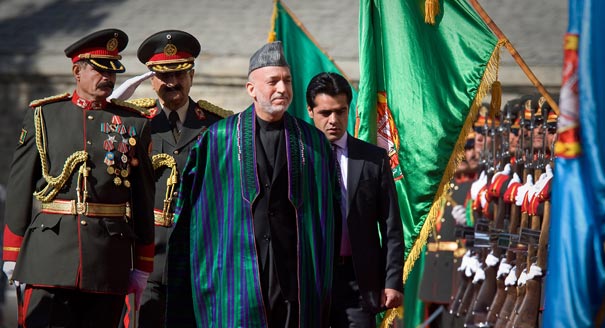
Afghan President Hamid Karzai's ousting of two top security officials may signal an increased tolerance for the Taliban and a closer alignment with Pakistan in the years to come.
Source: Los Angeles Times

It is always hazardous to claim to see through the complexities of Afghan politics, but the ousters were clearly rooted, at least in part, in a fierce struggle for positioning in a post-America Afghanistan that may well implode.
One reason cited by officials and the media for the no-confidence vote is that the lawmakers had grown exasperated by the security forces' inability to stem or respond to artillery fire that has been pummeling Afghanistan from neighboring Pakistan. It's certainly true that people are frustrated by the shelling, but whether that is the reason or the excuse for the vote is less clear. Short of a declaration of war on Pakistan, an eminently political decision that would require at least some international coordination, it's not clear what the army could do.A second reason cited for the ousters is that Karzai wants to demonstrate that he is at last taking action against corruption in his government, and the record of police and military personnel is particularly poor. However, having worked for two commanders of international military forces as well as for the Joint Staff on anti-corruption policy in Afghanistan, I have not observed Karzai, since 2003, make a good-faith move to address the institutionalized graft that plagues his country. Rather, he has obstructed anti-corruption efforts, directing ministers to shut down investigations, ordering detained suspects set free, and reportedly helping arrange the 2010 escape from Afghanistan of a former minister of religious affairs indicted on charges of corruption. It seems unlikely that high-mindedness is motivating the president now.
A third reason frequently cited for the vote is that the members of the Afghan parliament—far from immune to corruption themselves—were irritated at their inability to obtain some of the jobs and lucrative contracts the two ministers hand out. Though all of these possibilities probably contain elements of truth, and may have helped stoke lawmakers' enthusiasm for the vote, this third one rings truest.
But to understand the move's greatest significance, you have to examine the ouster of the interior minister, Bismullah Khan Mohammadi.
Mohammadi, an ethnic Tajik, was a key commander in the northern resistance to the Taliban during the civil war that raged in Afghanistan from 1994 through the fall of that regime in 2001. For the first eight years of the Karzai government, he served as chief of staff of the Afghan national army. Senior U.S. and Afghan military officers once described to me how shrewdly he calculated his appointments, especially at the crucial middle-management level, larding the officer corps with lieutenant colonels and colonels loyal to the old northern commanders.
As minister of the interior, a position he assumed in June 2010, he aggressively pursued the same policy within the Afghan national police while retaining the personal loyalty of many ranking army officers. In 2011, NATO's International Security Assistance Force Joint Command, which manages the day-to-day running of the war, was tracking the way he gerrymandered police zones in the north so as to build what amounted to a region that excludes ethnic Pashtuns. He also rapidly expanded the arming of local militias in the north.
Most Afghans and experienced observers I know say a plausible scenario upon the large-scale departure of international troops in 2014 is either disintegration into civil conflict or a de facto division of power along ethnic lines, with a Pakistan-backed Pashtun bloc in the south and east lining up against one or more northern non-Pashtun blocs that might well gain military support from India and Uzbekistan, if not Iran. Recent signs indicate that many key players are already rushing to consolidate their positions within this framework, already operating, for all intents and purposes, in a post-2014 world.
It is in this context that Mohammadi's dismissal is to be understood. He is a key northern bloc asset. And in the same way international forces stepped up their campaign to capture and kill Taliban commanders, northern military leaders are being neutralized at a rapid rate, regardless of their official positions in the Karzai government. Before Mohammadi, it was key Uzbek former commander Ahmad Khan Samanghani, killed in a blast at a wedding in mid-July.
The other minister voted out of office this month, Abdul Rahim Wardak, is far less consequential. Though described as a Karzai loyalist and appreciated by international officials, he was known to be the butt of verbal abuse by Karzai in Cabinet meetings and was reputed to be a heavy drinker with little real control over the Afghan army. Karzai typically removes officials in pairs to provide the appearance of ethnic or tribal evenhandedness. In this case, Wardak would be the fig leaf for Mohammadi's removal.
This reading of events suggests that Karzai will end up aligning himself with the Pakistan/Pashtun, Taliban-tolerant bloc. While as president he has often criticized Pakistan, he also has expressed understanding for the Taliban and has pardoned dozens of Taliban prisoners. In 1994, when the Taliban took power in southern Afghanistan, Karzai was a strong supporter. The regime selected him to serve as its ambassador to the United Nations, though it never got a seat in the world body. So perhaps we should not be surprised if he lines up that way again today.
This article was originally published in the Los Angeles Times.
Former Senior Fellow, Democracy, Conflict, and Governance Program
Sarah Chayes is internationally recognized for her innovative thinking on corruption and its implications. Her work explores how severe corruption can help prompt such crises as terrorism, revolutions and their violent aftermaths, and environmental degradation.
Recent Work
Sarah Chayes
Carnegie does not take institutional positions on public policy issues; the views represented herein are those of the author(s) and do not necessarily reflect the views of Carnegie, its staff, or its trustees.

If the Russian-speaking community in Latvia cannot articulate their interests without being seen as disloyal, they could end up embracing a pro-Kremlin agenda.

Sergejs Potapkins

Russia’s ruling party would have benefited from Putin appearing as its distant patron, but as an active frontman imposing his views on the public, he has done nothing but harm both the party’s election campaign and the ruling system overall.

Andrey Pertsev

In the tenth year of his presidency, President Mirziyoyev’s system is becoming even more personalized than that of his predecessor Karimov.

Galiya Ibragimova

With the growth in points of friction between the great powers, organizations like the SCO will continue to play a role in the strategic adaptation of the smaller powers caught between them.

Temur Umarov
The greater threat to Zelensky comes not from Fedorov alone, but from the convergence between the former defense minister’s political campaign and the anti-corruption investigations moving ever closer to the presidential administration.

Balázs Jarábik