

In The Media
David Rothkopf
{
  "authors": [
    "David Rothkopf"
  ],
  "type": "legacyinthemedia",
  "centerAffiliationAll": "",
  "centers": [
    "Carnegie Endowment for International Peace"
  ],
  "collections": [],
  "englishNewsletterAll": "",
  "nonEnglishNewsletterAll": "",
  "primaryCenter": "Carnegie Endowment for International Peace",
  "programAffiliation": "",
  "programs": [],
  "projects": [],
  "regions": [
    "North America",
    "United States"
  ],
  "topics": [
    "Political Reform"
  ]
}
Source: Getty
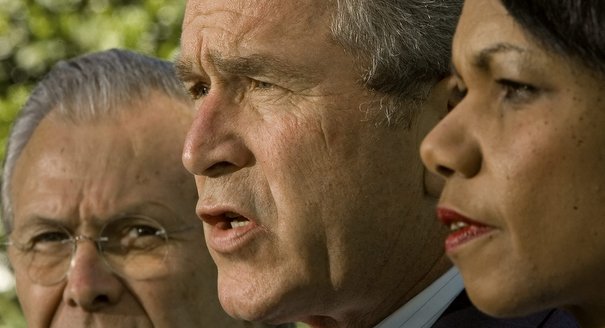
Fewer than four years after George W. Bush left office, his team members are back in high places, their reputation is being reconsidered, and the Bush name is regaining its old luster.
Source: Washington Post

Not bad for one of the marquee names of an administration that left office with a deeply damaged reputation, particularly on foreign policy.
The rehabilitation of Rice is just part of a broader restoration of the Bush brand and of those who worked with our 43rd president. Fewer than four years after George W. Bush left office, his team members are back in high places, their reputation is being reconsidered, and the Bush name is regaining its old luster and then some.
Among those joining Rice at Romney’s June retreat for top donors were former top Bush administration officials such as Karl Rove, who also addressed the 800 attendees; former homeland security czar Michael Chertoff; former Florida governor Jeb Bush; and even luminaries from the George H.W. Bush administration such as former secretary of state James Baker III. Jeb Bush was also a GOP convention headliner, delivering a well-received speech on education.
Particularly striking is the degree to which Bush 43 foreign policy players have assumed leading roles in shaping policy for Romney. John Bolton, Bush’s U.N. ambassador and an especially combative member of the neoconservative contingent so closely linked with that administration, has been part of Romney’s inner circle throughout the year.
Cofer Black, a former top executive at the Bush-era security contractor once called Blackwater, is a top adviser to Romney on intelligence issues, shaping his views on subjects such as interrogations of terrorism suspects. And Dan Senor, who was a top official in the Coalition Provisional Authority in Iraq in the year after the invasion, is now at the right hand of vice presidential nominee Paul Ryan. Senor was also cited as one of the influential thinkers behind some of Romney’s controversial comments during his trip to Israel, when he said the innate superiority of Israeli culture is one reason the Israelis are doing better economically than the Palestinians.
Barack Obama was swept into the presidency four years ago in part because of his explicit rejection of Bush’s policies. The Bush vision of an America unhesitant to impose its will with or without international support had cost the country too much in lives, resources and international standing, and the neocons and other top Bush figures had fallen into disrepute, perhaps never to be heard from again. But now they’re out of the wilderness — and finding homes in the Romney campaign.
By facilitating the reconsideration of the Bush legacy, the Republican nominee may also be inviting some of the feuds that characterized Bush’s foreign policy team. Other Bush alums who are advising or quietly consulting with the campaign could become rivals to the neocons because they offer more moderate or “realist” views. This group, led by Romney’s national security transition leader, Robert Zoellick — who was deputy secretary of stateand later head of the World Bank — includes people such as former CIA director Michael Hayden and Rice, a former protege of Brent Scowcroft, who served as national security adviser to the first President Bush.
It appears a battle is already underway between the neocons, who seem to think the answer to any problem is more military spending and the threat of force, and the foreign policy traditionalists from the George H.W. Bush administration — now widely regarded as one of the most competent in modern U.S. history for its deft management of the end of the Cold War and of the Persian Gulf War, which achieved its goals but did not escalate or alienate the world.
Even Dubya himself has begun to get more respect, whether it is MSNBC’s Joe Scarborough saying that Bush was more direct and principle-driven than Romney, or a senior diplomat from the developing world telling me recently that “we miss Bush. You knew where he stood. From Africa to Latin America to India to Russia, the people I speak to felt he was easier to read and more dependable than Obama.”
And investors I speak to suggest that Bush and his Treasury secretary, Hank Paulson, acted far more decisively and effectively in 2008 than their European counterparts have in dealing with the continent’s financial crisis.
Even Iraq is now seen as likely to have a better long-term outcome than the war in Afghanistan, to which Obama has devoted more resources and attention. And in his most recent book, “Confront and Conceal,” the New York Times’ David Sanger reported that Obama’s “light footprint” warfare of drones, Special Forces and cyberattacks is one of the few policy initiatives that Bush, as he was leaving office, urged on the incoming president.
No doubt, former presidents often have their public standing swing from one extreme to another. Richard Nixon saw his reputation recover, while Jimmy Carter and Bill Clinton left office with damaged images but emerged as great ex-presidents. Old wounds heal over time, and more nuanced perspectives arise when partisan emotions begin to fade.
Even so, the rebound for Bush and his team has been uncommonly and surprisingly fast. And while the dubious case for the war in Iraq, Abu Ghraib, Guantanamo and the Patriot Act still stir deserved resentment and criticism in many circles, apparently people have begun to forgive, even before they have had time to forget.
Former Visiting Scholar
David Rothkopf was a visiting scholar at the Carnegie Endowment as well as the former CEO and editor in chief of the FP Group.
Recent Work
David Rothkopf
David Rothkopf
Carnegie does not take institutional positions on public policy issues; the views represented herein are those of the author(s) and do not necessarily reflect the views of Carnegie, its staff, or its trustees.

Putin’s conservative staffing policies and search for ever greater control have cemented parliament’s transformation into a bureaucratic appendage of the executive branch.

Andrey Pertsev

Ex-president Gurbanguly Berdimuhamedov remains interested in politics, but his son Serdar, Turkmenistan’s current president, is becoming increasingly independent and willing to break with his father’s legacy. If their covert rivalry goes too far, both risk losing power.

Galiya Ibragimova

Sergei Kiriyenko used Russia’s parliamentary vote to further hone his strategy of corporate mobilization that is designed to maximize votes for United Russia.
Andrey Pertsev

Trump has promised Belarus a massive potash deal. But Minsk is seeking something greater: restored Western transit and greater room for maneuver from Russia.

Balázs Jarábik

The European far right might fail to steer EU policy in the direction Russia wants, but they will create enough chaos inside Europe to benefit the Kremlin.

Dimitar Bechev