

• Research
  • Politika
  • About
Carnegie Russia Eurasia center logoCarnegie lettermark logo
  • Donate
{
  "authors": [
    "Nathan J. Brown",
    "Mokhtar Awad"
  ],
  "type": "legacyinthemedia",
  "centerAffiliationAll": "dc",
  "centers": [
    "Carnegie Endowment for International Peace",
    "Malcolm H. Kerr Carnegie Middle East Center"
  ],
  "collections": [
    "Arab Awakening"
  ],
  "englishNewsletterAll": "menaTransitions",
  "nonEnglishNewsletterAll": "",
  "primaryCenter": "Carnegie Endowment for International Peace",
  "programAffiliation": "MEP",
  "programs": [
    "Middle East"
  ],
  "projects": [],
  "regions": [
    "North Africa",
    "Egypt"
  ],
  "topics": [
    "Political Reform"
  ]
}

Source: Getty

In The Media

Violent Protests, Judge Shortages Plague Egypt's Referendum

Rallies and protests centered on Egypt's constitutional referendum turned violent as the struggle for the political future of Egypt continues.

Link Copied
By Nathan J. Brown and Mokhtar Awad
Published on Dec 14, 2012

Source: NewsHour

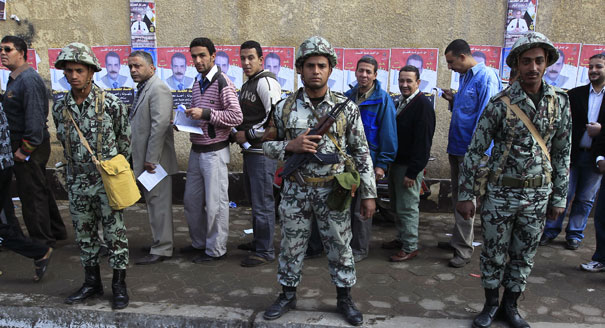
Rallies for and against Egyptian President Mohammed Morsi got violent in Alexandria Friday on the eve of a referendum on a constitution drafted mainly by his Muslim Brotherhood party.

The voting was split into two rounds -- this Saturday and Dec. 22 -- to ensure enough judges would be available to supervise polling sites after many decided to go on strike.

Nathan Brown, professor of political science and international affairs at George Washington University, and Mokhtar Awad, junior fellow at the Carnegie Endowment for International Peace, discussed the discontent in Egypt. They answered the following questions in a joint email:

What is it about the constitution that the opposition doesn't like?

Their original complaints were about the process -- that it was written by an assembly that was dominated by Islamists. They have other procedural complaints as well -- the speed of the drafting and the short time between the drafting and the referendum. They are beginning to develop criticism of the content as well-they say the draft is too presidential, offers weak protections for basic rights, and enshrines conservative religious principles in law. These criticisms have some foundation, though some are exaggerated.

Why did they decide to urge a "no" vote rather than a boycott?

This was a big topic of debate. They have been pressured by some to come up with a positive agenda rather than just a negative one; they may also be drawing back from seeming to want to delegitimate the entire system. They hope that a narrow win will but enough pressure on Morsi domestically and internationally that it will stop emerging authoritarian tendencies. They also may hope to get practice for parliamentary elections that follow in two months should the constitution be approved.

In general, why has each step been problematic in Egypt?

The process was badly designed at the beginning with the military taking full control over the process and mismanaging it rather than setting up a consensual transition leadership. Egypt has been run by a series of constitutional declarations since the suspension of the 1971 constitution, the first of which was a 63 article constitutional declaration issued on March 30, 2011 to govern the provisional period-it mostly included articles from the 1971 constitution, including articles amended by the March 19, 2011 referendum. The March 30, 2011 constitutional declaration was a complicated and problematic document and helped set the stage for an opaque and legally confusing transitional period.

This article originally appeared on PBS' NewsHour.

About the Authors

Nathan J. Brown

Nonresident Senior Fellow, Middle East Program

Nathan J. Brown, a professor of political science and international affairs at George Washington University, is a distinguished scholar and author of nine books on Arab politics and governance, as well as editor of five books.

Mokhtar Awad

Former Junior Fellow, Middle East Program

Authors

Nathan J. Brown
Nonresident Senior Fellow, Middle East Program
Nathan J. Brown
Mokhtar Awad
Former Junior Fellow, Middle East Program
Political ReformNorth AfricaEgypt

Carnegie does not take institutional positions on public policy issues; the views represented herein are those of the author(s) and do not necessarily reflect the views of Carnegie, its staff, or its trustees.

More Work from Carnegie Russia Eurasia Center

  • Commentary
    Carnegie Politika
    The Kremlin Is Destroying Its Own System of Coerced Voting

    The use of technology to mobilize Russians to vote—a system tied to the relative material well-being of the electorate, its high dependence on the state, and a far-reaching system of digital control—is breaking down.

      Andrey Pertsev

  • Commentary
    Carnegie Politika
    Notes From Kyiv: Is Ukraine Preparing for Elections?

    As discussions about settlement and elections move from speculation to preparation, Kyiv will have to manage not only the battlefield, but also the terms of political transition. The thaw will not resolve underlying tensions; it will only expose them more clearly.

      Balázs Jarábik

  • Commentary
    Carnegie Politika
    Where Does the Split in the Ruling Tandem Leave Kyrgyzstan?

    Despite its reputation as an island of democracy in Central Asia, Kyrgyzstan appears to be on the brink of becoming a personalist autocracy.

      Temur Umarov

  • Commentary
    Carnegie Politika
    In Uzbekistan, the President’s Daughter Is Now His Second-in-Command

    Having failed to build a team that he can fully trust or establish strong state institutions, Mirziyoyev has become reliant on his family.

      Galiya Ibragimova

  • Commentary
    Carnegie Politika
    Japan’s “Militarist Turn” and What It Means for Russia

    For a real example of political forces engaged in the militarization of society, the Russian leadership might consider looking closer to home.

      James D.J. Brown

Get more news and analysis from
Carnegie Russia Eurasia Center
Carnegie Russia Eurasia logo, white
  • Research
  • Politika
  • About
  • Experts
  • Events
  • Contact
  • Privacy
Get more news and analysis from
Carnegie Russia Eurasia Center
© 2026 Carnegie Endowment for International Peace. All rights reserved.