

Research
- +6
Yasmine Farouk, Nathan J. Brown, Maysaa Shuja Al-Deen, …
{
  "authors": [
    "Anouar Boukhars"
  ],
  "type": "other",
  "centerAffiliationAll": "dc",
  "centers": [
    "Carnegie Endowment for International Peace"
  ],
  "collections": [],
  "englishNewsletterAll": "menaTransitions",
  "nonEnglishNewsletterAll": "",
  "primaryCenter": "Carnegie Endowment for International Peace",
  "programAffiliation": "MEP",
  "programs": [
    "Middle East"
  ],
  "projects": [],
  "regions": [
    "North Africa",
    "Mali"
  ],
  "topics": [
    "Political Reform",
    "Security",
    "Military"
  ]
}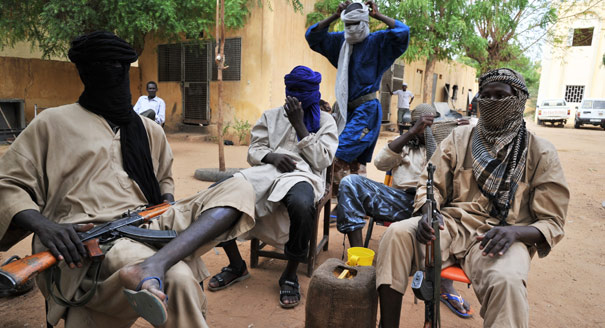
Source: Getty
French military gains in northern Mali will be fruitless unless they are included in a comprehensive strategy that addresses the root causes of the conflict.
Source: FRIDE
When radical Islamists launched an offensive against the south of Mali, France had no choice but to intervene militarily. The success of the campaign, however, depends on a sound understanding of the complex dynamics of Mali’s internal conflict and fragility. To view the turmoil through the lens of Islamic radicalization only is a dangerous oversimplification. Equally misguided is the common characterization of the problem as a simple North-South dispute. Such confusion imperils strategic practice and detracts attention from the essential set of tensions that makes the conflict self-reinforcing. The causal factors are as diverse as the motivations of the competing tribal and ethnic actors and organizations that sustain instability.
Thus, the French military gains in northern Mali will be fruitless unless they are included in a comprehensive strategy that addresses the root causes of the conflict: weak and corrupt state institutions, ethnic tensions, and competition over scarce resources. In the short term, the international community’s immediate priority should be to provide urgent humanitarian relief and push for political dialogue and military reform. Promoting extensive consultations with all stakeholders and stabilizing civil-military relations are crucial to reconciliation and recovery.
The full text of this policy brief is available on the FRIDE website.
Former Nonresident Fellow, Middle East Program
Boukhars was a nonresident fellow in Carnegie’s Middle East Program. He is a professor of countering violent extremism and counter-terrorism at the Africa Center for Strategic Studies, National Defense University.
Recent Work


Yasmine Farouk, Nathan J. Brown, Maysaa Shuja Al-Deen, …

Frederic Wehrey, Nathan J. Brown, Bader Al-Saif, …
Carnegie does not take institutional positions on public policy issues; the views represented herein are those of the author(s) and do not necessarily reflect the views of Carnegie, its staff, or its trustees.

Putin’s conservative staffing policies and search for ever greater control have cemented parliament’s transformation into a bureaucratic appendage of the executive branch.

Andrey Pertsev

Russia’s AI-driven propaganda campaigns operate in a fragmented, chaotic, and often illogical manner. That’s not necessarily a problem for the Kremlin, though: It’s much easier to mimic genuine public debate that way.

Ilya Klishin

Russian strikes are weakening the economy sustaining Ukraine’s war effort. Closing the growing funding gap will require more European support and politically contentious reforms in Kyiv.

Balázs Jarábik

Ex-president Gurbanguly Berdimuhamedov remains interested in politics, but his son Serdar, Turkmenistan’s current president, is becoming increasingly independent and willing to break with his father’s legacy. If their covert rivalry goes too far, both risk losing power.

Galiya Ibragimova

Sergei Kiriyenko used Russia’s parliamentary vote to further hone his strategy of corporate mobilization that is designed to maximize votes for United Russia.
Andrey Pertsev