

Article
Frederic Grare
{
  "authors": [
    "Frederic Grare"
  ],
  "type": "legacyinthemedia",
  "centerAffiliationAll": "dc",
  "centers": [
    "Carnegie Endowment for International Peace",
    "Carnegie China"
  ],
  "collections": [
    "China’s Foreign Relations"
  ],
  "englishNewsletterAll": "ctw",
  "nonEnglishNewsletterAll": "",
  "primaryCenter": "Carnegie Endowment for International Peace",
  "programAffiliation": "SAP",
  "programs": [
    "South Asia"
  ],
  "projects": [],
  "regions": [
    "South Asia",
    "India",
    "East Asia",
    "China"
  ],
  "topics": [
    "Security",
    "Foreign Policy"
  ]
}
Source: Getty
China keeps sending seemingly contradictory signals, indicating that it is not ready for any meaningful compromise on the border but also that it wants a non-confrontational relationship with India.
Source: Indian Express
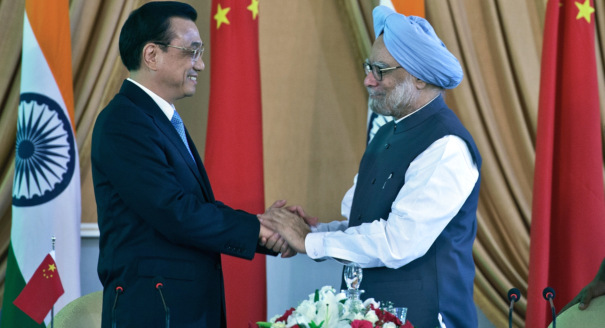
Prime Minister Manmohan Singh's trip to China last week was, by all appearances, a success. Coming just a few months after Chinese Premier Li Keqiang's visit to New Delhi, it left the impression of healthy and sustained working relations. The trip was fruitful, producing nine signed agreements, including the much-discussed-in-India Border Defence Cooperation Agreement (BDCA), as well as an agreement on strengthening cooperation on trans-border rivers. A closer look indicates, however, that the visit only institutionalised the status quo at best, or, if one takes a more pessimistic view of India's situation, reflected the deterioration of its regional position. To guard against the latter, India ought to strengthen partnerships with neighbours — China will certainly not be shy about doing the same.
The new BDCA, the fifth since 1993, commits the two sides to "maximum self-restraint". It states that neither side shall use its military capability against the other. The two sides will also have to give notice of patrols along the border and will ensure that "they shall not follow or tail patrols on the other side in areas where there is no common understanding of the Line of Actual Control in the India-China border areas."The agreement does not address the border issue per se and thus, to some extent, institutionalises the status quo. It has been criticised for de facto allowing what India used to consider border violations. While it is presented by both sides as a means of ensuring the safety of a border area (where, indeed, not a single bullet has been fired since 1975), the agreement is primarily a tool for the political management of bilateral relations. It does not constitute a guarantee against potential future incidents. The safety of the border area is likely to remain dependent on future political tensions between the two countries. The BDCA is, however, a pragmatic and realistic answer to a rapidly changing situation along the border, where the construction of new military infrastructure and the deployment of additional troops on both sides increase the risk of incidents.
What is perhaps more worrisome is the regional context in which the border agreement is taking place. China continues its longstanding strategy of counterbalancing India by supporting Pakistan; just days before Singh's visit, Beijing announced it would sell two additional nuclear reactors to Pakistan at a time when Islamabad is increasing its arsenal of tactical nuclear weapons. Moreover, India cannot ignore China's sudden diplomatic burst in Southeast Asia. President Xi Jinping recently visited Malaysia, while Li attended the ASEAN and East Asia summits before visiting Thailand and Vietnam. Beijing is trying to improve relations with its southern neighbours after years of tension, bringing tangible economic benefits to its new partners in the process. In so doing, it widens existing fissures among ASEAN states. Moreover, Delhi looks with increasing suspicion at Chinese arms exports to the region.
The effort may not be aimed primarily at India — observers underline the growing China-Japan competition in the area — but it will affect all of India's ASEAN partners. It is hardly a coincidence that Chinese analysts commenting on Singh's visit underline the contrast between the confrontational Japanese and accommodating Indian attitudes vis-à-vis border issues with China, and the independence of India's foreign policy, in a clear attempt to pull the two apart. Russia, India's traditional strategic and defence partner, is unlikely to be of much help as it needs to export arms to sustain its domestic defence industry and has become China's main arms supplier.
On the economic side, relations with China have fallen victim to the global economic crisis. The exports of both countries to each other suffered in 2012, but China's exports to India diminished by only 5 per cent, while India's exports to China have diminished by some 20 per cent, increasing the already unsustainable trade deficit. In order to bridge or at least reduce the gap, the two countries have decided to explore the possibility of creating a Chinese industrial park in India and the feasibility of the Bangladesh-China-India-Myanmar economic corridor. But these projects are unlikely to materialise any time soon, and the already huge trade imbalance is likely to persist.
It is not clear at this stage that India has any response other than biding time. There is no easy answer to the current asymmetry of power between India and China, and therefore to India's incapacity to match Chinese influence in its larger neighbourhood. Regardless of the government that comes to power after the 2014 Lok Sabha elections, it will be unable to simply decree stronger defence capacities and rejuvenated economic growth into existence.
India does, however, have some diplomatic space it could leverage to its advantage. For years, its ASEAN and East Asian partners have been asking Delhi to become more involved in regional affairs, in particular the existing security institutions. India has always been careful not to antagonise China though, and most Indian analysts readily admit that Delhi is in no position to take a confrontational public posture vis-à-vis Beijing. China understands this. The new Chinese leadership keeps sending seemingly contradictory signals, indicating that it is not ready for any meaningful compromise on the border, but that it wants a non-confrontational relationship with India. The message here seems to be that Beijing wants Delhi to know it wants a peaceful relationship, but it wants that relationship to be defined on its terms.
Perhaps India would also be well advised to remember its recent history. It was Delhi's rapprochement with Washington that prompted China to seek better relations with India. Today, Washington's choices are again affecting the region's dynamics. Uncertainty about the US role in the Asia-Pacific is helping China's designs as regional actors try to hedge their bets. There seems, therefore, to be no alternative for India but to promote its network of regional partnerships and give them the substance that would help insulate it from the perils of relative American isolationism. In the process, Delhi will not have to renounce its cherished strategic autonomy — but realise that the capacity to act independently matters less than the capacity to decide autonomously, while leveraging the forces of others.
This article was originally published in the Indian Express.

Former Nonresident Senior Fellow, South Asia Program
Frédéric Grare was a nonresident senior fellow at the Carnegie Endowment for International Peace, where his research focuses on Indo-Pacific dynamics, the search for a security architecture, and South Asia Security issues.
Recent Work
Frederic Grare
Frederic Grare
Carnegie does not take institutional positions on public policy issues; the views represented herein are those of the author(s) and do not necessarily reflect the views of Carnegie, its staff, or its trustees.

With the growth in points of friction between the great powers, organizations like the SCO will continue to play a role in the strategic adaptation of the smaller powers caught between them.

Temur Umarov

When faced with fuel shortages in the past, Central Asian governments could always count on additional supplies from Moscow. That safety net no longer exists.

Galiya Ibragimova

Two divergent trends—Putin’s hardline vision of how to prosecute the war in Ukraine, and a growing desire for change in Russia—could tear the regime apart.

Tatiana Stanovaya

Andrey Melnichenko’s essay offers no answer to the fundamental question of how, under any kind of negotiated settlement, Europe can protect itself from the Russian ressentiment that is inevitable in all scenarios except for an outright victory for Putin.

Leonid Bershidsky

Despite unhappiness on the ground, Moscow is determined to use both carrot and stick to ensure there is record support for United Russia in occupied Ukraine.

Konstantin Skorkin