

Commentary
With the growth in points of friction between the great powers, organizations like the SCO will continue to play a role in the strategic adaptation of the smaller powers caught between them.
Temur Umarov
{
  "authors": [
    "Alexey Arbatov"
  ],
  "type": "legacyinthemedia",
  "centerAffiliationAll": "",
  "centers": [
    "Carnegie Endowment for International Peace",
    "Carnegie Russia Eurasia Center"
  ],
  "collections": [],
  "englishNewsletterAll": "",
  "nonEnglishNewsletterAll": "",
  "primaryCenter": "Carnegie Russia Eurasia Center",
  "programAffiliation": "",
  "programs": [],
  "projects": [],
  "regions": [
    "North America",
    "United States",
    "Russia"
  ],
  "topics": [
    "Security",
    "Military",
    "Foreign Policy"
  ]
}
Source: Getty
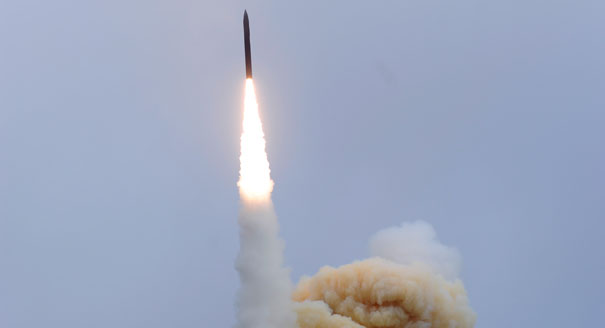
The current confidence-building and arms limitation measures are less effective for resolving the problems caused by the conventional prompt global strike systems being developed by the United States.
Source: YABLOKO
On Tuesday, October 22, senior associate at the Carnegie Endowment’s Nuclear Policy Program James M. Acton met with Russian journalists and military experts to discuss the conventional prompt global strike systems (CPGS), which the United States has been working on for more than a decade now. The participants discussed the potential risks that these new systems’ deployment could create. One of the participants in the discussion was chair of the Carnegie Moscow Center’s Nonproliferation Program Alexei Arbatov.
The new global strike systems create problems for Russia. What are the causes of Russia’s concerns?The U.S. boost-glide systems are creating the threat of an essentially sudden strike. Satellites might detect the launch of a ballistic booster, but Russian radars would then detect the vehicle just before it strikes the target. In this context, it is not so important whether the warhead is nuclear or conventional. In any case, Russian specialists would act on the assumption that the vehicles are armed with nuclear warheads.
Today, as in the past, it is implied that a massive launch of ballistic missiles by one side would invoke the possibility of a launch-on-warning by the other side. It is not so important in the current context just how realistic this concept actually is. What matters is that it works as a deterrent. But if boost-glide vehicles are launched, radars would confirm satellite signals too late for a launch-on-warning. The other option would be to start a launch-on-warning based on the satellite signal, but this would create a tremendous risk of triggering nuclear war upon a false alarm. This represents the first danger if the new systems are deployed in large numbers (many hundreds of units).
The second problem is what response Russia should make in the event of a mass disarming strike against it with precision-guided conventional weapons. Delivery vehicle speed is not so important here, although delivery vehicles operating at subsonic speeds are easier to intercept by an air defense system. Would nuclear weapons be used for a retaliatory strike? This is the biggest strategic issue worrying Russian analysts at present. After all, it is logical to respond to a nuclear attack with a nuclear strike. This is the logic deterrence rests on. But in the new situation, a serious dilemma arises: does one decide to respond to a conventional strike, not having such a great collateral damage, with a nuclear retaliation, and then have the aggressor launch a devastating nuclear strike using with the remaining nuclear forces? Or is it more appropriate not to retaliate and to loose one’s nuclear forces that would be destroyed by the adversary’s conventional strike?
The current confidence-building and arms limitation measures are becoming no longer effective as a means to resolve these problems through a system of agreements. One needs to develop new ones. Rather than wringing hands and lamenting “We are being surrounded,” Russian and U.S. specialists who want to maintain strategic stability need to concentrate now on coming up with these new measures.
This article originally appeared in Russian on the YABLOKO site.
Alexey Arbatov
Alexey Arbatov is the head of the Center for International Security at the Primakov National Research Institute of World Economy and International Relations.
Carnegie does not take institutional positions on public policy issues; the views represented herein are those of the author(s) and do not necessarily reflect the views of Carnegie, its staff, or its trustees.

With the growth in points of friction between the great powers, organizations like the SCO will continue to play a role in the strategic adaptation of the smaller powers caught between them.

Temur Umarov

The war in Ukraine and a change in ownership led VK to neglect its commercial ventures in favor of implementing the Kremlin’s online agenda. Now it’s been sanctioned by the EU.

Maria Kolomychenko

A regime founded on force, coercion, and repression does not want its propaganda, with all its flaws of logic, omissions, and outright lies, to be competing with the most simple of all messages: Thou shalt not kill.

Leonid Bershidsky

Political pressure and economic headwinds are closely intertwined problems for Russian publishers and booksellers. Together, they risk propelling Russia into a “post-literate” era.

Galina Yuzefovich

In the discussions made possible by the State Duma election campaign, one question is being asked more and more loudly. “What next?”

Andrey Pertsev