

Commentary
Dmitri Trenin
{
  "authors": [
    "Dmitri Trenin"
  ],
  "type": "legacyinthemedia",
  "centerAffiliationAll": "dc",
  "centers": [
    "Carnegie Endowment for International Peace",
    "Malcolm H. Kerr Carnegie Middle East Center",
    "Carnegie Russia Eurasia Center"
  ],
  "collections": [],
  "englishNewsletterAll": "menaTransitions",
  "nonEnglishNewsletterAll": "",
  "primaryCenter": "Carnegie Russia Eurasia Center",
  "programAffiliation": "MEP",
  "programs": [
    "Middle East"
  ],
  "projects": [
    "Eurasia in Transition"
  ],
  "regions": [
    "Levant",
    "Russia",
    "Syria"
  ],
  "topics": [
    "Foreign Policy",
    "Global Governance"
  ]
}
Source: Getty
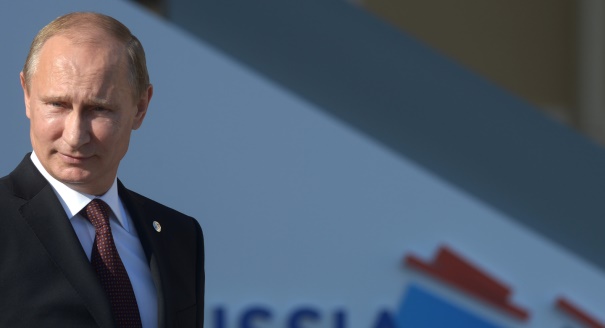
Putin aims for a world order in which the Security Council’s five permanent members, not the United States—alone or with its allies—decide on major issues pertaining to war and peace.
Source: World Today
The problem Vladimir Putin has faced is how to convince the West that Russia means business when it offers a solution to the chemical weapons issue. After all, for well over a decade Russia has been a naysayer and spoiler, either protesting against US military interventions or seeking to obstruct Washington’s policies. Why has Russia now stepped forward and offered an alternative solution, tentatively accepted both by Damascus and the Americans?
By reaching out to Barack Obama at the G20 summit in St. Petersburg, Putin was hardly seeking either to ‘humiliate’ the US President or to ‘save’ him. The personal relationship between the two leaders is missing; it is all business. In offering his plan to Obama, Putin had important interests in mind.
The Russian leader’s short-term goal was to prevent US military strikes against Damascus. Putin admitted to having been surprised by the vote in the British Parliament ruling out UK participation in US-led attacks. He must have been no less impressed by Obama’s decision to turn to Congress for approval of military action. Watching the House debate, he saw that Obama stood a good chance of getting a ‘no’ from Congress. By coming up with his initiative, the Russian president was seeking to strengthen the hand of those in the US who opposed military action in Syria.He also has a long-term goal. It is to turn the tide in US foreign policy by supporting the neo-isolationist trend in American politics against the interventionists, who have prevailed since the mid-1990s.
Putin understood that both goals were ambitious enough to warrant his direct engagement. Rather than leaving the job to Sergei Lavrov, his Foreign Minister, Putin assumed personal responsibility for the Syrian chemical disarmament plan.
He realized that Russia had first to deliver Assad, and then to make sure that the Syrians stuck to the terms of the deal. He knew he was taking a big risk, but letting things run their course threatened to produce the outcome in Syria that Russia feared: a new lease on life for US interventionism, and the triumph of the jihadists on the ground.
In making his offer to Damascus, Putin counted on Assad’s rationality. For the Syrian president, chemical weapons were the only WMD in his arsenal. They could only function as a credible deterrent against Israel – or the US, should it consider a ground invasion. Trading the weapons for US non-intervention, implicitly guaranteed by Russia, must have appeared a good bargain to Assad as he faced the prospect of US airstrikes. By going along with the Putin plan, Assad would be saving his rule in Damascus and possibly his own life.
Putin has never considered Assad to be Russia’s ally – whatever the Western, Arab and Israeli media write. He knows enough about Middle Eastern politics not to be complacent. An American threat helps keep Assad rational, but it is not enough. Hence, Russia’s agreement that the UN Security Council resolution on the Syrian chemical disarmament refers to Chapter VII of the UN Charter, which allows the use of force. Moscow only wants to make sure that such use is not automatic, and that Russia will have a final say in the decision-making.
Syria’s chemical weapons arsenal needs to be brought under international control before being removed and eliminated. Having already destroyed most of the Soviet Union’s chemical weapons, Russia is prepared to engage on the ground. A decade after withdrawing from UN peacekeeping operations in the Balkans, Putin has indicated the possibility of sending Russian troops on a UN mission to the Middle East.
In May, as John Kerry, the US Secretary of State, and Lavrov came up with an agreement in Moscow to work towards political settlement in Syria – Geneva II – Putin thought he had Obama committed to something like ‘Dayton for two’, a more balanced version of the US-led process which ended the Bosnian war in 1995.
The Russians and Americans would both push the Syrian side, kicking and screaming, toward a ceasefire and a compromise political settlement. Washington, however, was still thinking in terms of Moscow helping it ease Assad out of power. Now, the US-Russian Syrian chemical deal logically leads to the need to establish local ceasefires, and to advance to a political settlement. Crucially, Moscow and Washington are leading the process on an equal basis.
For Putin, Syria has always been more than just Syria. He aims at a world order in which the Security Council’s five permanent members, not the US – alone or with its allies – decide on major issues pertaining to war and peace. It is a tall order. Putin knows he may fail, but he evidently believes the risk is worth taking.
Former Director, Carnegie Moscow Center
Trenin was director of the Carnegie Moscow Center from 2008 to early 2022.
Recent Work
Dmitri Trenin
Dmitri Trenin
Carnegie does not take institutional positions on public policy issues; the views represented herein are those of the author(s) and do not necessarily reflect the views of Carnegie, its staff, or its trustees.
A leak of Russian gas price data helps establish that China is paying Russia far less than Central Asian countries and Gazprom’s former European customers.

Sergey Vakulenko

Japan’s long-term security policy is driven by concerns about China, and there is little appetite for (or interest in) pursuing a confrontation with Moscow.

James D.J. Brown

The truth of the strategic situation is that Europe and Russia are extremely unlikely to be able to “turn the page” on their confrontation within the next two decades.

Arkady Moshes
Russia spent years building a “sovereign internet,” concentrating web infrastructure exclusively within Russian territory. Ukrainian drone attacks have shown how vulnerable that approach has left the Russian internet.

Maria Kolomychenko

Putin’s conservative staffing policies and search for ever greater control have cemented parliament’s transformation into a bureaucratic appendage of the executive branch.

Andrey Pertsev