

Article
Thomas de Waal
{
  "authors": [
    "Thomas de Waal"
  ],
  "type": "commentary",
  "centerAffiliationAll": "",
  "centers": [
    "Carnegie Endowment for International Peace",
    "Carnegie Europe",
    "Carnegie Russia Eurasia Center"
  ],
  "collections": [],
  "englishNewsletterAll": "",
  "nonEnglishNewsletterAll": "",
  "primaryCenter": "Carnegie Europe",
  "programAffiliation": "",
  "programs": [],
  "projects": [],
  "regions": [
    "Caucasus",
    "Russia",
    "Georgia"
  ],
  "topics": [
    "Foreign Policy"
  ]
}
Source: Getty
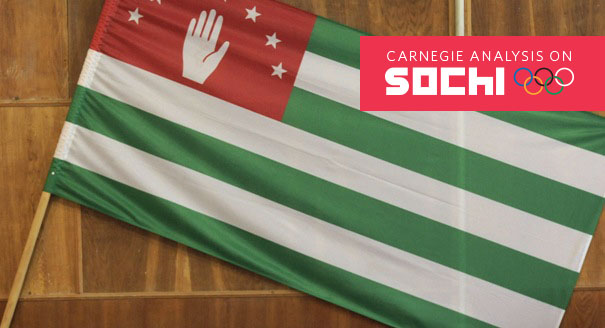
Abkhazia has a right to feel disappointed. The Olympic Games are happening just a few miles to the north and yet the republic has little to do with it.
People in Abkhazia have a right to feel disappointed. The Olympic Games are happening just a few miles to the north and yet the republic—still regarded by most of the world as the sovereign territory of Georgia, recognized by Russia as independent—has little to do with it.
This is has very little to do with Georgian pressure, and a lot to do with Russia's own calculations. Two years ago, it was surely part of Vladimir Putin's plan to use the Sochi Games as a vindication for his 2008 recognition policy of Abkhazia—and simultaneously poke his bête noire, then Georgian leader Mikheil Saakashvili, in the eye.
There was speculation about opening the airport in Abkhazia or settling Olympic tourists in Gagra and Pitsunda. It would have been quite easy to give Abkhaz President Alexander Ankvab a prominent seat at the Opening Ceremony.
None of that happened. As the Sochi games turned into Russia's "Lockdown OIympics," politics was subordinated to security. For the Russian authorities, the turning point was surely the assassination last September in Abkhazia of the Russian vice-consul there. A Chechen, now in detention in Georgia, is the prime suspect.
That killing will have prompted the decision to set up a new 11-kilometer "border zone" south of the River Psou that divides Abkhazia from Sochi. The Georgian foreign ministry issued a formal protest (even though the decision had no real consequences for them), but the main losers were the local Abkhaz who had to put up with extra security measures—and who anyway cannot even take their cars across the border to Sochi and must use public transport to travel to the games.
Ankvab was at the ceremony but not conspicuously. He at least will be grateful for the games because they have put on ice a domestic political struggle inside Abkhazia which will probably resume in the spring.
All in all, the main thing the Georgians got upset about was a satellite picture of their country at the Opening Ceremony in which Abkhazia and South Ossetia were obscured by clouds.
And the main achievement for Abkhazia was the success of a stunning tourist video advertising its natural beauty in many languages, including the extraordinary throaty native language of the Abkhaz themselves. Those lakes and mountains are still beautiful—and still remote.

Senior Fellow, Carnegie Europe
Thomas de Waal is a senior fellow at Carnegie Europe, specializing in Eastern Europe and the Caucasus.
Recent Work
Thomas de Waal
Thomas de Waal
Carnegie does not take institutional positions on public policy issues; the views represented herein are those of the author(s) and do not necessarily reflect the views of Carnegie, its staff, or its trustees.

Russia’s ruling party would have benefited from Putin appearing as its distant patron, but as an active frontman imposing his views on the public, he has done nothing but harm both the party’s election campaign and the ruling system overall.

Andrey Pertsev

Depleted financial reserves and a shrinking tax base mean it is no longer possible to simultaneously deliver high defense spending, price stability, and economic growth.

Alexandra Prokopenko
Blurring the line between humans and animals is a long-standing tradition in social utopian prose. In his latest novel, Leonid Bershidsky reminds us that in social experiments, people are often treated no differently than animals.

Alexander Baunov
While France and Australia are seeking to establish the legal obligations of messaging apps like Telegram, Russia wants total subordination.

Maria Kolomychenko
The recent uncovering of Dmitry Donskoy’s relics in the Cathedral of the Archangel is yet another attempt by the Russian Orthodox Church to help the state solve its problems. However, parroting the state’s version of Russian history leaves the Church with no message except “patriotism.”
Alexander Zanemonets