

Commentary
Dmitri Trenin
{
  "authors": [
    "Dmitri Trenin"
  ],
  "type": "commentary",
  "centerAffiliationAll": "",
  "centers": [
    "Carnegie Endowment for International Peace",
    "Carnegie Russia Eurasia Center"
  ],
  "collections": [],
  "englishNewsletterAll": "",
  "nonEnglishNewsletterAll": "",
  "primaryCenter": "Carnegie Russia Eurasia Center",
  "programAffiliation": "",
  "programs": [],
  "projects": [],
  "regions": [
    "Russia"
  ],
  "topics": [
    "Political Reform",
    "Security"
  ]
}
Source: Getty
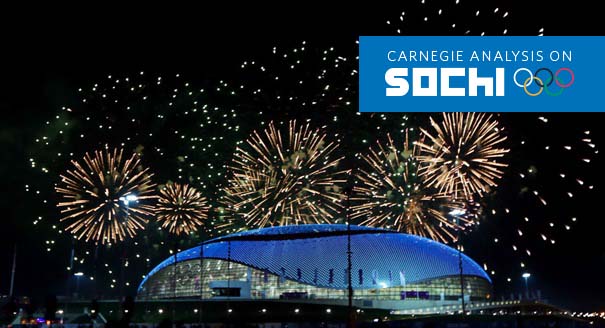
Although Russia has failed to get at the Winter Olympics the one prize it particularly coveted, the ice hockey title, it managed to win a far more important victory—in ensuring that the Games, the athletes, and spectators were safe. However, making Russia safer remains a challenge.
Although Russia has failed to get at the Winter Olympics the one prize it particularly coveted, the ice hockey title, it managed to win a far more important victory—not in the overall medals count, although it counts—but in ensuring that the Games, the athletes and spectators were safe.
With so many worries just before the Olympics, all made credible by the terrible double suicide attacks in Volgograd on New Year's Eve, this was a feat that particularly deserves recognition. We may never know how realistic the threat of terrorist attack actually was, but the Russian security services did their very best.
They were certainly motivated by President Vladimir Putin's constant, intense and very personal attention to the issue, but it must also be that the services have learned a lot in the last decade and a half. Their level of professionalism has definitely improved, as far as counter-terrorism is concerned, even if counter-insurgency— for example, in Dagestan—still underperforms.
Keeping Sochi safe for the Olympics has been highly important, but, with the Games over, making Russia safer remains a challenge. Rising to that challenge requires embedding counter-insurgency within a broader political and economic strategy for the North Caucasus, and preventing terrorist attacks demands a much higher degree of mutual confidence between the law enforcers and ordinary citizens.
Former Director, Carnegie Moscow Center
Trenin was director of the Carnegie Moscow Center from 2008 to early 2022.
Recent Work
Dmitri Trenin
Dmitri Trenin
Carnegie does not take institutional positions on public policy issues; the views represented herein are those of the author(s) and do not necessarily reflect the views of Carnegie, its staff, or its trustees.

The European far right might fail to steer EU policy in the direction Russia wants, but they will create enough chaos inside Europe to benefit the Kremlin.

Dimitar Bechev

If the Russian-speaking community in Latvia cannot articulate their interests without being seen as disloyal, they could end up embracing a pro-Kremlin agenda.

Sergejs Potapkins

Russia’s ruling party would have benefited from Putin appearing as its distant patron, but as an active frontman imposing his views on the public, he has done nothing but harm both the party’s election campaign and the ruling system overall.

Andrey Pertsev

Depleted financial reserves and a shrinking tax base mean it is no longer possible to simultaneously deliver high defense spending, price stability, and economic growth.

Alexandra Prokopenko
Blurring the line between humans and animals is a long-standing tradition in social utopian prose. In his latest novel, Leonid Bershidsky reminds us that in social experiments, people are often treated no differently than animals.

Alexander Baunov