

Commentary
Dmitri Trenin
{
  "authors": [
    "Dmitri Trenin"
  ],
  "type": "legacyinthemedia",
  "centerAffiliationAll": "dc",
  "centers": [
    "Carnegie Endowment for International Peace",
    "Carnegie Europe",
    "Carnegie Russia Eurasia Center"
  ],
  "collections": [
    "Europe’s Eastern Neighborhood"
  ],
  "englishNewsletterAll": "ctw",
  "nonEnglishNewsletterAll": "",
  "primaryCenter": "Carnegie Russia Eurasia Center",
  "programAffiliation": "EP",
  "programs": [
    "Europe"
  ],
  "projects": [],
  "regions": [
    "Russia",
    "Eastern Europe",
    "Ukraine",
    "Western Europe",
    "Iran"
  ],
  "topics": [
    "Political Reform",
    "Security",
    "Foreign Policy"
  ]
}
Source: Getty
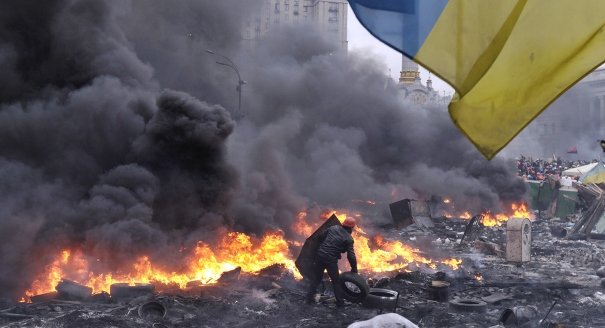
As Ukraine is teetering on the brink of a civil war, the West and Russia have found themselves on the brink of new confrontation. Instead, they should cooperate on Ukraine and push the Ukrainian sides toward stopping violence.
Source: National Interest
This week, the crisis in Ukraine has crossed a dangerous line. What was expected to be a revolution is morphing into a civil war. Should this happen, Ukraine will turn into another Yugoslavia: a terrifying prospect. It should also be sobering. So far, the West and Russia have been trading accusations about their respective meddling in Ukraine. True, neither side has been impartial, and each has its preferences and its clients. Yet, both are likely to lose heavily in case Ukraine becomes Europe’s newest battlefield. There are several things the leaders in Brussels and Berlin, Washington and Moscow need to keep in mind, and several things they need to do jointly and in parallel.
Outsiders need to realize that Ukraine’s crisis, essentially, is not primarily about Kiev’s international orientation. It is above all about high-level corruption and poor governance; it is about rivalries among largely irresponsible oligarchical clans; and it is about the cultural divide between the country’s west and east, which has not been eased after Ukraine, received its independence in 1991. These issues can only be tackled and hopefully resolved by the Ukrainians themselves. In the foreseeable future, Ukraine will not move either east or west; it might, however, go south.The European Union needs to be aware of the high social cost of Ukraine’s accession to the Deep Free Trade Area with the European Union. It also needs to be aware of the high expectations in Ukrainian society of Europe’s assistance in the process of Ukrainian modernization. The Russian Federation should be able to see not only the similarities between Ukraine and Russia, but also the glaring dissimilarities: Ukraine is not Little Russia. The Russians should also appreciate most Ukrainians’ strong desire for national independence, which means that there can be no serious pro-Russian politicians in Ukraine. ...
Read the full text of this article in the National Interest.
Former Director, Carnegie Moscow Center
Trenin was director of the Carnegie Moscow Center from 2008 to early 2022.
Recent Work
Dmitri Trenin
Dmitri Trenin
Carnegie does not take institutional positions on public policy issues; the views represented herein are those of the author(s) and do not necessarily reflect the views of Carnegie, its staff, or its trustees.

Depleted financial reserves and a shrinking tax base mean it is no longer possible to simultaneously deliver high defense spending, price stability, and economic growth.

Alexandra Prokopenko

Blurring the line between humans and animals is a long-standing tradition in social utopian prose. In his latest novel, Leonid Bershidsky reminds us that in social experiments, people are often treated no differently than animals.

Alexander Baunov

In the tenth year of his presidency, President Mirziyoyev’s system is becoming even more personalized than that of his predecessor Karimov.

Galiya Ibragimova
While France and Australia are seeking to establish the legal obligations of messaging apps like Telegram, Russia wants total subordination.

Maria Kolomychenko
The recent uncovering of Dmitry Donskoy’s relics in the Cathedral of the Archangel is yet another attempt by the Russian Orthodox Church to help the state solve its problems. However, parroting the state’s version of Russian history leaves the Church with no message except “patriotism.”
Alexander Zanemonets