

Paper
James M. Acton, Ankit Panda
{
  "authors": [
    "James M. Acton"
  ],
  "type": "other",
  "centerAffiliationAll": "dc",
  "centers": [
    "Carnegie Endowment for International Peace"
  ],
  "collections": [
    "U.S. Nuclear Policy"
  ],
  "englishNewsletterAll": "ctw",
  "nonEnglishNewsletterAll": "",
  "primaryCenter": "Carnegie Endowment for International Peace",
  "programAffiliation": "NPP",
  "programs": [
    "Nuclear Policy"
  ],
  "projects": [],
  "regions": [
    "North America",
    "United States",
    "Russia"
  ],
  "topics": [
    "Nuclear Policy",
    "Arms Control"
  ]
}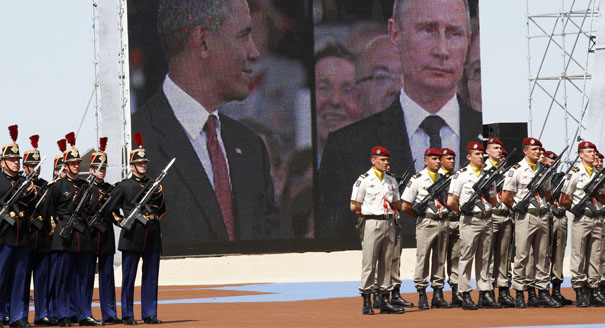
Source: Getty
The epithet “Cold War,” as applied to nuclear strategy, is almost never meant kindly. No part of the intellectual inheritance from the Cold War is more frequently maligned than the concept of strategic stability.
Source: Rand Corporation
The epithet "Cold War," as applied to nuclear strategy, is almost never meant kindly. Officials and analysts from both the left and right - for quite different reasons - regularly urge the United States to purge itself of a Cold War mentality. President Obama himself, in a 2009 speech in Prague that recommitted the United States to the goal of a world without nuclear weapons, promised to "put an end to Cold War thinking." Ironically, opponents of his nuclear policy also argue for the same goal on the grounds that received wisdom inhibits the United States from crafting a more-effective nuclear force (which is usually argued to require low-yield, high-accuracy nuclear weapons capable of greater discrimination than the "Cold War" legacy systems in today's U.S. stockpile).No part of the intellectual inheritance from the Cold War is more frequently maligned than the concept of strategic stability. Its advocates generally argue against attempting to undermine the survivability of other states' nuclear forces - at least in the cases of Russia and, more recently, China - out of concern that doing so might lead to arms racing and, even more seriously, preemptive attacks in a crisis. Critics who believe in the utility of nuclear superiority argue that, when applied to today's security environment, "[s]tability metrics from the Cold War can lead to dangerous and sometimes absurd conclusions."
The chapter "On Not Throwing the Nuclear Strategy Baby Out with the Cold War Bath Water: The Enduring Relevance of the Cold War" was originally published in the book Challenges in U.S. National Security Policy published by the Rand Corporation.

Jessica T. Mathews Chair, Co-director, Nuclear Policy Program
Acton holds the Jessica T. Mathews Chair and is co-director of the Nuclear Policy Program at the Carnegie Endowment for International Peace.
Recent Work

James M. Acton, Ankit Panda
James M. Acton
Carnegie does not take institutional positions on public policy issues; the views represented herein are those of the author(s) and do not necessarily reflect the views of Carnegie, its staff, or its trustees.

Russian strikes are weakening the economy sustaining Ukraine’s war effort. Closing the growing funding gap will require more European support and politically contentious reforms in Kyiv.

Balázs Jarábik

Despite a new textbook, an influx of Russian teachers and managers, and an end to the teaching of Ukrainian, the Kremlin is unlikely to have “reprogrammed” locals.

Konstantin Skorkin

For every ruble allocated to social policy, health, and education in 2027, double that amount is earmarked for the army, the police, and the security services.

Alexandra Prokopenko

Cargo traffic through Russia’s Northern Sea Route has increased because of the disruption caused by the conflict in the Middle East, the Ukraine war, and U.S.-China tensions.

Mikhail Korostikov
An analysis of traffic accident data suggests that Ukrainian drone attacks caused a material but not disastrous fall in Russian gasoline consumption over the summer.

Sergey Vakulenko