

Q&A
Suzanne Maloney, Aaron David Miller, Karim Sadjadpour
{
  "authors": [
    "Karim Sadjadpour"
  ],
  "type": "legacyinthemedia",
  "centerAffiliationAll": "dc",
  "centers": [
    "Carnegie Endowment for International Peace",
    "Malcolm H. Kerr Carnegie Middle East Center"
  ],
  "collections": [
    "Iranian Proliferation"
  ],
  "englishNewsletterAll": "menaTransitions",
  "nonEnglishNewsletterAll": "",
  "primaryCenter": "Carnegie Endowment for International Peace",
  "programAffiliation": "MEP",
  "programs": [
    "Middle East"
  ],
  "projects": [],
  "regions": [
    "Middle East",
    "Iran"
  ],
  "topics": [
    "Political Reform",
    "Economy",
    "Nuclear Policy",
    "Foreign Policy",
    "Arms Control",
    "Security"
  ]
}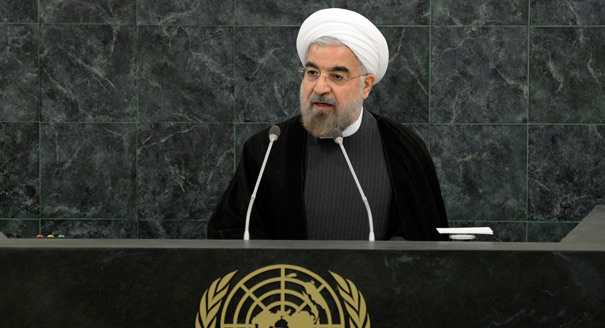
Source: Getty
Unless and until Iran prioritizes national and economic interests before revolutionary ideology, it will continue to remain a country with enormous but squandered potential.
Source: Daily Star
During Iran’s 2013 presidential campaign, Hassan Rouhani marketed himself to a wary Iranian public and hard-line political establishment as the man who could reconcile the ideological prerogatives of the Islamic Republic with the economic interests of the Iranian nation. Iran did not need to decide whether to wage Death to America or détente, whether to resist the global order or reintegrate with it, or whether to be theocratic or democratic. Under his leadership, Rouhani implied, the Islamic Republic of Iran could do it all.
From the outset of his presidency, Rouhani understood that Iran’s economic malaise could not be reversed without a lifting of international sanctions, and lifting these sanctions required a deal over Iran’s nuclear program. He accordingly invested all of his political capital in foreign policy rather than domestic affairs. Rouhani also refrained from unsettling Iran’s conservatives – whose support he needs to secure a nuclear compromise – with talk of democracy and human rights. Iranian civil society nonetheless patiently accommodated him, hoping that a more relaxed external environment could usher in a less repressive domestic environment.
One of Rouhani’s greatest advantages as president has been that his bombastic predecessor, Mahmoud Ahmadinejad, set an incredibly low bar for competent management and public diplomacy. Indeed some of Rouhani’s most tangible achievements have been simply undoing the damage wrought by Ahmadinejad, such as restoring relations with the United Kingdom that were severed after a government-sanctioned mob ransacked the British Embassy in Tehran in 2011.Most importantly, Rouhani deserves credit for helping to normalize direct dialogue between Tehran and Washington. For three decades the nearly sole method of communication between the two countries had been public threats and invective. While mutual antipathy remains, today American and Iranian officials communicate regularly via email and telephone, when they aren’t negotiating in European hotels. Rouhani himself broke a 35-year Islamic Republic taboo by talking via telephone with President Barack Obama.
But Rouhani has had less success moderating the revolutionary principles that most animate the U.S. Congress, namely Iran’s active rejection of Israel’s existence and support for militant groups such as Hezbollah, Islamic Jihad, and Hamas (a once-fraught relationship that was rekindled after Israel’s recent onslaught in the Gaza Strip). Nor has Tehran’s support for the Syrian government wavered, despite President Bashar Assad’s brutality – including an August 2013 chemical weapons attack in Ghouta, just weeks into Rouhani’s tenure that killed, by some estimates, nearly 1,500 people, including over 400 children.
This record, together with worsening human rights and a still-elusive nuclear deal, has led to public disillusionment with Rouhani. Such criticism is misdirected. Rouhani is at best second lieutenant to Supreme Leader Ayatollah Ali Khamenei, a rigid 75-year-old ideologue whose goal is to conserve Iran’s revolutionary principles, not alter or dilute them. After eight years of Ahmadinejad, an exasperated Iranian public and international community had unrealistic hopes that Rouhani, a pragmatic regime insider, had both the will and ability to bring fundamental change.
While Rouhani’s international detractors – such as Israeli Prime Minister Benjamin Netanyahu – accuse him of being duplicitous, Rouhani’s domestic supporters worry that the fate of his presidency rests largely on a nuclear deal he does not have the authority to consummate. He must convince a skeptical Khamenei that Iran is giving up a little for a short time in exchange for a lot. Meanwhile a skeptical U.S. Congress in its turn must be persuaded that Iran is giving up a lot for a long time in exchange for a little. This will be a much taller order than the November 2013 interim nuclear deal.
Rouhani’s greatest asset is the fact that a clear majority of his population, and much of the outside world, want Iran to emerge from political and economic isolation. Indeed, there are few nations in the world with a greater gap between what they once were and what they today aspire to be. Rouhani’s popular mandate was, in essence, to narrow this gap.
However, the Islamic Republic’s 35-year history has shown us that what hard-liners lack in popular support, they make up for in coercive strength. And unless and until Iran prioritizes national and economic interests before revolutionary ideology, it will continue to remain a country with enormous but squandered potential.

Senior Fellow, Middle East Program
Karim Sadjadpour is a senior fellow at the Carnegie Endowment for International Peace, where he focuses on Iran and U.S. foreign policy toward the Middle East.
Recent Work


Suzanne Maloney, Aaron David Miller, Karim Sadjadpour

Aaron David Miller, Karim Sadjadpour, Robin Wright
Carnegie does not take institutional positions on public policy issues; the views represented herein are those of the author(s) and do not necessarily reflect the views of Carnegie, its staff, or its trustees.

Putin’s conservative staffing policies and search for ever greater control have cemented parliament’s transformation into a bureaucratic appendage of the executive branch.

Andrey Pertsev

Russia’s AI-driven propaganda campaigns operate in a fragmented, chaotic, and often illogical manner. That’s not necessarily a problem for the Kremlin, though: It’s much easier to mimic genuine public debate that way.

Ilya Klishin

Without a ceasefire with Ukraine on attacking each other’s energy infrastructure—to which the Kremlin is unlikely to agree—the diesel agreement between Putin and Trump is largely for show, rather than representing a genuine increase in the volumes of Russian diesel on the global market.

Sergey Vakulenko

Russian strikes are weakening the economy sustaining Ukraine’s war effort. Closing the growing funding gap will require more European support and politically contentious reforms in Kyiv.

Balázs Jarábik

Ex-president Gurbanguly Berdimuhamedov remains interested in politics, but his son Serdar, Turkmenistan’s current president, is becoming increasingly independent and willing to break with his father’s legacy. If their covert rivalry goes too far, both risk losing power.

Galiya Ibragimova