

In The Media
Lilia Shevtsova
{
  "authors": [
    "Lilia Shevtsova"
  ],
  "type": "legacyinthemedia",
  "centerAffiliationAll": "",
  "centers": [
    "Carnegie Endowment for International Peace",
    "Carnegie Russia Eurasia Center"
  ],
  "collections": [],
  "englishNewsletterAll": "",
  "nonEnglishNewsletterAll": "",
  "primaryCenter": "Carnegie Russia Eurasia Center",
  "programAffiliation": "",
  "programs": [],
  "projects": [],
  "regions": [
    "North America",
    "United States",
    "Russia",
    "Eastern Europe",
    "Ukraine",
    "Western Europe"
  ],
  "topics": [
    "Political Reform",
    "Democracy",
    "Security",
    "Military",
    "Foreign Policy"
  ]
}
Source: Getty
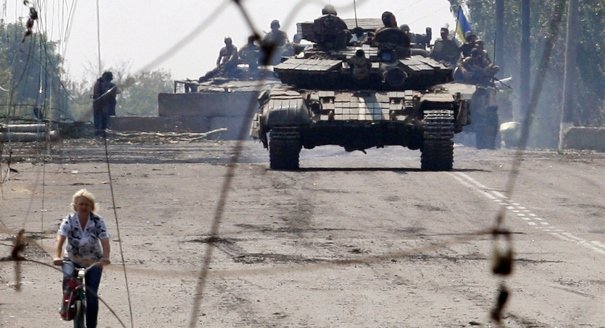
Vladimir Putin’s increasingly reckless interventions in Ukraine should force the West to reevaluate everything it thought it knew about the collapse of the Soviet Union and the past two decades of Western policy on Russia.
Source: American Interest
When the Gaza War and the threat from ISIS pulled global attention away from Ukraine, you could almost hear the sighs of relief emanating from the Western capitals: Finally, something to distract us from this Eurasian conundrum! This isn’t to say that Western leaders don’t understand that the war in Ukraine has implications for both the international order and the West’s own internal workings. By now they appreciate the stakes (or at least they ought to); they just haven’t been able to come up with an answer.
Meanwhile, Russia itself faces a conundrum of its own. By attempting to shift Russia backward to an older civilizational model, Putin has already inflicted a deep strategic defeat on his country. His efforts to turn Russia back to the “Besieged Fortress” model will only rob Russia of its chance to become a modern society. Moreover, Putin has also unleashed forces he can’t hope to contain, thus accelerating the agonizing decay of his own regime. Nevertheless, though he has lost the battle with history, Putin has been moving from one tactical victory to the next by forcing the West to constantly react and try to accommodate his reckless behavior.Russia’s recent “humanitarian invasion” of nearly 200 trucks—which crossed the border and then returned, the Ukrainian government alleges, with stolen factory equipment—is only one of the more recent Kremlin experiments aimed at testing both the global rules of the game and Western leaders’ readiness to confront Russia. This alleged mass theft, in particular, took place just before Ukraine’s Independence day, on the eve of German Chancellor Angela Merkel’s visit to Kiev and before the meeting between Putin and Poroshenko. It was an intentional slap in the face, meant to bring across a simple message: “Screw you! We don’t care what you say!”
The Kremlin has been intentionally escalating tensions in order to ready us for Putin’s attempt to assume the role of Peacemaker—albeit on his terms. Peacemaking, for the Russian leader, is merely a means to another goal: forcing the West to accept the Kremlin’s right to change the rules of the game whenever it suits its interests. Indeed this is precisely what he demonstrated at the recent meeting in Minsk between the EU, Russia, and Ukraine, where Putin stubbornly refused to admit to the Russian military’s involvement in the war in Ukraine.
What this means is that there are no concessions on the part of the West and Ukraine that can satisfy the other side. This is true not because of bellicosity or incompetence of the Russian leader; he is quite rational and competent. Rather, he understands all too well the logic of personalized power in Russia—that, at this late stage of regime decay, it requires him to keep Russia in a state of war with the outside world. The war with Ukraine has thus become an existential problem for the current Russian political regime. It can’t afford a defeat. Yesterday Ukraine’s President Petro Poroshenko claimed—and NATO satellite imagery appears to confirm—that Russian troops have openly invaded the Ukrainian territory, proving that the Kremlin is no longer interested in forestalling an escalation. Hell is unfolding… ...
Read the full text of this article in the American Interest.
Former Senior Associate, Russian Domestic Politics and Political Institutions Program, Moscow Center
Shevtsova chaired the Russian Domestic Politics and Political Institutions Program at the Carnegie Moscow Center, dividing her time between Carnegie’s offices in Washington, DC, and Moscow. She had been with Carnegie since 1995.
Recent Work
Lilia Shevtsova
Lilia Shevtsova
Carnegie does not take institutional positions on public policy issues; the views represented herein are those of the author(s) and do not necessarily reflect the views of Carnegie, its staff, or its trustees.

Despite a new textbook, an influx of Russian teachers and managers, and an end to the teaching of Ukrainian, the Kremlin is unlikely to have “reprogrammed” locals.

Konstantin Skorkin

For every ruble allocated to social policy, health, and education in 2027, double that amount is earmarked for the army, the police, and the security services.

Alexandra Prokopenko

Cargo traffic through Russia’s Northern Sea Route has increased because of the disruption caused by the conflict in the Middle East, the Ukraine war, and U.S.-China tensions.

Mikhail Korostikov
An analysis of traffic accident data suggests that Ukrainian drone attacks caused a material but not disastrous fall in Russian gasoline consumption over the summer.

Sergey Vakulenko

Sergei Kiriyenko used Russia’s parliamentary vote to further hone his strategy of corporate mobilization that is designed to maximize votes for United Russia.

Andrey Pertsev