

Commentary
Sergey Vakulenko
{
  "authors": [
    "Sergey Vakulenko"
  ],
  "type": "commentary",
  "blog": "Carnegie Politika",
  "centerAffiliationAll": "",
  "centers": [
    "Carnegie Endowment for International Peace",
    "Carnegie Russia Eurasia Center"
  ],
  "englishNewsletterAll": "",
  "nonEnglishNewsletterAll": "",
  "primaryCenter": "Carnegie Russia Eurasia Center",
  "programAffiliation": "",
  "regions": [
    "Russia"
  ],
  "topics": [
    "Domestic Politics",
    "Energy"
  ]
}
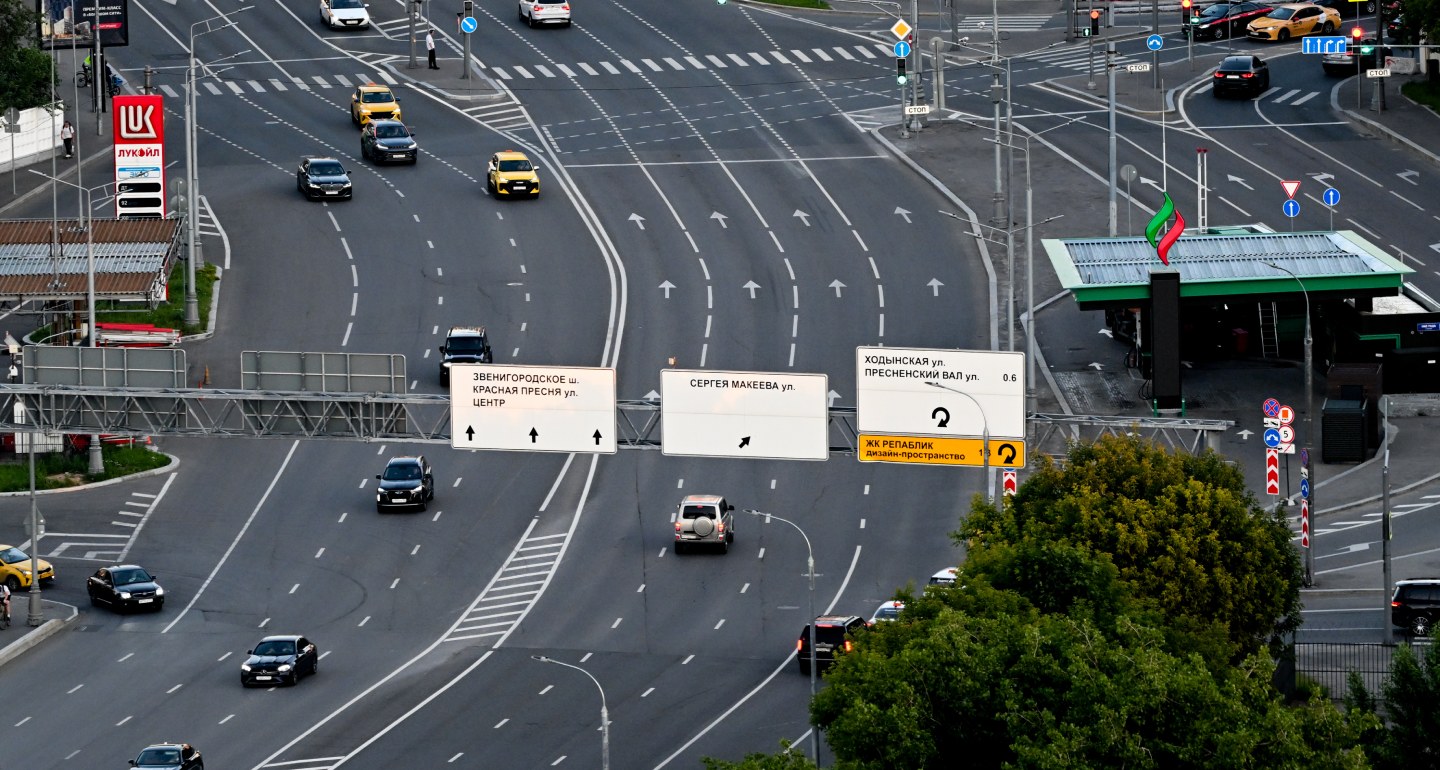
Source: Getty
An analysis of traffic accident data suggests that Ukrainian drone attacks caused a material but not disastrous fall in Russian gasoline consumption over the summer.
Researchers looking at the fuel crisis that gripped Russia in the summer of 2026 need to answer two key questions: How large were the shortages and what effect did they have? Most of the debate has been about the former, with traffic data serving as an additional argument or general observation (“look how long the lines are at gas stations!” or “everyone’s taking public transportation!”). In other words, qualitative assessments. But what if we use a quantitative approach to the fall in vehicle mileage caused by shortages?
Russia classified gasoline production figures in May 2024 because of Ukrainian attacks on oil refineries. Ever since, analysts have been obliged to rely on secondary data. The result has been a wide range of different estimates and plenty of debate.
One way to assess the scale of the shortages is to track announcements about attacks on refineries and their reopening after repairs, and then gauge the loss of fuel production capacity. A second is to subtract the volume of crude oil and petroleum product exports from total oil production (and then check this against secondary sources like thermal imaging analysis that reveals whether units are functioning or idle).
A third is to look at the retail market: whether there is gasoline at the pumps, restrictions on sales, or lines at gas stations. The problem with this method is that it gives rise to some wild interpretations, including claims that oil refining output in Russia fell by as much as 70 percent over the summer.
In reality, retail market disruption only indicates whether there is a fuel crisis—it can’t pinpoint the size of the shortages. Notably, there were fuel crises in Russia before the full-scale invasion of Ukraine, when all refineries were working normally.
Nevertheless, there are ways to improve the accuracy of an assessment based on the retail market. When there are significant gasoline shortages, the only way balance can be restored is through demand destruction that would mean a fall in traffic levels. In other words, the decline in oil refinery output can be estimated by looking at how often Russians got behind the wheel. While there are no statistics about vehicle journeys in Russia, there are detailed data on traffic accidents.
The number of accidents is closely linked to traffic volume, and analyzing these two data sets in different countries (Germany, the United Kingdom, Finland, Latvia, and the United States) shows an extremely high degree of correlation. This is also demonstrated by the fact that when there were fewer journeys in coronavirus lockdowns, accident numbers fell proportionally.
In other words, the number of traffic accidents in Russia can be used as a proxy for total vehicle mileage. However, it’s a tricky relationship. Accidents are strongly seasonal and have several underlying drivers. On the one hand, the number of cars on the road and their total mileage are increasing, which should result in more accidents. On the other hand, the condition of roads is improving and cars are increasingly fitted with safety systems designed to prevent accidents, which means there should be fewer collisions. All of this makes analysis difficult.
A functional model for the number of car accidents using data over a number of years is very similar to the actual graph of accident numbers, although it deviates slightly to either side. Some months, it differed significantly (for example, extreme cold and snow in January 2026 might mean that people opted not to drive). Such fluctuations, however, are more characteristic of the winter months, and from March through September they are usually minimal.
The coronavirus lockdowns are clearly visible: in April 2020, the number of accidents was 39.6 percent lower than expected (45.2 percent lower in urban areas and 17.3 percent lower in rural areas). Back then, life in urban areas came to an almost complete standstill, whereas people continued to drive and transport goods over long distances.
There was a commensurate fall in gasoline consumption. According to weekly reports from Russia’s Central Dispatching Department of the Fuel Energy Complex (which monitors the energy markets), shipments of gasoline for domestic use in April and May 2020 fell 29.2 percent year on year. Vedomosti newspaper reported that in April 2020 gasoline sales at Russia’s three largest gas station networks declined by between 27 percent and 40 percent.
Using the same methodology with recent data indicates that the uptick in Ukrainian drone strikes on Russian oil refineries in July, August, and September 2025 had no noticeable impact on the number of traffic accidents. While there were lines at gas stations in that period, there was no knock-on effect on road traffic (at least nothing outside the margin of error of this approach).
However, there was a clear anomaly in the accident data for July and August 2026. The number of accidents in July was 7.9 percent lower than expected, and in August it was 12.4 percent lower. That’s far beyond the normal random fluctuation for this data set (3.3 percent).
The ratio of traffic accidents in urban areas to those in rural areas (mostly on freeways) in the summer of 2026 was also significant. In July, the number of accidents was 2.8 percent lower than expected in urban areas (well within the normal random fluctuation), whereas it was 11.5 percent lower in rural areas—a very significant anomaly.
For the moment, only provisional data are available for August 2026 (Russia’s traffic police usually finalize their tallies the following month, with particularly large adjustments in the month’s final week). But the preliminary data suggest the difference between traffic accidents in urban areas and those in rural ones was even bigger: The number of urban accidents was 5.9 percent lower, while the number of rural accidents was down 15.7 percent. If the August data are corrected in the same way as the July data, the final figures are likely to be, respectively, 4.3 percent and 11 percent.
There was no such drop during Russia’s previous fuel crises. Before 2026, interruptions to gasoline deliveries meant drivers had to wait in line at gas stations, but there was ultimately enough fuel to go around—and no destruction of demand.
It’s also instructive to compare July 2026 with the coronavirus lockdown of 2020, when there were significantly fewer traffic accidents in urban areas. There were no problems with gasoline supplies in 2020, but lockdown caused a reduction in everyday activity (this affected the situation inside towns and cities more than it did long-distance travel). In 2026, by contrast, the limitation was the availability of fuel itself, with journey times determined by the amount of available gasoline.
Short urban journeys, prompted largely by necessity, continued to take place. Even at the height of the crisis, it was still possible to buy gasoline in cities (albeit after waiting in line). And if drivers found themselves without gasoline, it was not the end of the world: They could park their car by the side of the road and use public transportation.
The logic of out-of-town journeys is different. Firstly, more of them are nonessential. Secondly, the risks of being unable to find gasoline are higher, and the consequences of running out of fuel are far more inconvenient. It seems that these sorts of journeys were the first to go.
What all this means for gasoline consumption can be assessed by looking at the relationship between gasoline sales prior to the war in Ukraine (when data were still being published) and traffic accidents. These data suggest that vehicle mileage in July 2026 fell by between 7 percent and 12 percent, while gasoline consumption dropped between 7.5 percent and 9.5 percent (assuming the entire mileage decline was within vehicles running on gasoline).
Preliminary data from August 2026 showed vehicle mileage falling between 10 percent and 13 percent, and gasoline consumption dropping between 11 percent and 14 percent (after the expected statistical adjustment, these figures are likely to be, respectively, between 7 percent and 9 percent, and 7.5 percent and 10 percent).
All this aligns with estimates of a fall in gasoline production of between 20 percent and 25 percent in July. That means about 85,000 tons of gasoline was produced per day (typical consumption in July is about 110,000 tons a day). Russia dealt with this daily shortfall of 25,000 tons by demand destruction, gasoline imports, and increased domestic production made possible by relaxing fuel-quality requirements. About 7,000 tons was imported from Belarus, and another 10,000 tons came from demand destruction (visible in the accident rate).
The data on traffic accidents show that demand destruction only became noticeable in the second half of June—though even at the start of the month, Russia was producing less gasoline than it consumed. Apparently, the monthly deficit (about 0.75 million tons) was covered using reserves built up by the government from December through March (judging from production and export volumes, about 1 million tons of gasoline was stockpiled). Since these reserves were sufficient, there was no fall in consumption.
The number of traffic accidents in rural areas closely tracked gasoline production: a collapse at the start of July, growth at the end of the month when Kyiv switched to targeting warehouses, and then a fall again after a new wave of attacks.
It’s also worth asking what would have happened if gasoline availability really had fallen, as some argue, by 70 percent. During the pandemic, an approximately 30 percent fall in consumption meant there were 40 percent fewer accidents. So, if gasoline production had really fallen 70 percent, the availability of gasoline and gasoline-like fuel would only have been enough to meet 44 percent of normal consumption. And that implies the number of traffic accidents should have been down 64 percent. Nothing even close to that figure was observed.
Claude AI (in Opus 5 and Fable 5 modes) was used to write data collection scripts and to perform statistical data processing for this article.

Senior Fellow, Carnegie Russia Eurasia Center
Sergey Vakulenko is a senior fellow at the Carnegie Russia Eurasia Center.
Recent Work
Sergey Vakulenko
Sergey Vakulenko
Carnegie does not take institutional positions on public policy issues; the views represented herein are those of the author(s) and do not necessarily reflect the views of Carnegie, its staff, or its trustees.

Japan’s long-term security policy is driven by concerns about China, and there is little appetite for (or interest in) pursuing a confrontation with Moscow.

James D.J. Brown
The truth of the strategic situation is that Europe and Russia are extremely unlikely to be able to “turn the page” on their confrontation within the next two decades.

Arkady Moshes

Russia spent years building a “sovereign internet,” concentrating web infrastructure exclusively within Russian territory. Ukrainian drone attacks have shown how vulnerable that approach has left the Russian internet.

Maria Kolomychenko

Putin’s conservative staffing policies and search for ever greater control have cemented parliament’s transformation into a bureaucratic appendage of the executive branch.

Andrey Pertsev

Russia’s AI-driven propaganda campaigns operate in a fragmented, chaotic, and often illogical manner. That’s not necessarily a problem for the Kremlin, though: It’s much easier to mimic genuine public debate that way.

Ilya Klishin