

Research
- +6
Yasmine Farouk, Nathan J. Brown, Maysaa Shuja Al-Deen, …
{
  "authors": [
    "Anouar Boukhars"
  ],
  "type": "other",
  "centerAffiliationAll": "dc",
  "centers": [
    "Carnegie Endowment for International Peace",
    "Malcolm H. Kerr Carnegie Middle East Center"
  ],
  "collections": [],
  "englishNewsletterAll": "menaTransitions",
  "nonEnglishNewsletterAll": "",
  "primaryCenter": "Carnegie Endowment for International Peace",
  "programAffiliation": "MEP",
  "programs": [
    "Middle East"
  ],
  "projects": [],
  "regions": [
    "North Africa",
    "Maghreb"
  ],
  "topics": [
    "Security"
  ]
}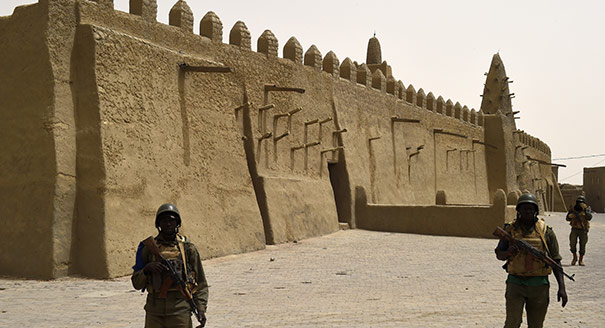
Source: Getty
The Sahel-Sahara region faces a multitude of security challenges, including structural factors that have contributed to radicalization and the successful exploitation of ethnicity and religion by violent extremist groups.
Source: FRIDE
The Sahel-Sahara faces a cluster of security challenges. The upsurge in ethnic radicalisation and its growing overlap with violent militancy are only the most visible signs of the troubles hanging over this vast region. This locus of insecurities mushrooms at the periphery of national boundaries where government writs rarely run. The permeability of borders, and proliferation of zones of political vacuums and economic marginalization in the hinterlands, fuel irredentism and enable the geographical expansion of violent extremists and their networking in excluded border communities. Violence spilling over from neighbouring conflicts often expedites the gradual transformation of such border communities into malignant epicentres of radicalized ethnic claims, cross-border militancy, and organized crime.
Understanding this deadly interplay of political grievances, social exclusion, and hinterland neglect is necessary for tackling the underlying causes of militancy in the Sahel/Saharan border regions. Mapping the dynamics that prompt radicalisation and drive individuals into the orbit of violent extremist networks also requires a keen understanding of the pull of social networks, ideology, and human agency. Conflicts in the Sahel Sahara show that while an abundance of structural factors such as weak governance, social exclusion and state repression creates enabling environments for radicalisation, they remain insufficient to pulling individuals into violent extremism in the absence of the pull exercised by extremist networks, inspirational ideologues, or political entrepreneurs. The spread of external fundamentalist ideas, the appeal of charismatic recruiters, and the material and emotional benefits generated from affiliation with radical social networks play a critical role in producing violent extremism....
Former Nonresident Fellow, Middle East Program
Boukhars was a nonresident fellow in Carnegie’s Middle East Program. He is a professor of countering violent extremism and counter-terrorism at the Africa Center for Strategic Studies, National Defense University.
Recent Work



Yasmine Farouk, Nathan J. Brown, Maysaa Shuja Al-Deen, …

Frederic Wehrey, Nathan J. Brown, Bader Al-Saif, …
Carnegie does not take institutional positions on public policy issues; the views represented herein are those of the author(s) and do not necessarily reflect the views of Carnegie, its staff, or its trustees.

The European far right might fail to steer EU policy in the direction Russia wants, but they will create enough chaos inside Europe to benefit the Kremlin.

Dimitar Bechev

With the growth in points of friction between the great powers, organizations like the SCO will continue to play a role in the strategic adaptation of the smaller powers caught between them.

Temur Umarov

Two divergent trends—Putin’s hardline vision of how to prosecute the war in Ukraine, and a growing desire for change in Russia—could tear the regime apart.

Tatiana Stanovaya
Andrey Melnichenko’s essay offers no answer to the fundamental question of how, under any kind of negotiated settlement, Europe can protect itself from the Russian ressentiment that is inevitable in all scenarios except for an outright victory for Putin.

Leonid Bershidsky
The recent damage inflicted by Ukrainian drones and missiles on Russia has made Belarus aware of its own vulnerabilities—and surprisingly amenable to Kyiv’s demands.

Artyom Shraibman